How Does Structure Become Emotion in the Work of Chris Cassimatis? Interview with DiFranco

Storage Devices and Balance Control: An Interview with Chris Cassimatis and DiFranco
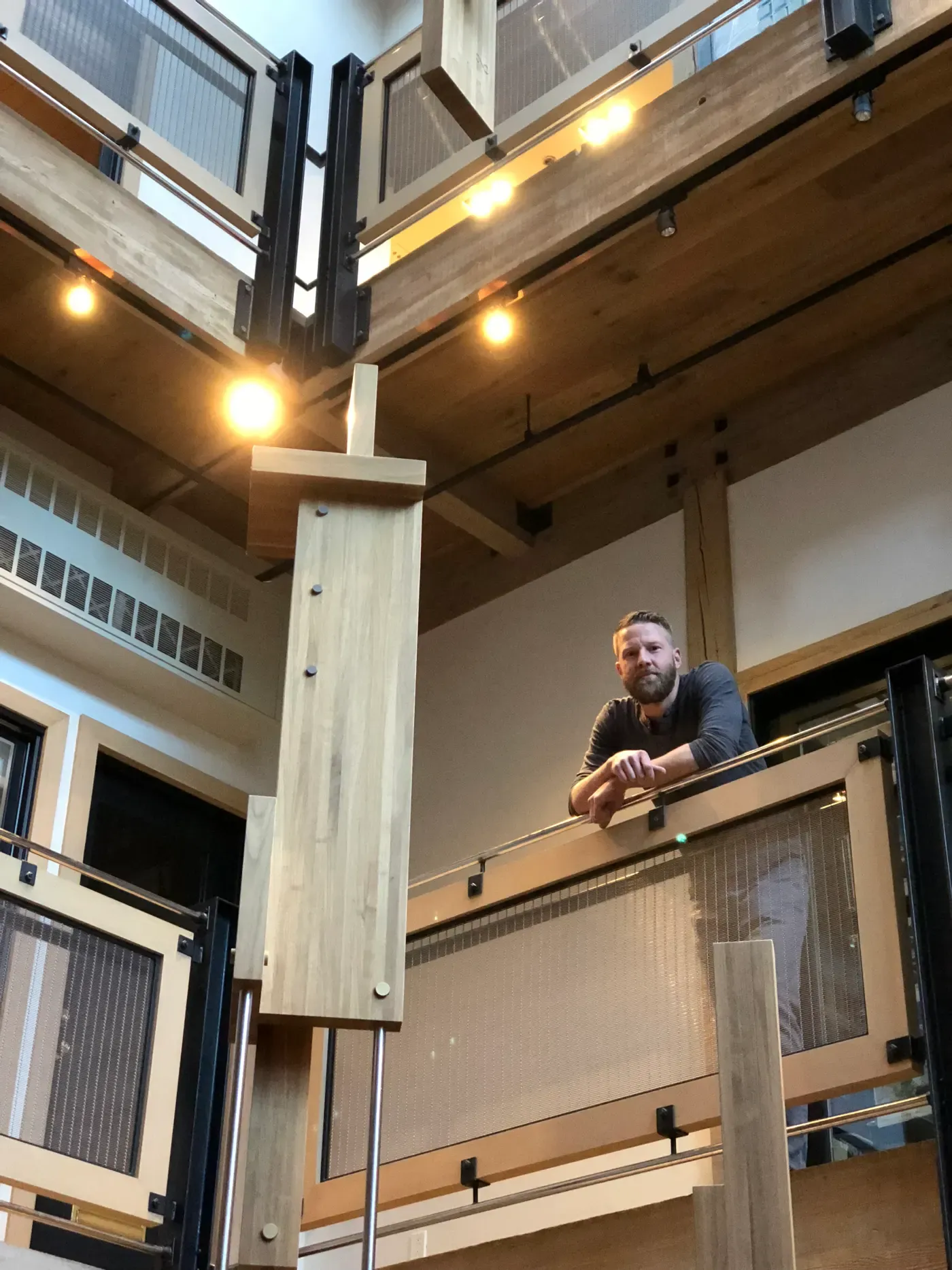
Originally from St. Louis, Missouri, Chris Cassimatis graduated in Art from the University of Oregon, where he focused on stone sculpture and art history.
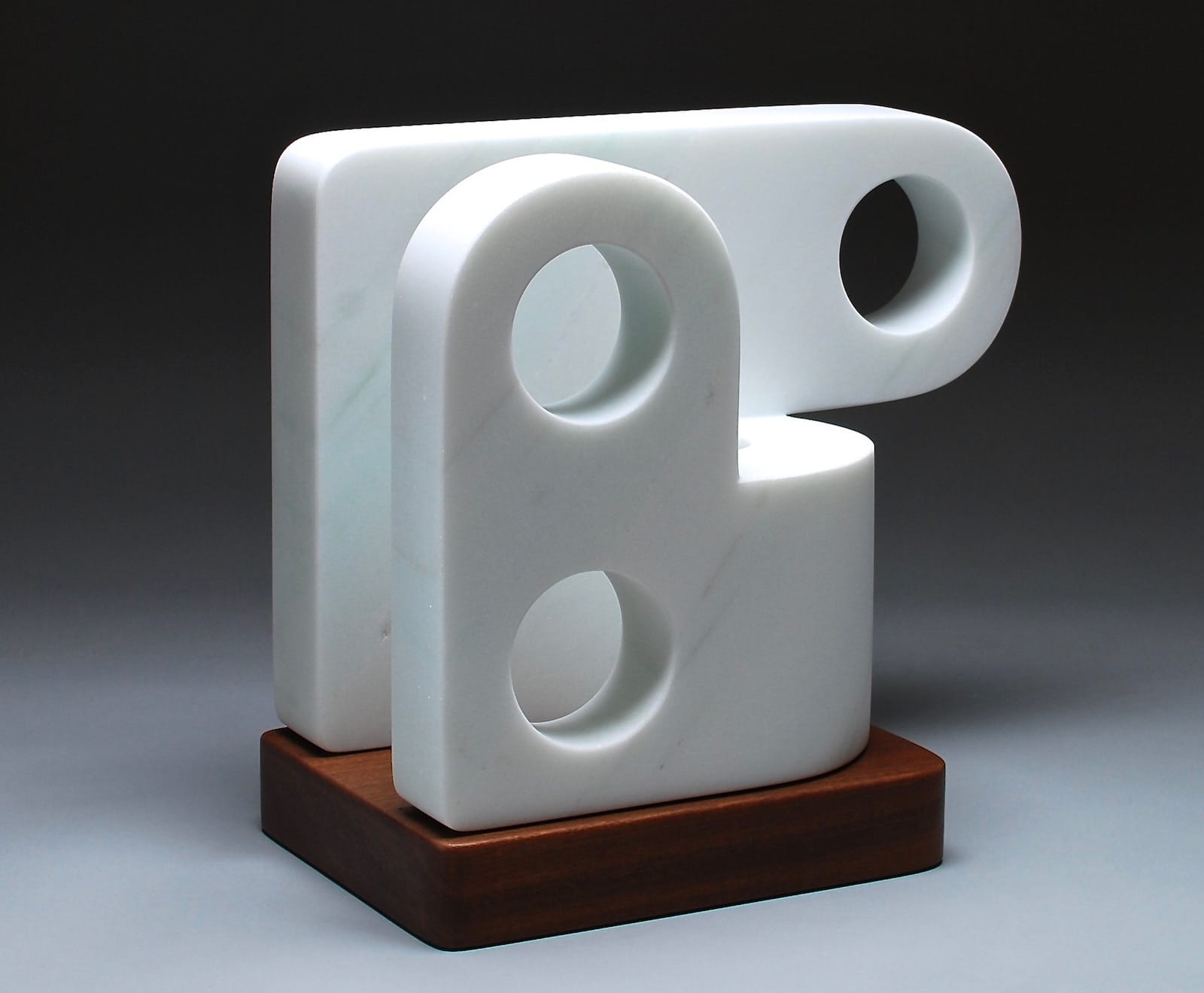
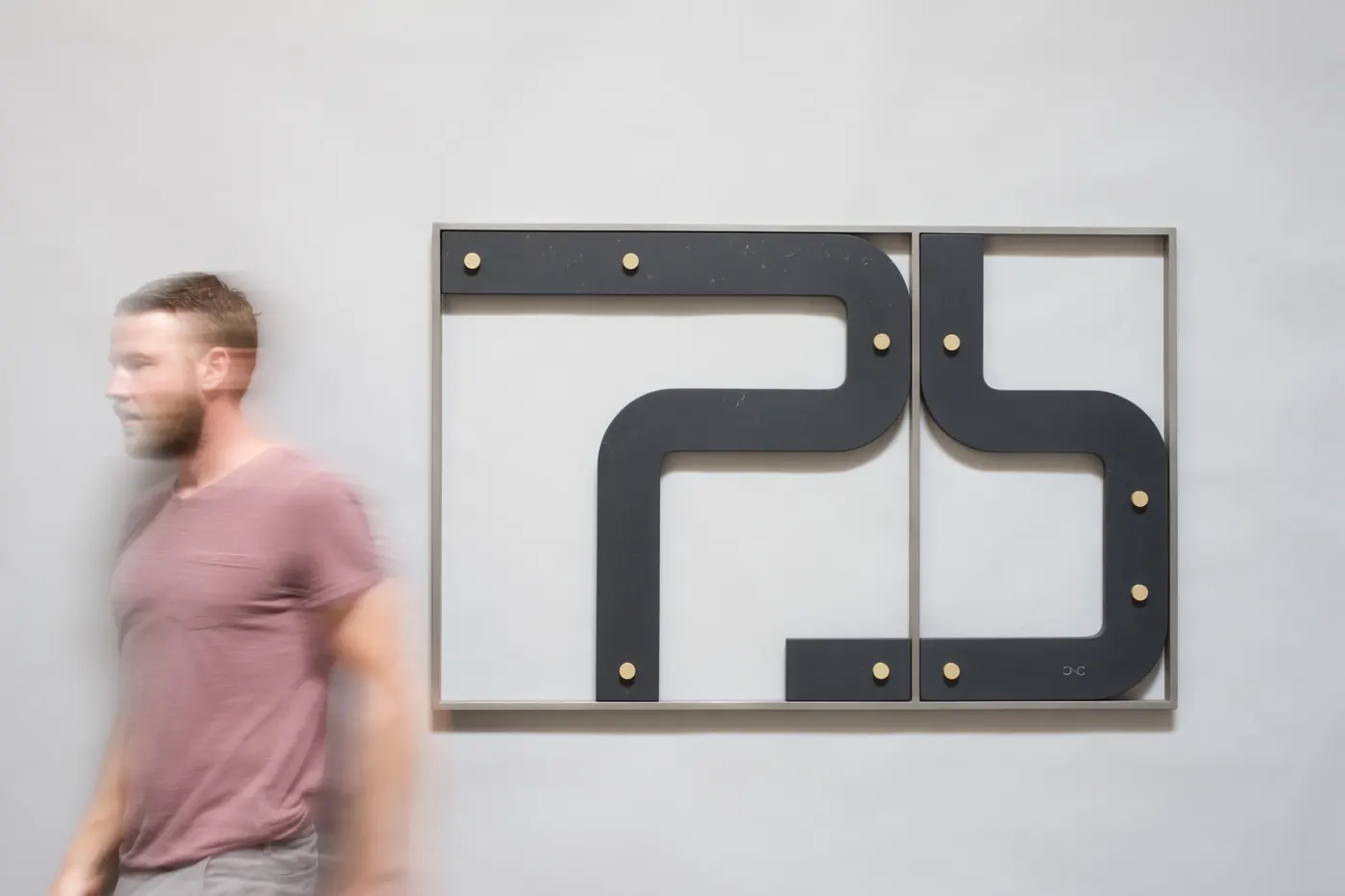
Although widely known for his sculptural work in stone, steel, and wood, he also develops a distinctive body of painting.
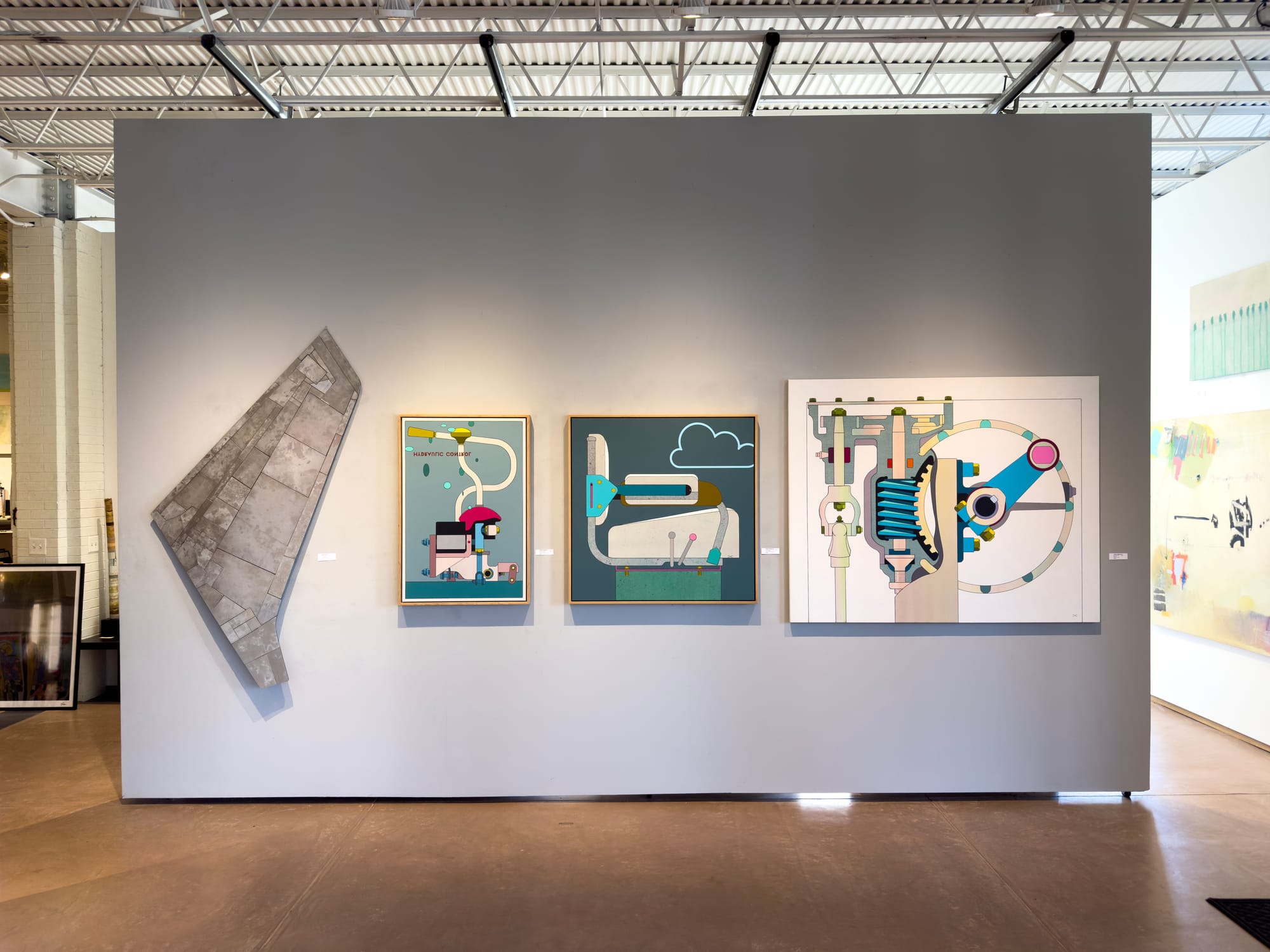
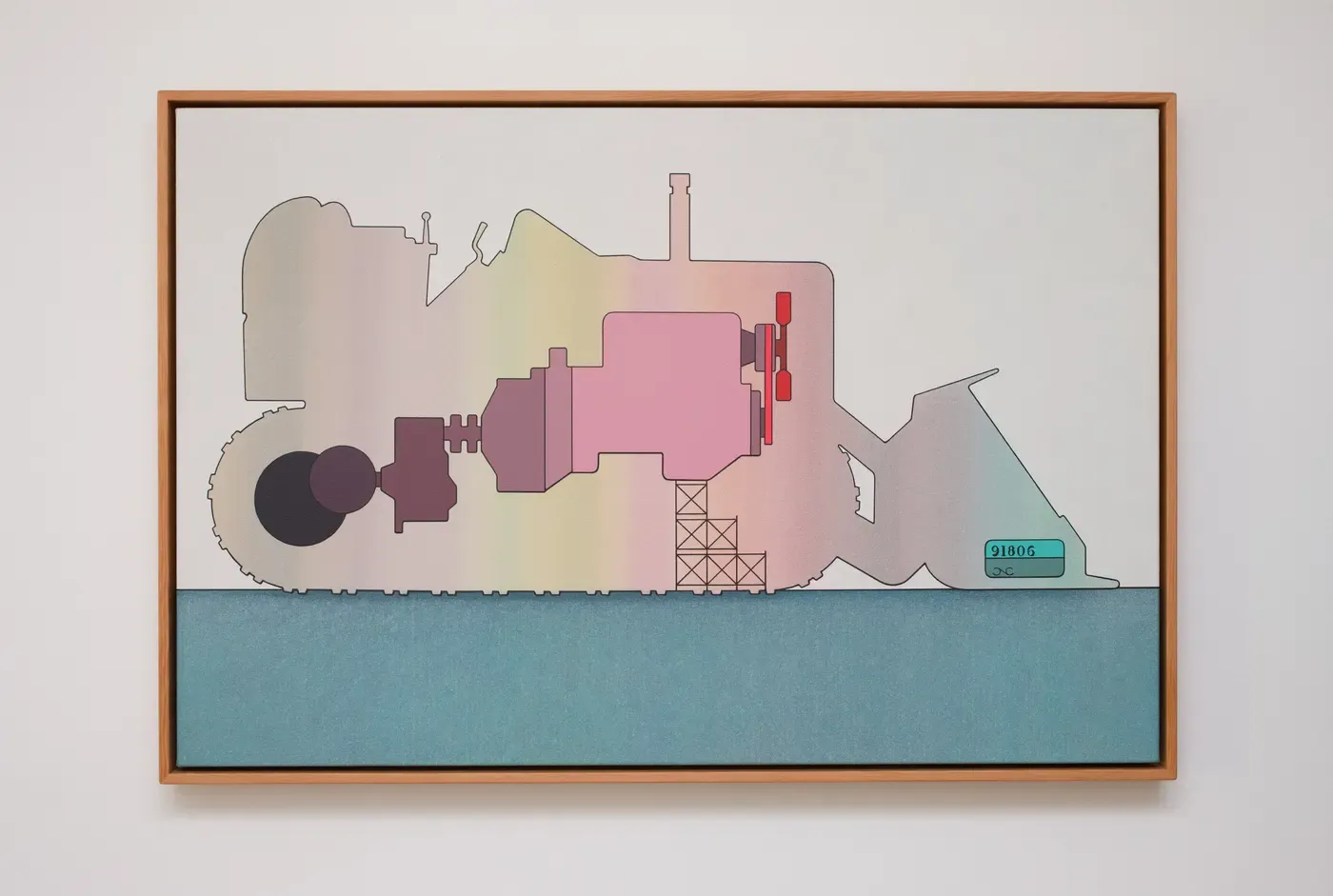
His pictorial work draws inspiration from machinery, technical manuals, and industrial forms, transforming functional imagery into something poetic and visually engaging.
We work with a limited number of artists and galleries each season. Selected collaborations are paid and curated.
More information here.
Through bold composition, color, and structure, Cassimatis creates a dialogue between technique and imagination, showing how sculpture and painting can inform and strengthen one another.
When art meets technology: Chris Cassimatis on his creative process-Interview with De Franco
Your shapes have this architectural precision, but at the same time they feel really free. How do you balance control and instinct when you paint?
I greatly appreciate that this is your opening question David, because free and precise is the way I want the work to land. My methodology is largely designed around developing processes that are most likely to lead to this balance.
I feel it must be stated that for most of my life as an artist, I was a sculptor.
My approach to making paintings, which is what we are mainly discussing here, is very influenced by that time.
Painting for me is self-taught, whereas I learned to carve stone and weld at The University of Oregon. It was very intentional to carry over echoes of working in three dimensions into the process of painting.
 Home
Home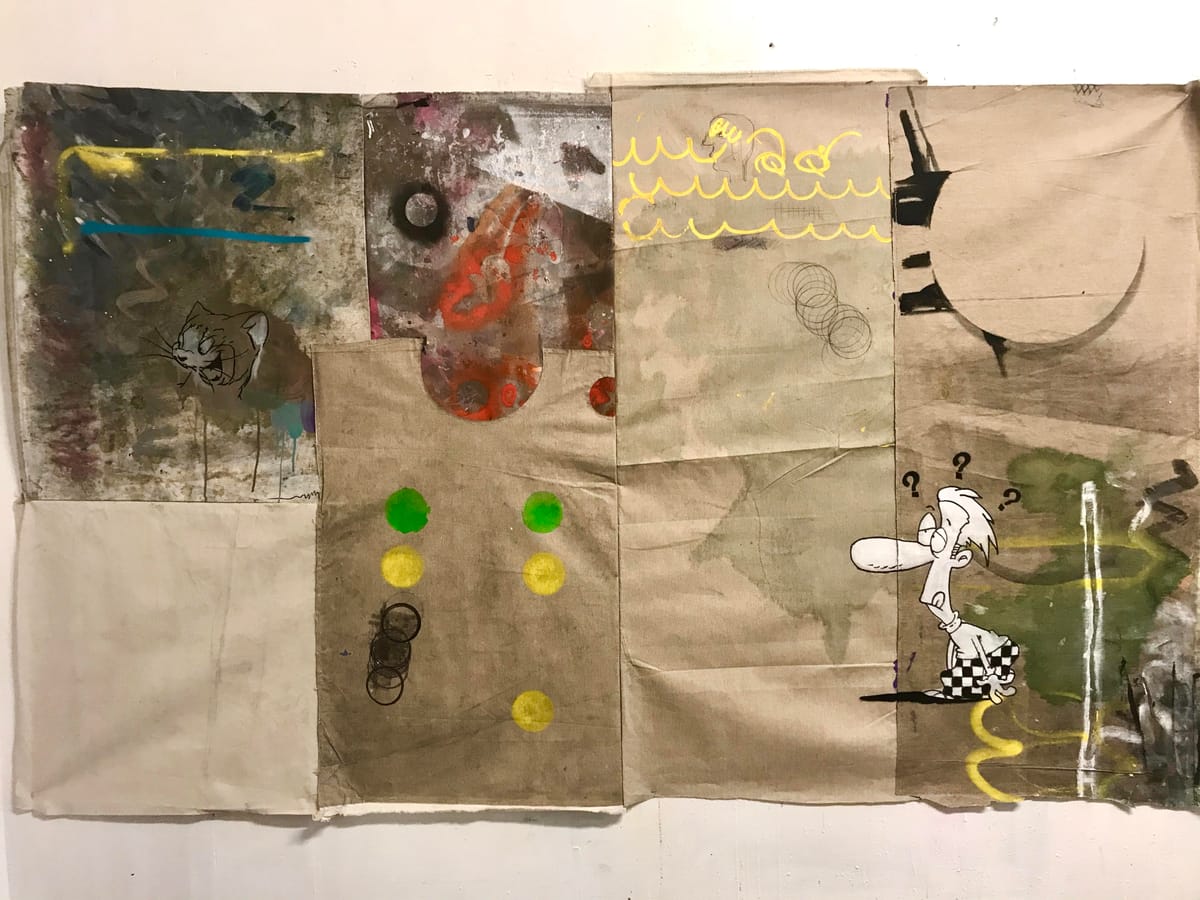
Di Franco - Interviews with artists - Catapult The New Munchies Art Club
I think this is where the precision comes from. Partially technique, but a lot
of what carried through is a deep commitment to patience; being precise takes time. The free feeling you are referring to is the aspect of my practice that I work on the most.
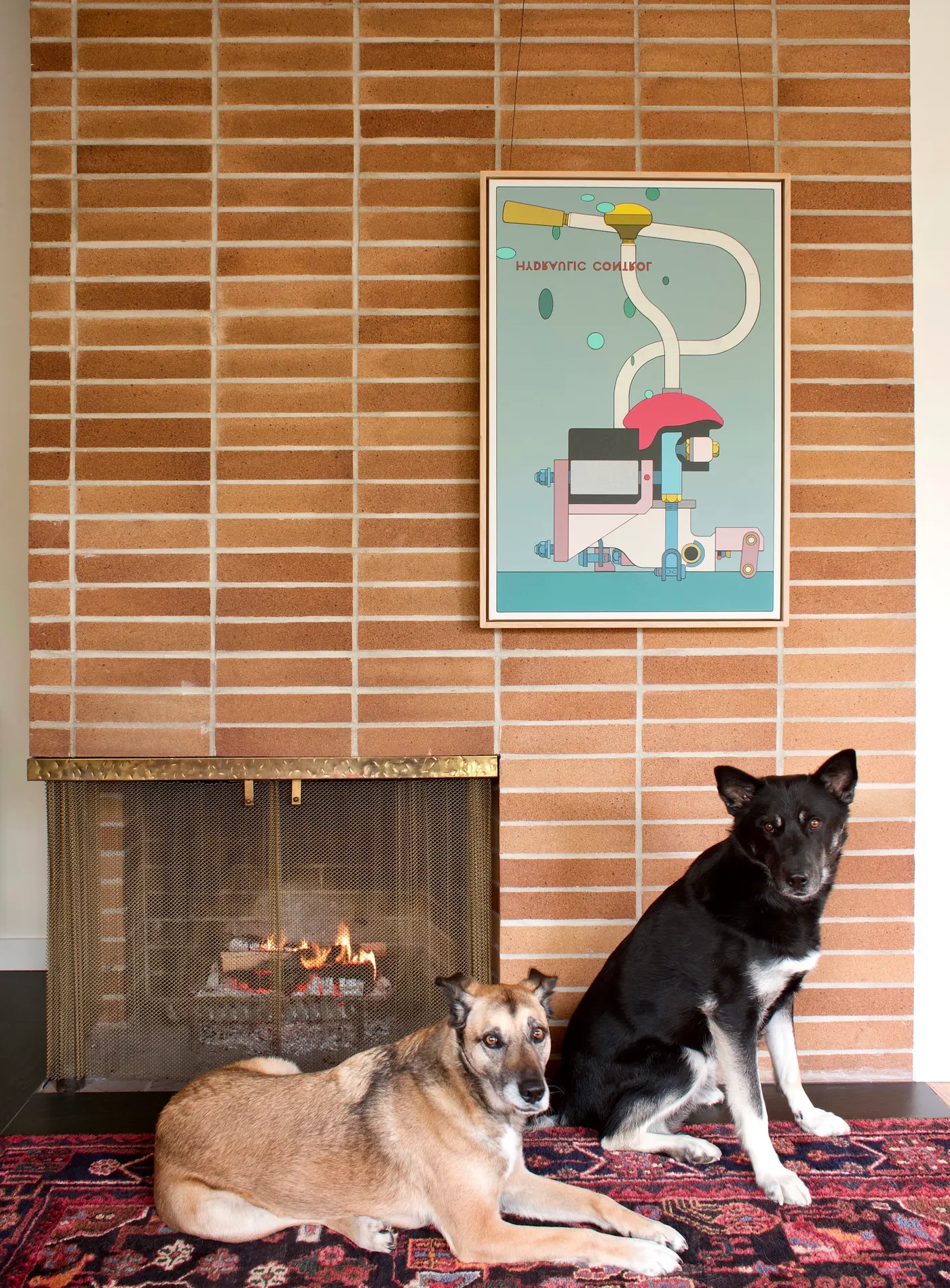
I found it to be particularly challenging with sculpture, because the cost of materials and space made experiments expensive. Out of fear of ruining an expensive block of stone, I would spend weeks designing an entire piece before ever even starting to carve.
I enjoyed the commitment to labor that followed – which can be meditative – but if I were going to switch mediums to painting, I wanted more mystery built in. Paint is low stakes compared to stone and stainless steel, so it is
the perfect medium for allowing things to evolve throughout the process.
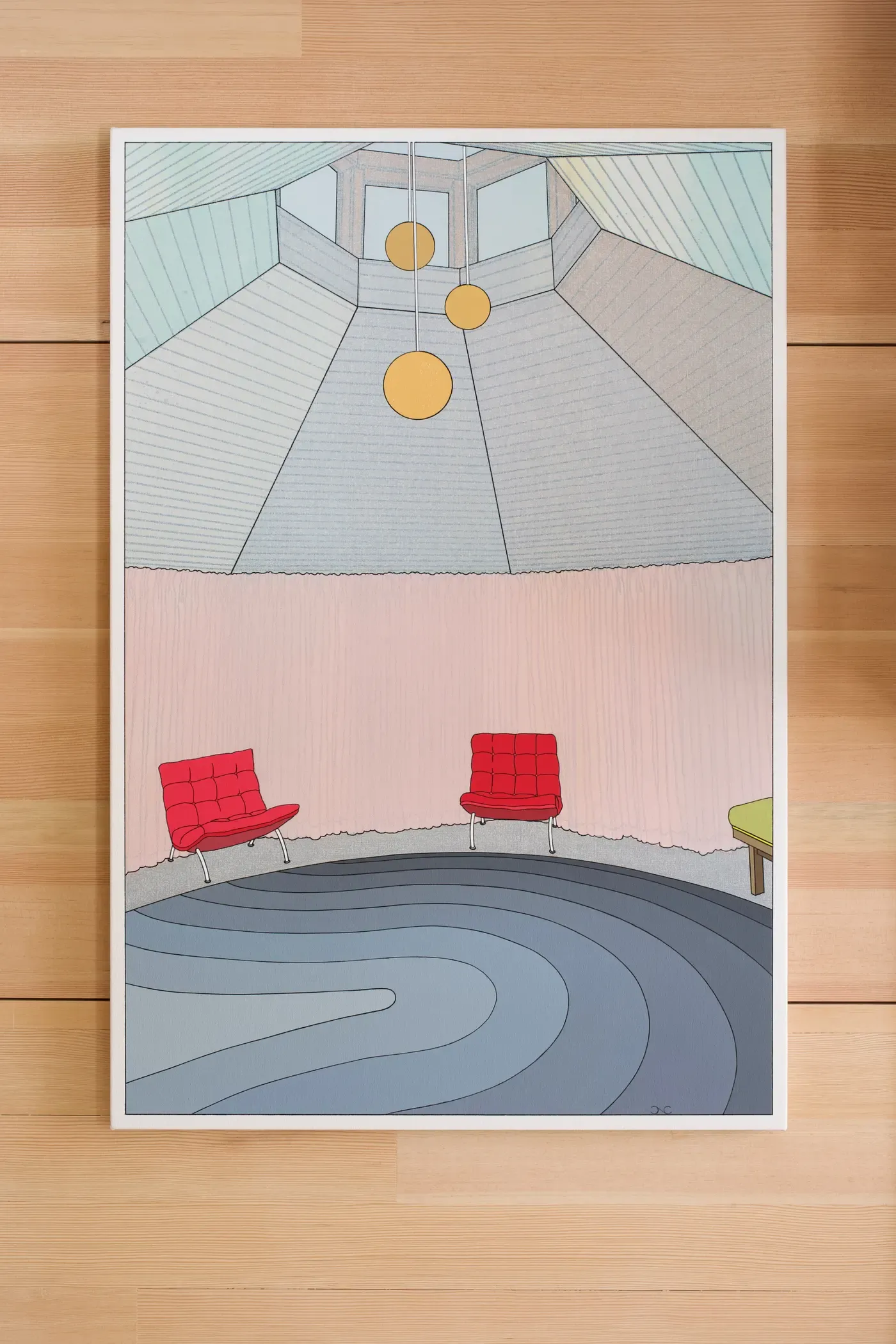
Early stages of a painting are where I commit to the largest momentary instinctive gestures.
It is always the goal that some part of those actions will show through the final picture. I think of it as building paintings, and as I build, my need for control takes over slowly, until the last passages might be fretted over for days.
Looking at your work, it feels like every color is in exactly the right place. Do you plan your palette in advance, or do you follow the flow as you go?
I like this as a follow up to the last question, because color is the main aspect of painting that I try to keep loose.
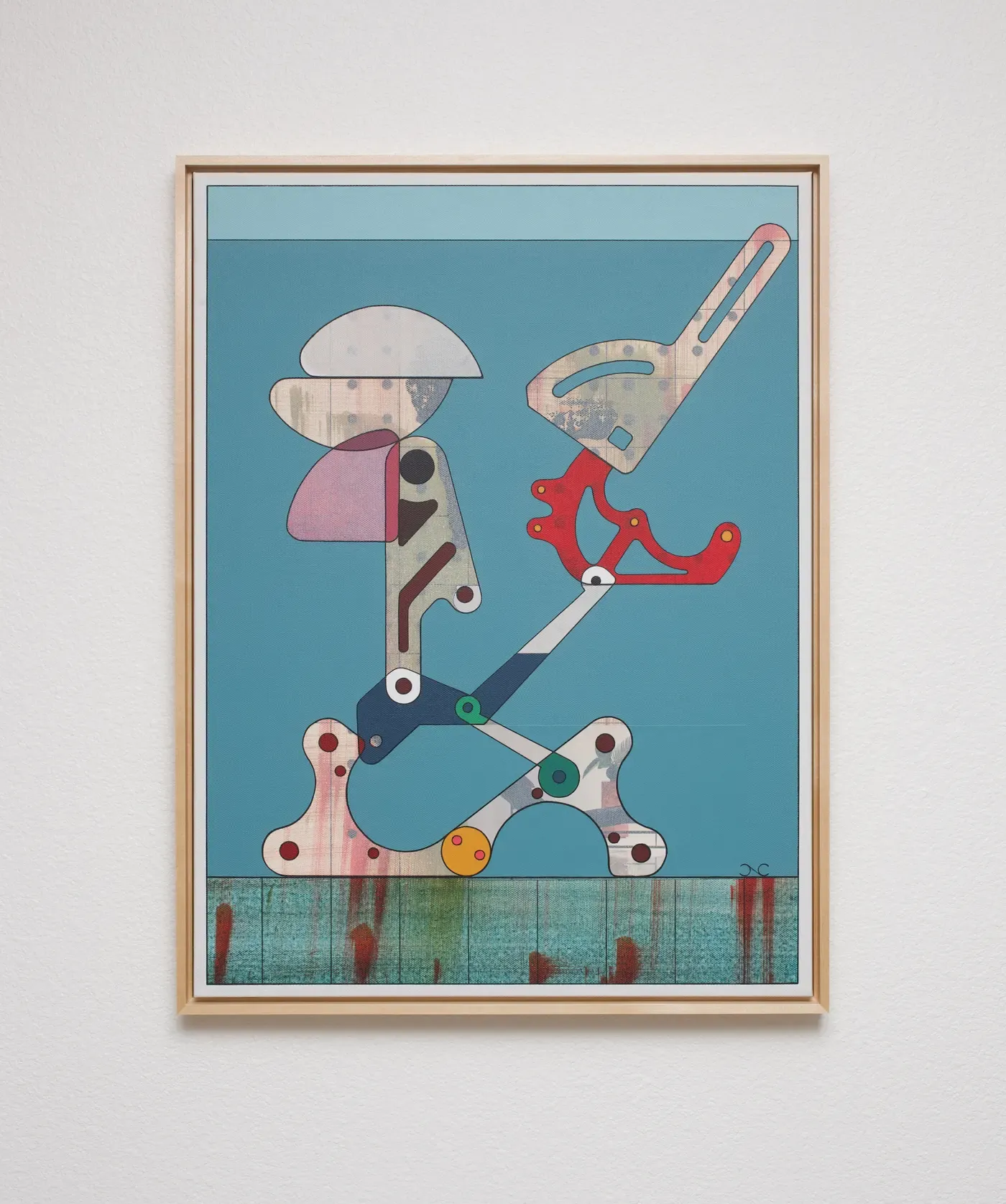
In recent work, the subject matter has become more reality based, so color is the biggest area of discovery. The first paint to hit the canvas is always leftover from a prior project.
I keep working samples of every hue in a painting all the way until it is varnished, then reuse them in future work.
This creates a kind of continuum as the colors flow from one canvas to the next. It also allows for some real experimentation, as I never end up using pigments straight from the tube.
As I progress through a painting, I try to keep things spontaneous for as long as possible. Once I become attached to what is happening on the canvas, I move the painting into the computer.
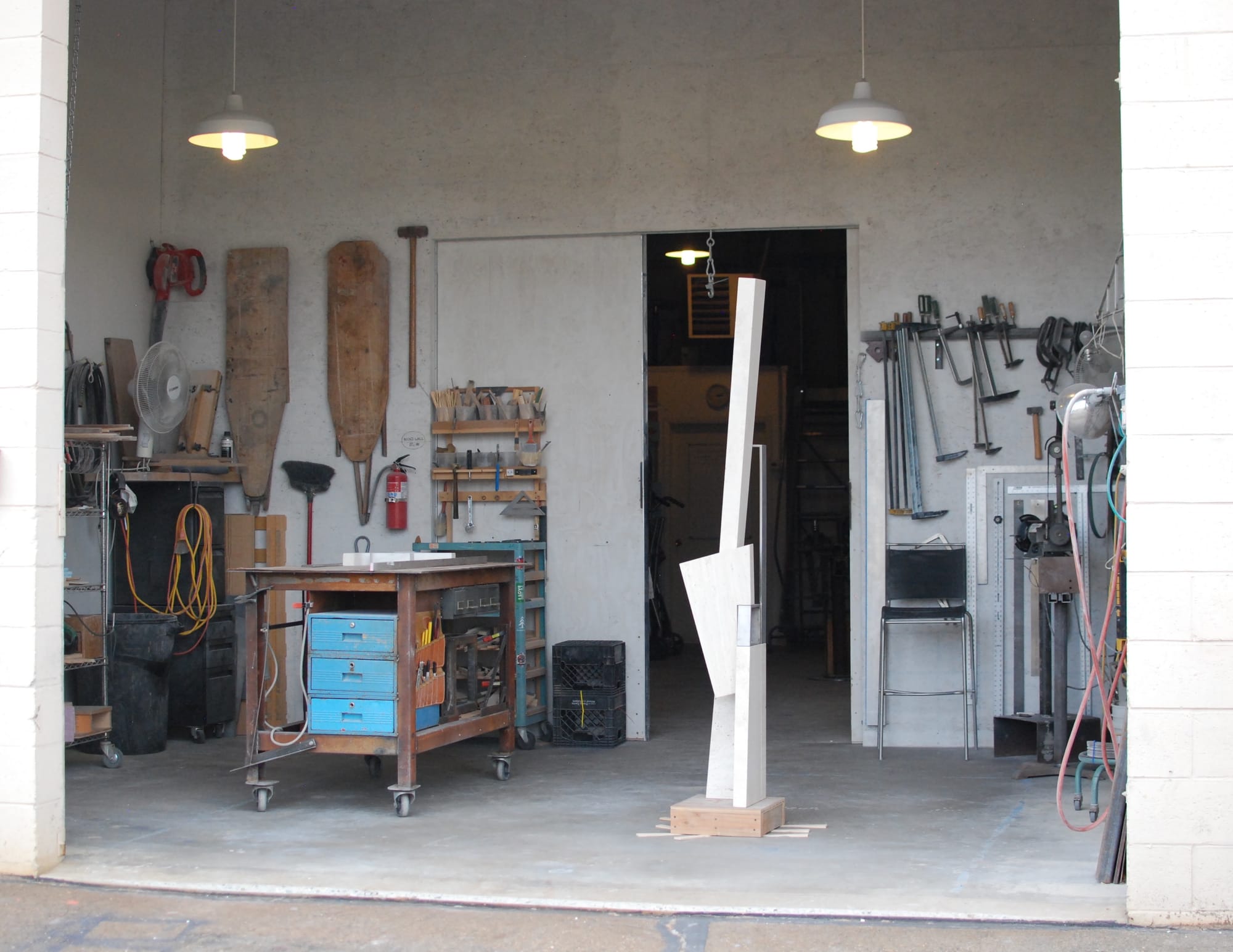
What I mean by that, is that I take a photo of the work and upload it into what is basically a free version of Photoshop, called Gimp.
I do this to play with wild ideas late in the process, without risking painting over the elements I like. Within this program, I am able to create many different layers of color and lines on top of whatever state the painting is in, in real life.
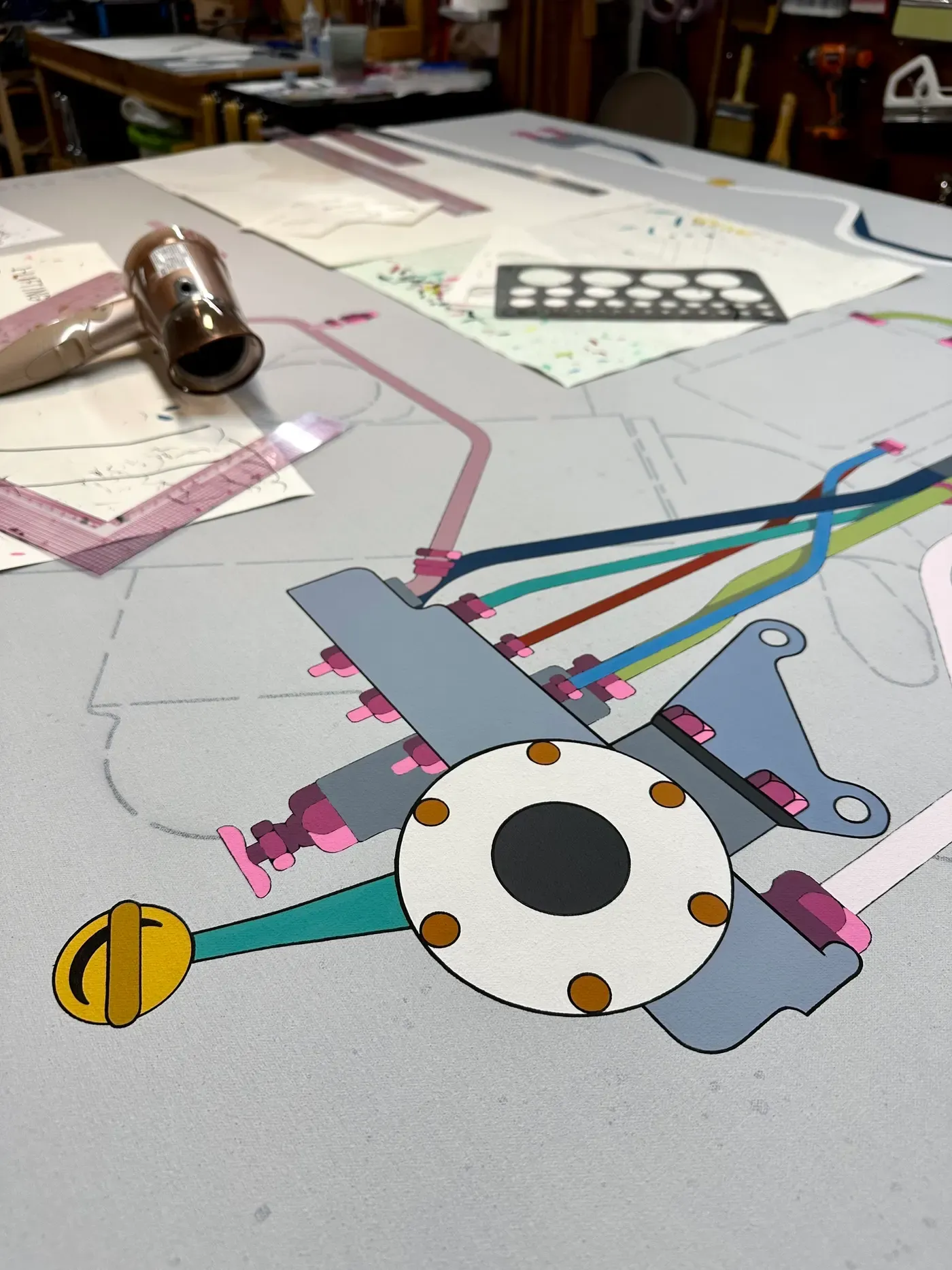
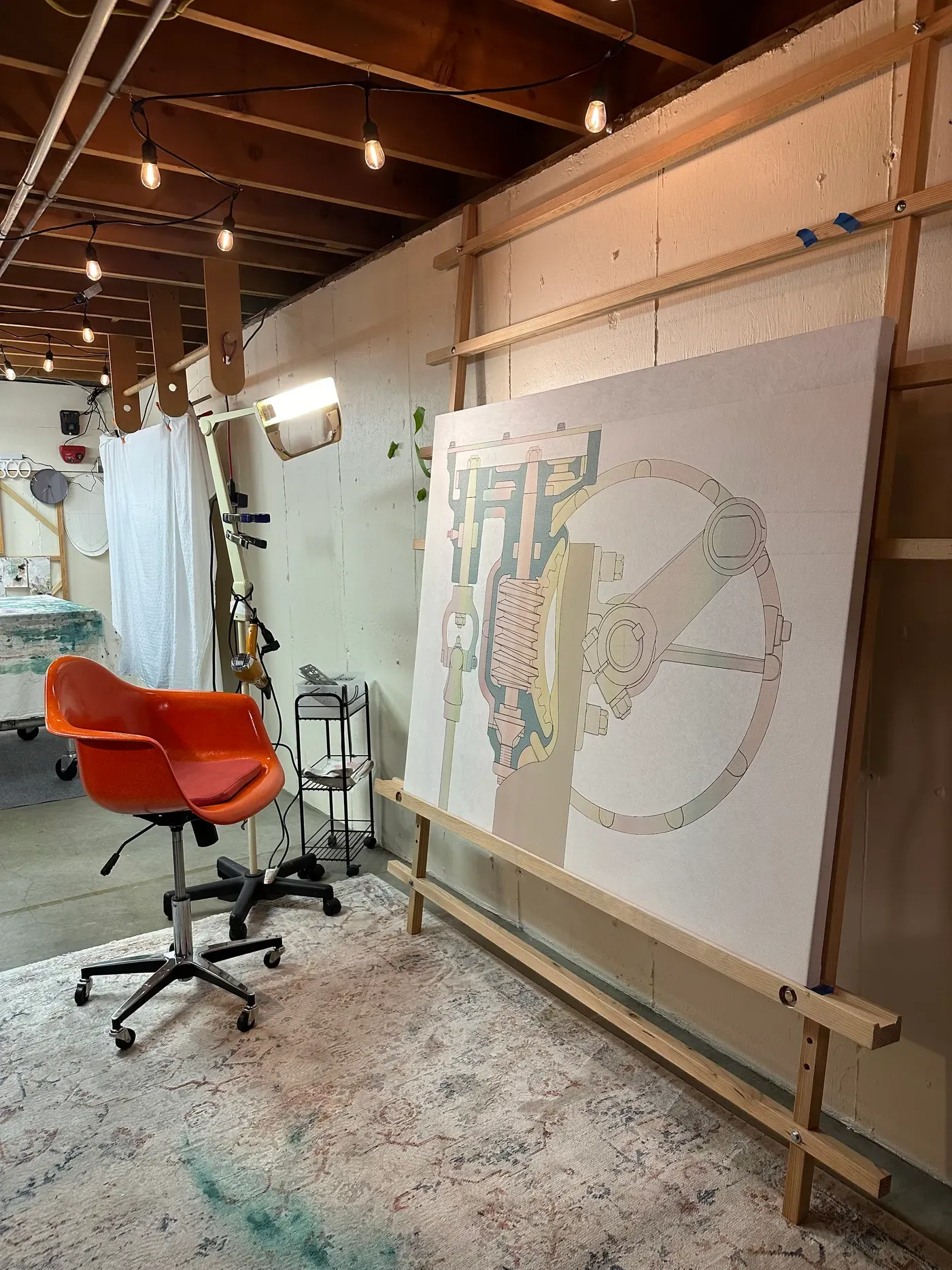
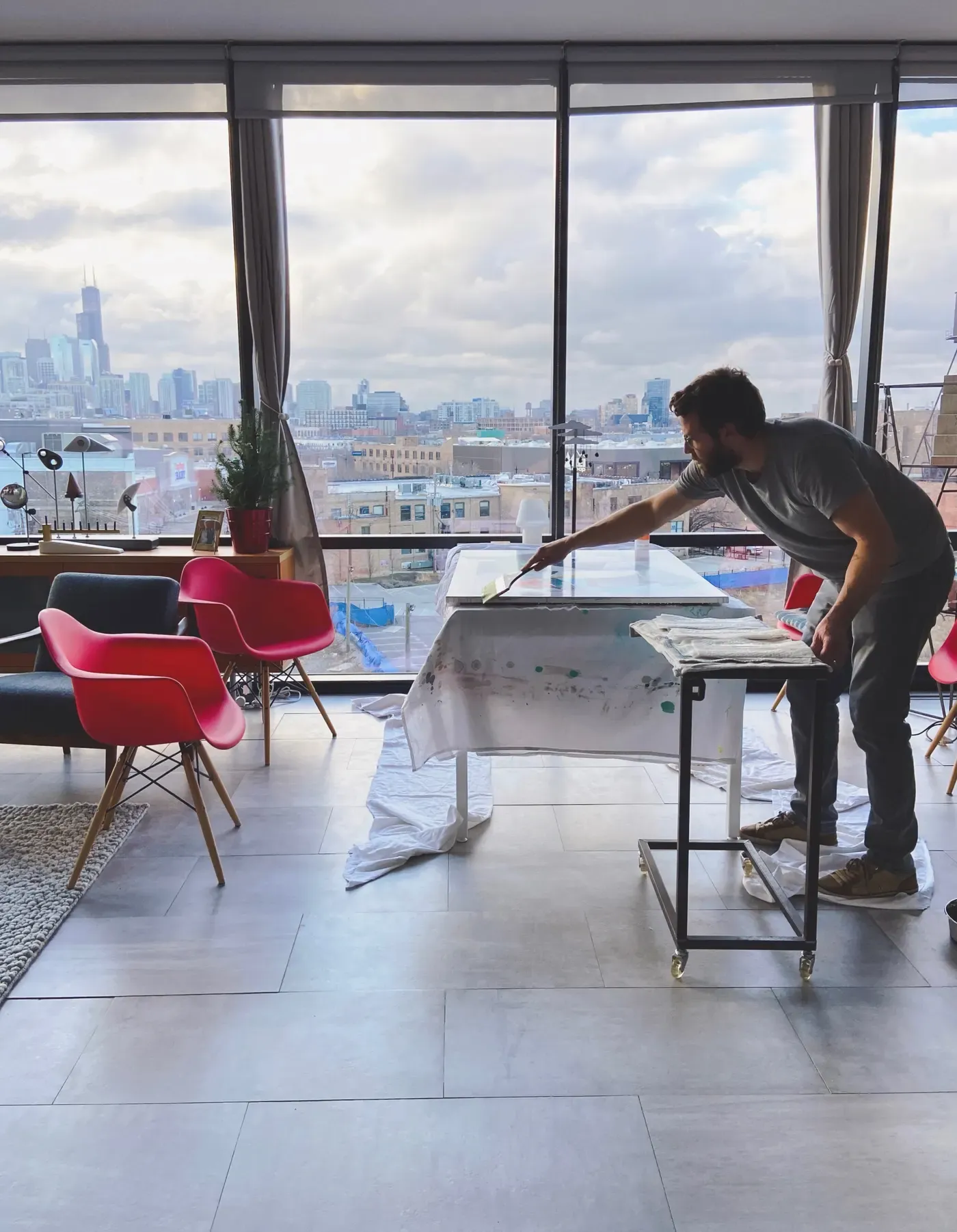
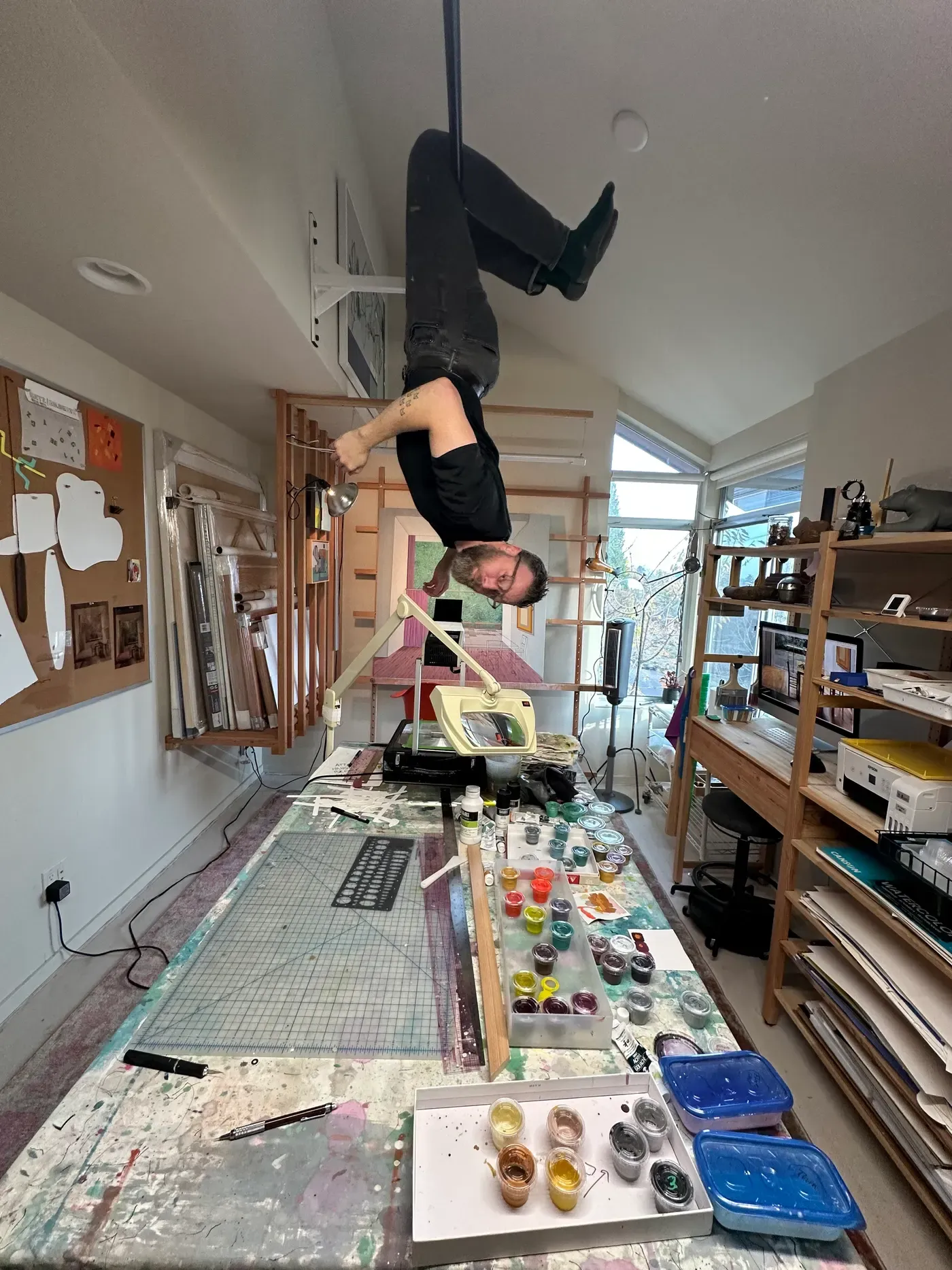
Chris Cassimatis, art practice insight, his studio and work in progress. Image Courtesy of the Artist.
I can toggle these layers on and off and use them to make up to a few hundred possible directions for the work to
take.
Then I narrow these down to the ones I find most interesting. In the current painting I’m working on, I have twenty-six variations still in the running out of ninety-five created (although I think it might just be between version #58 and version #82).
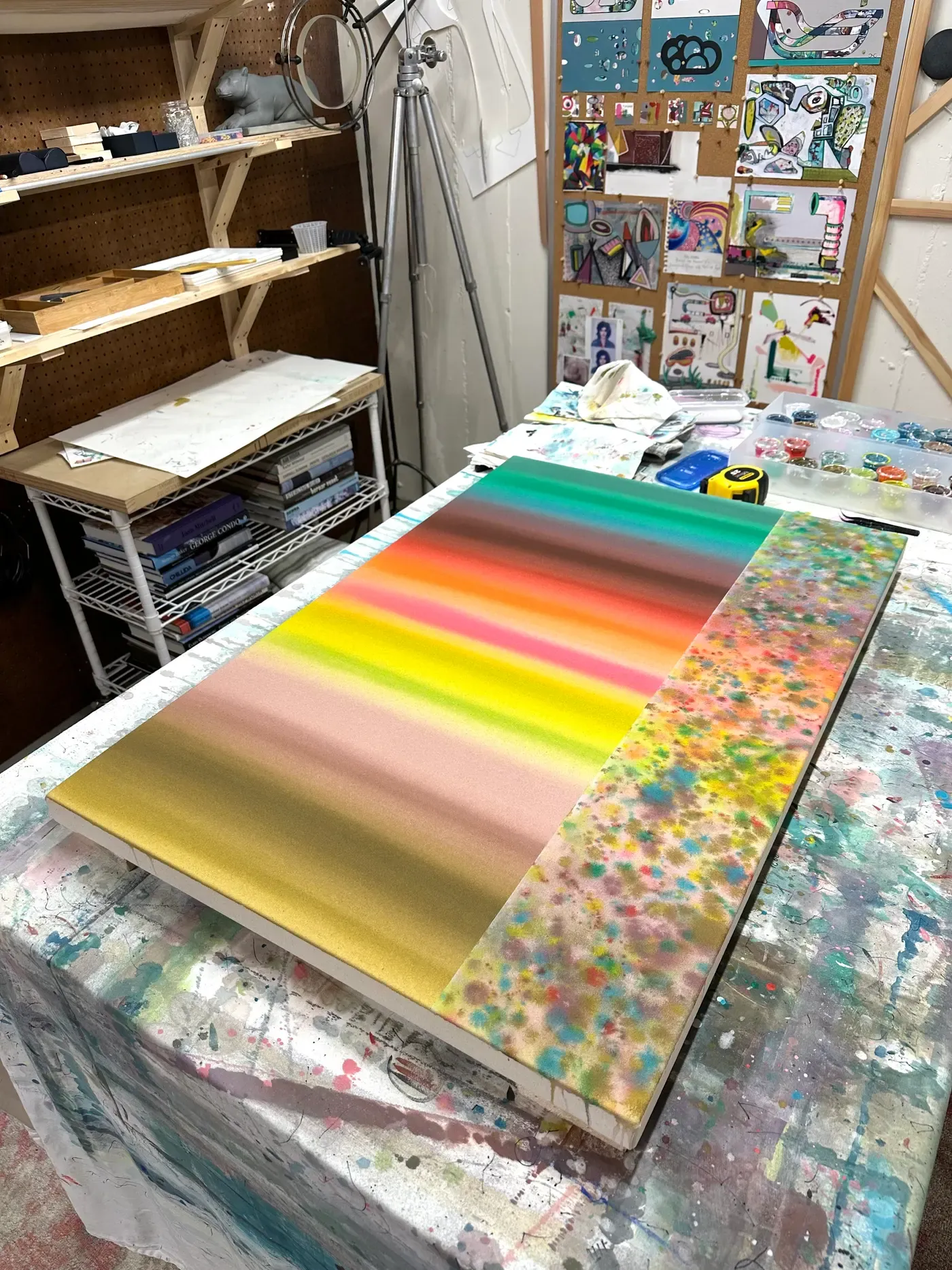
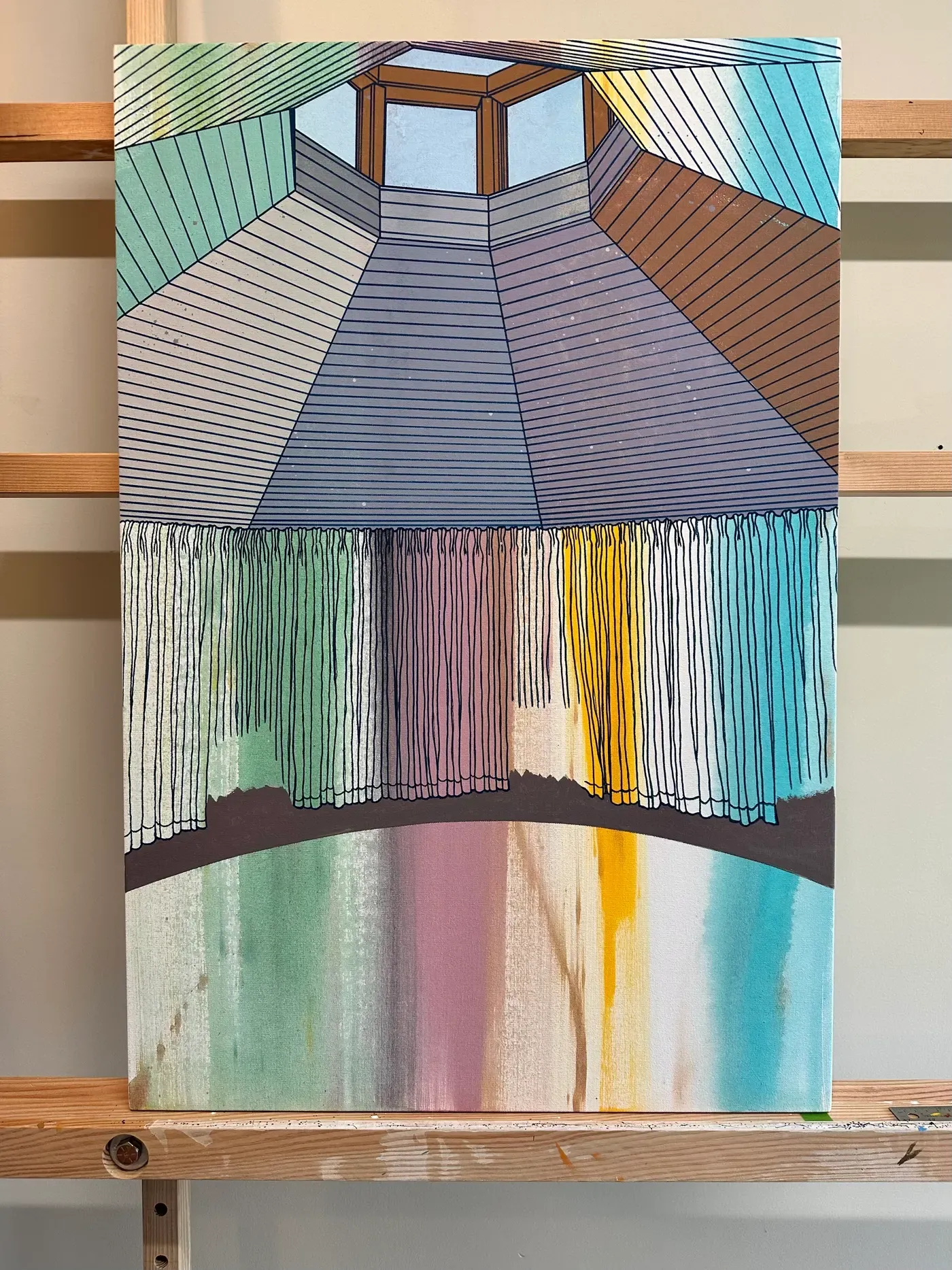
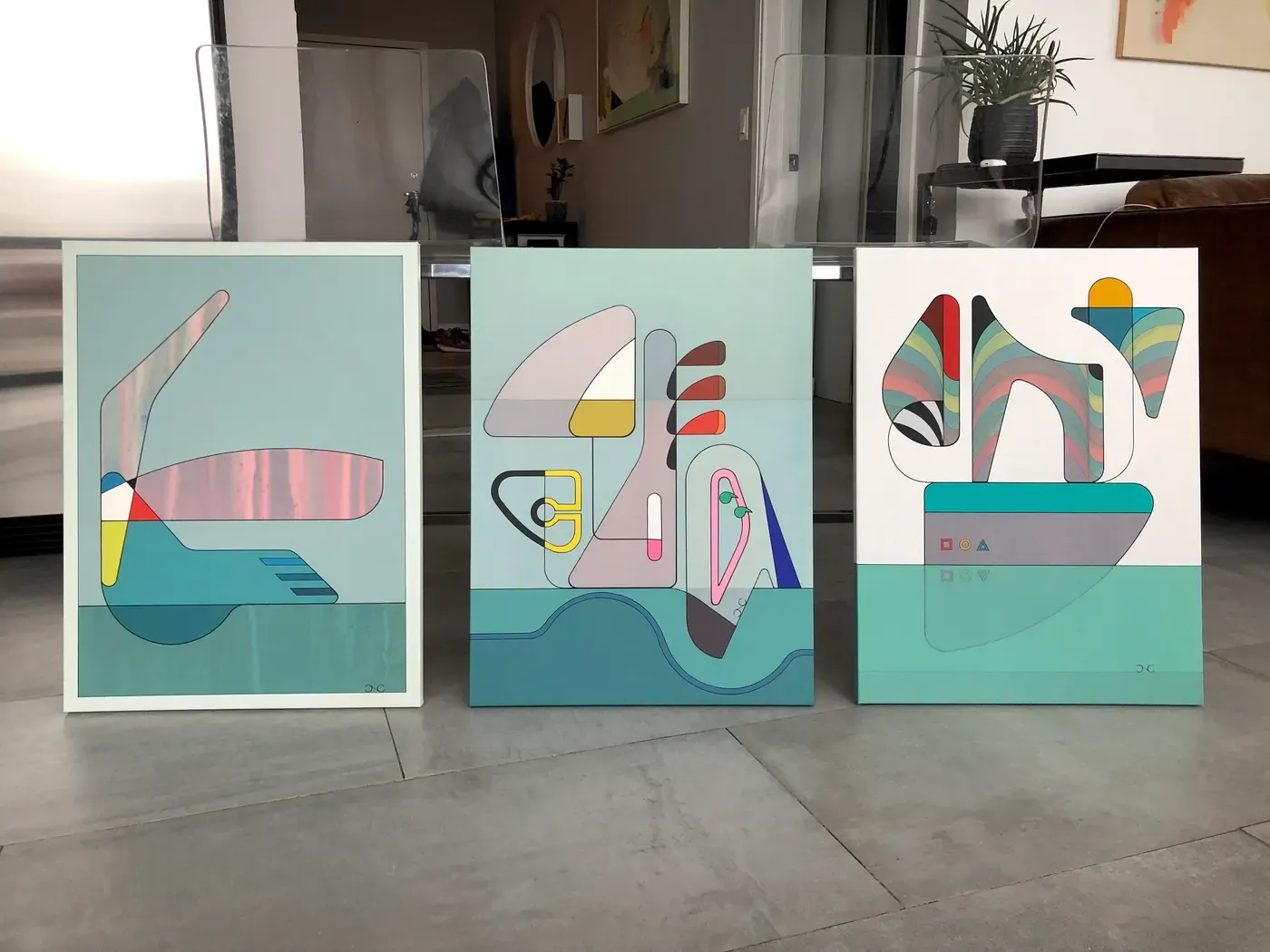
Chris Cassimatis, studio views and works in progress. These panels show the two poles of his process: atmospheric color fields built through slow layering, and architectural linework mapped with precision. Together they reveal how intuition and structure intertwine long before a painting reaches its final state. Image Courtesy of the Artist.
Once I choose just one, I start to work the painting in that direction, always with the possibility of putting it back into the computer if I feel it isn’t working. A nice side effect of this process is that I have become very
good at hand-mixing the many hues that a computer can spit out.
Your compositions look like little abstract cities. Are there stories or memories behind them, or is it all about form and balance?
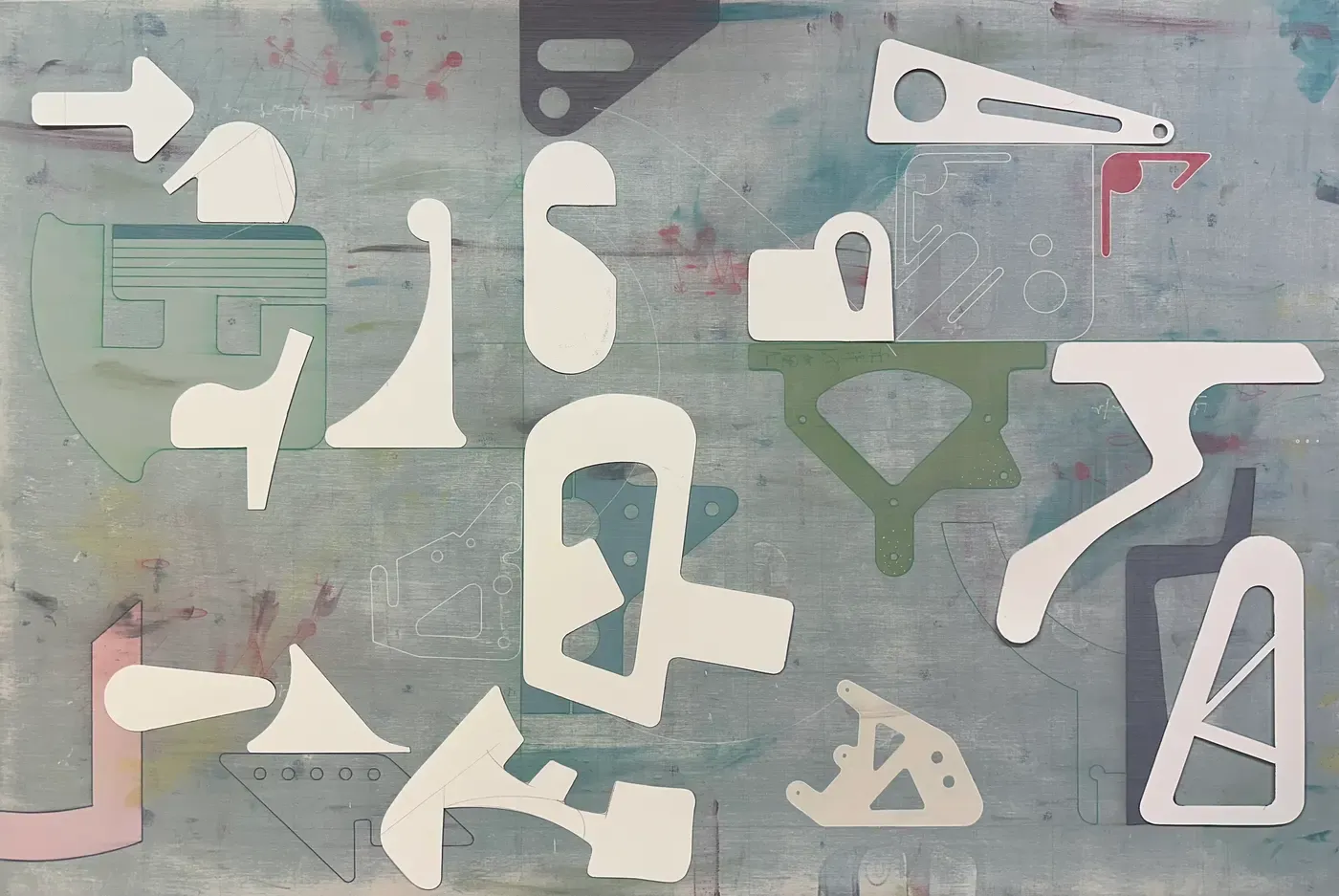
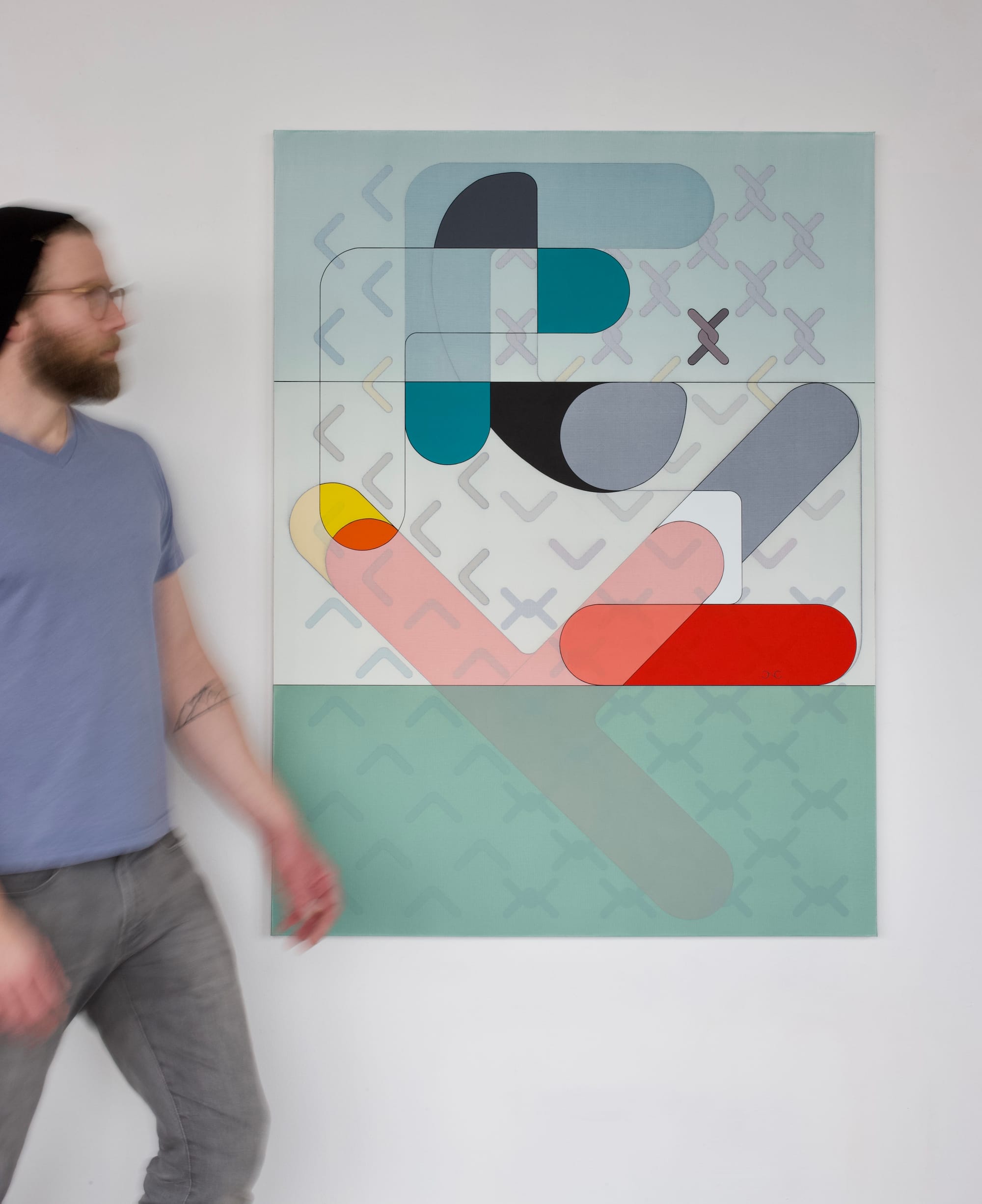
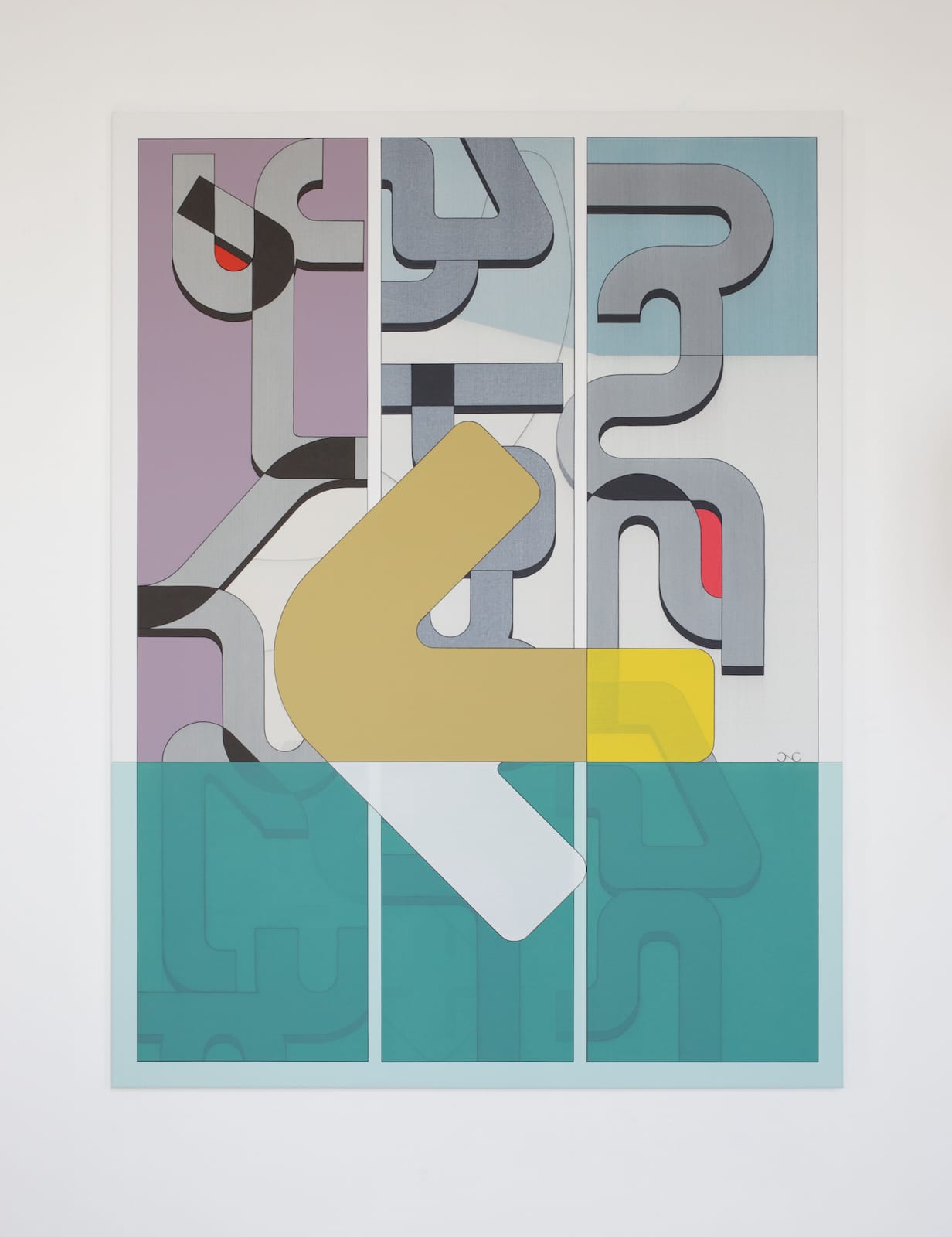
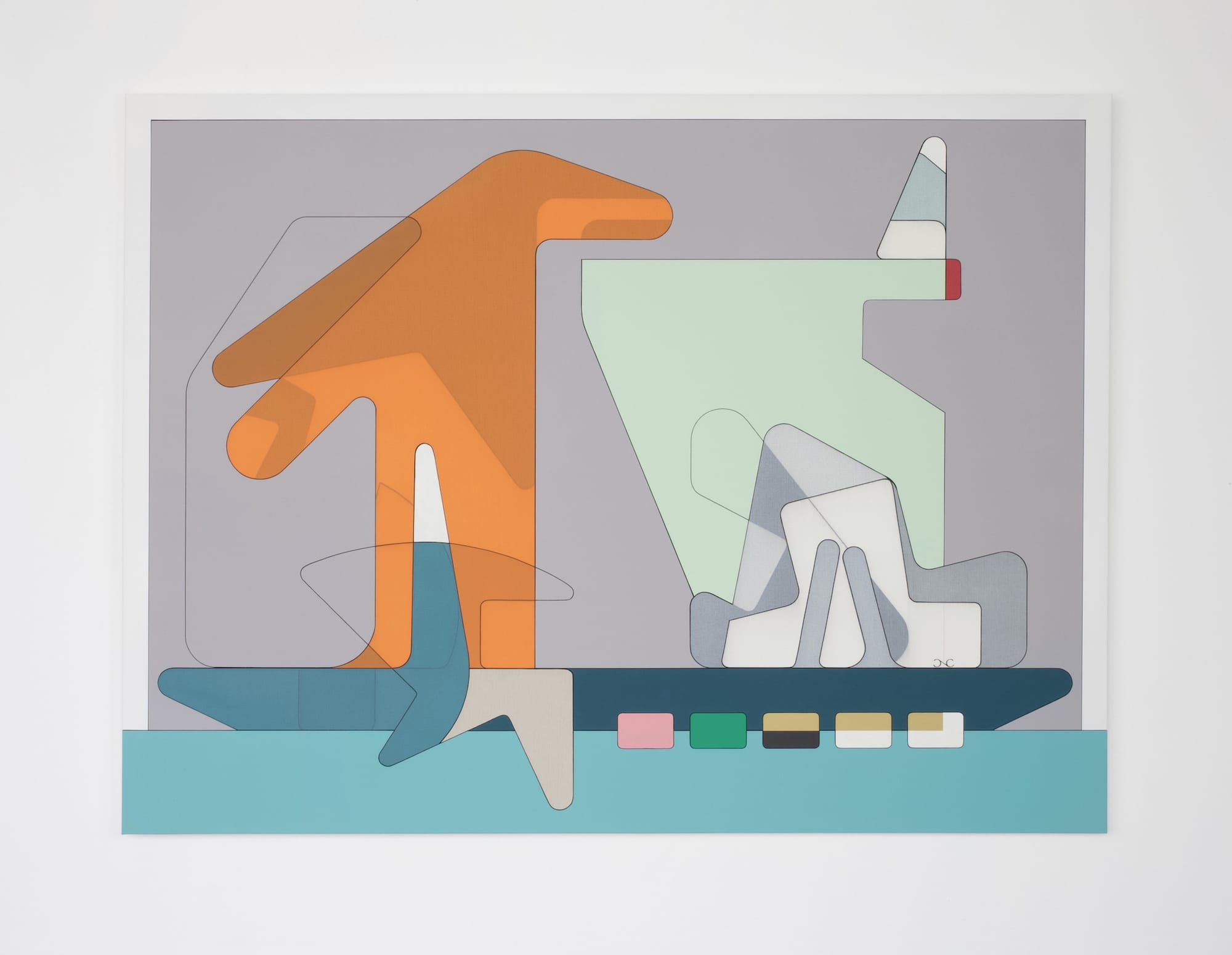
I divide my paintings thus far between three series. The first and most abstract, titled Gestural Geometry, represents the beginnings of my journey into painting. At that time, I was particularly focused on carrying over my sculptural instincts.
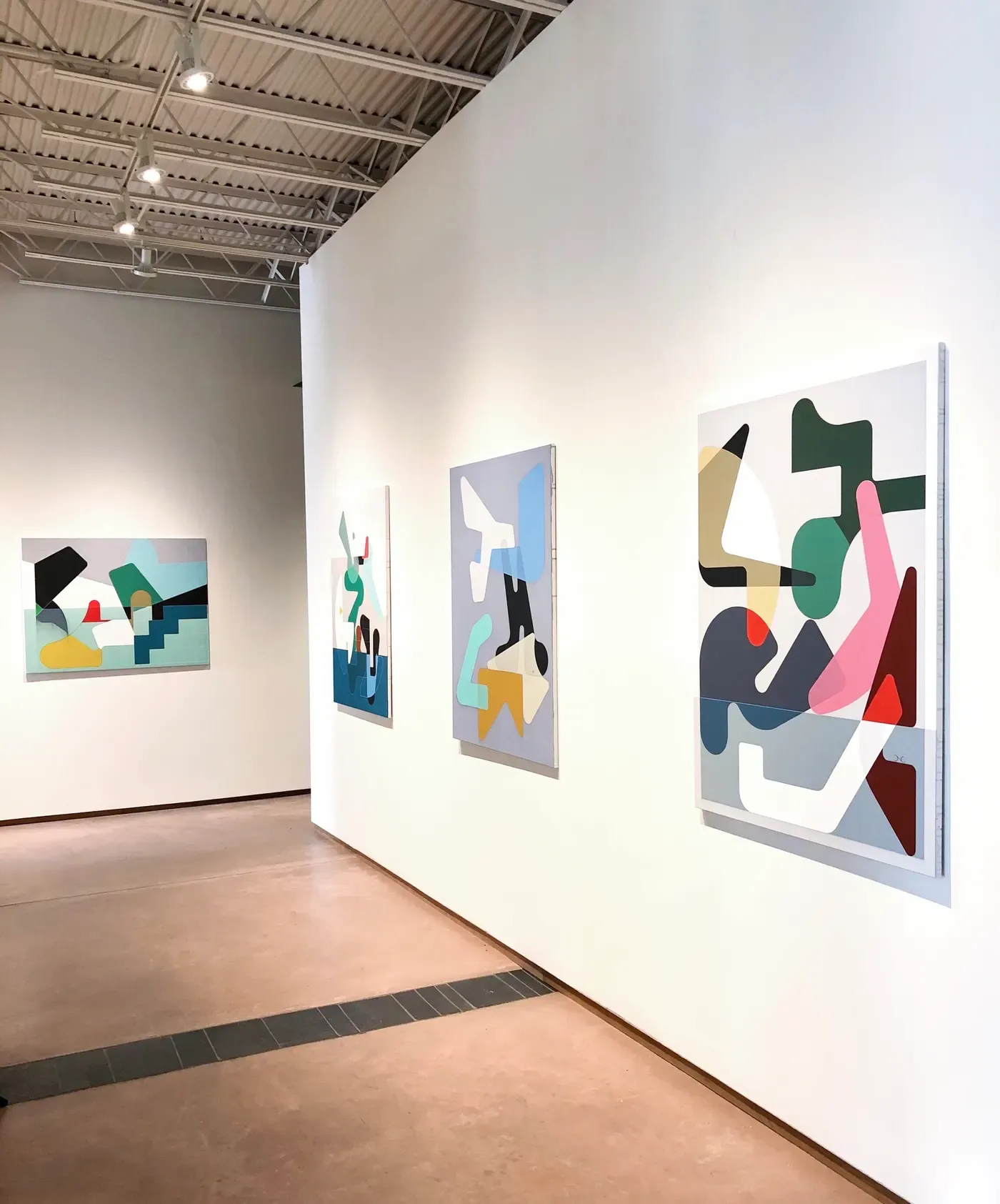
I decided that the most obvious through-line for this was shape. I cut hundreds of abstract shapes out of thick watercolor paper, like ones I made to trace lines within stone sculptures.
I could move them around the canvas before tracing them with an acrylic paint pen, and explore sculptural concerns like form and balance.
Recently, I have found it more important to represent real moments in time, and I have been titling my current work after the street where a source photo was taken.
This is very much related to memories, including the way that our phones/cameras function as backup storage devices for them.
At the same time, I want the work to become its own thing, and for it to invoke more personal stories or recollections in the viewer.
Geometry plays a big role in your work — does that come from a more technical mindset or just your natural way of seeing space and drawing?
I believe that my mind functions like that of an engineer or architect, and I want this to be visible in the work. But as an art lover myself, I am very often drawn to paintings that seem to be made with pure emotion and the absence of control. This is why I work so hard at trying to stay loose with it all, as contradictory as that sounds.
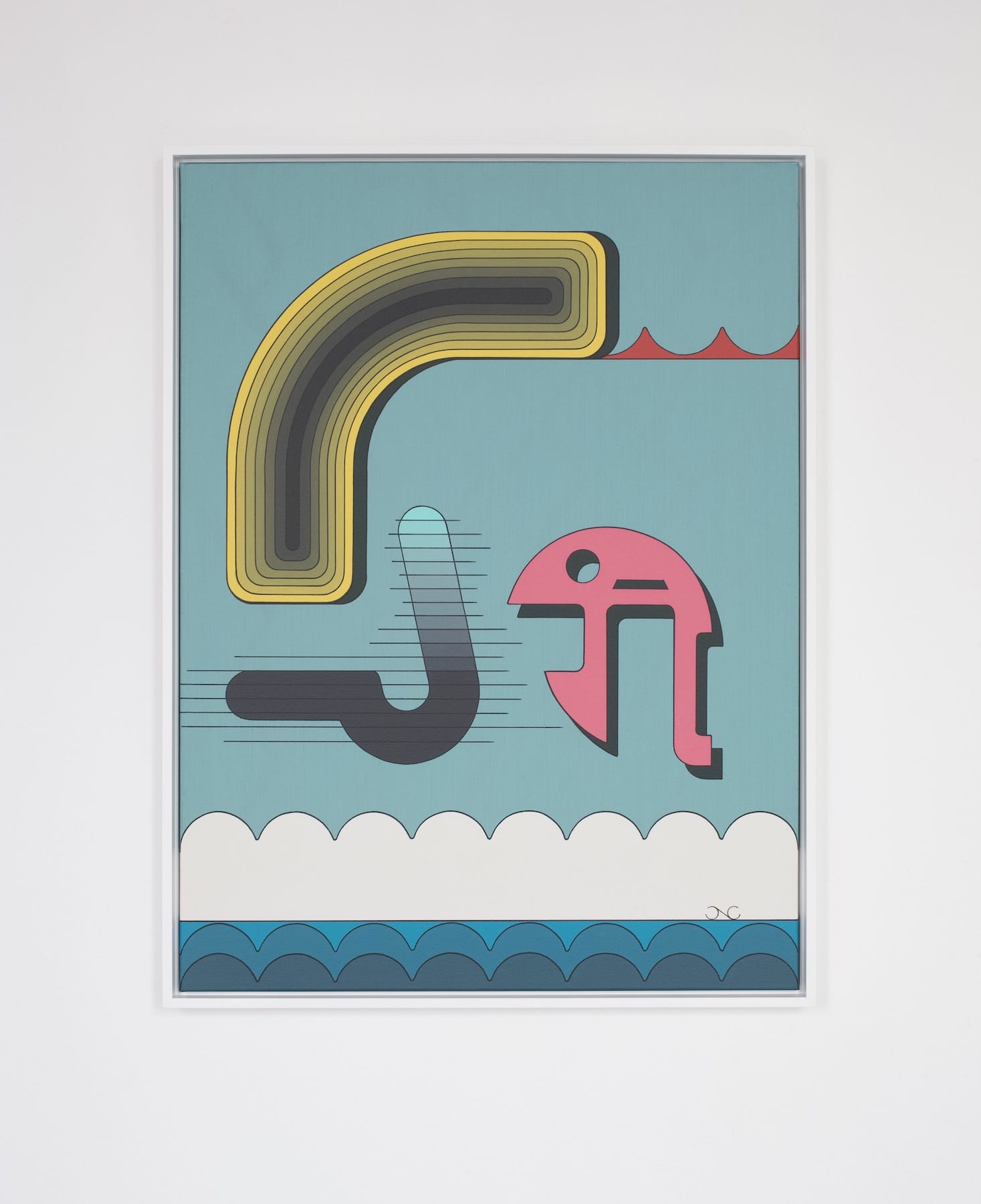
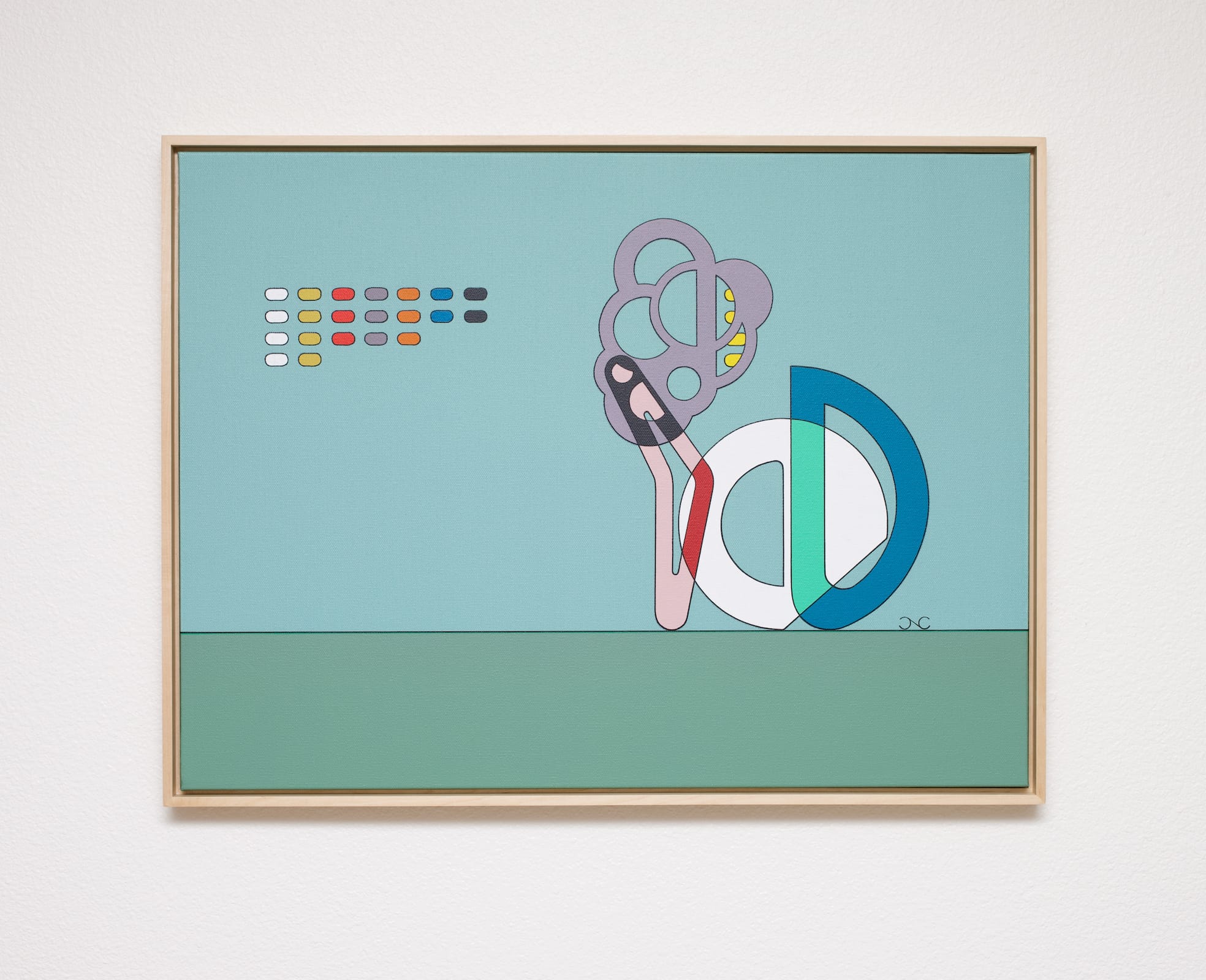
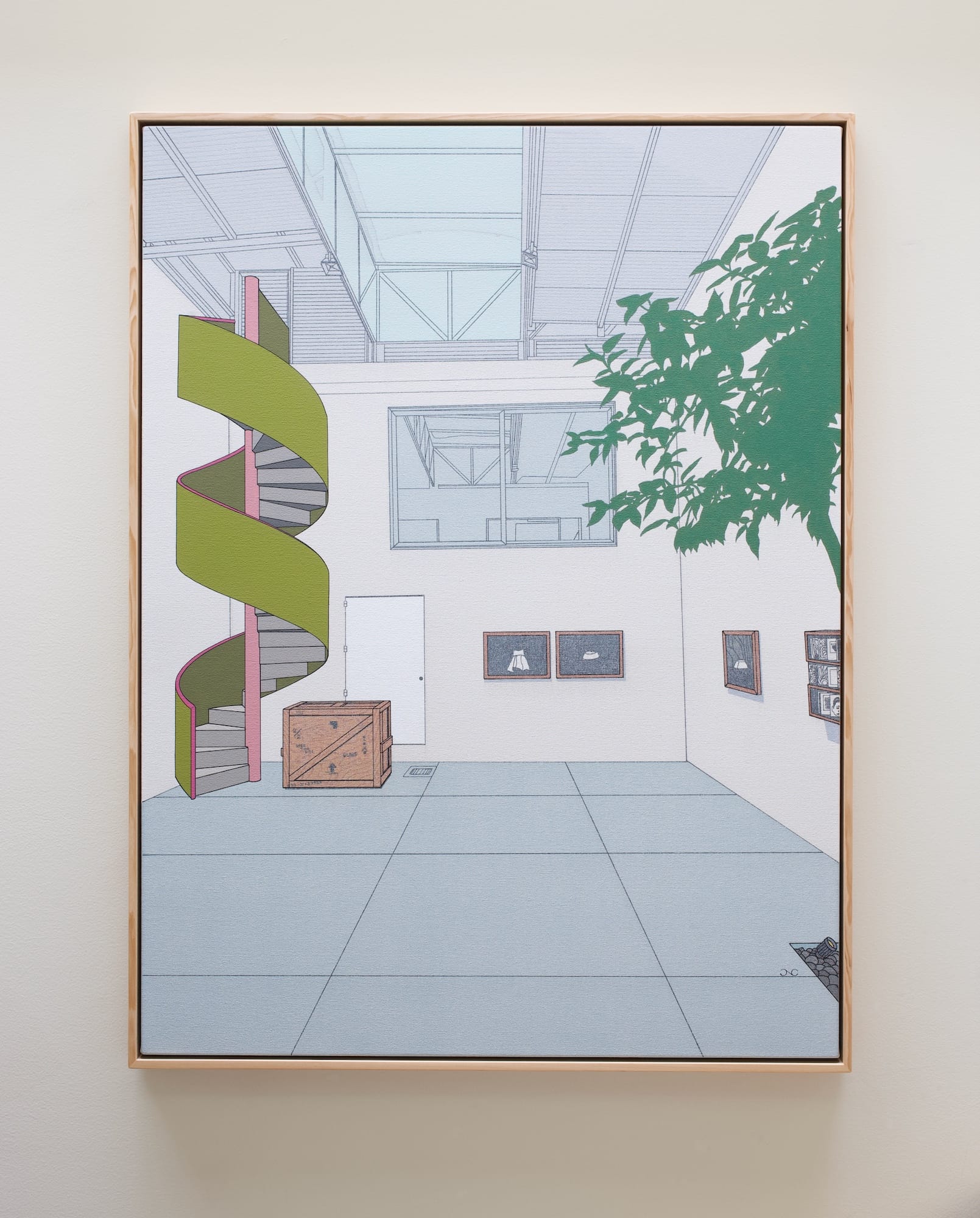
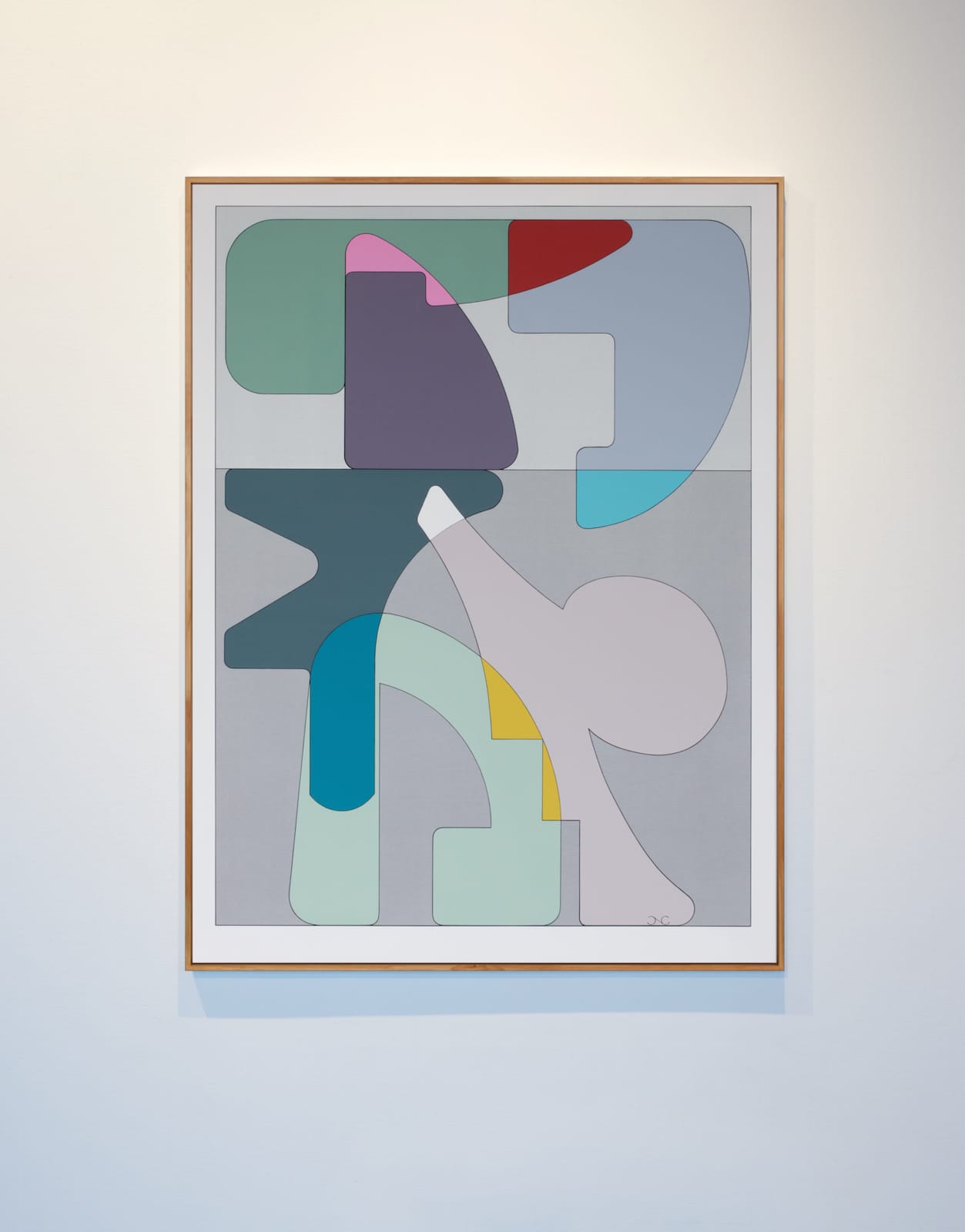
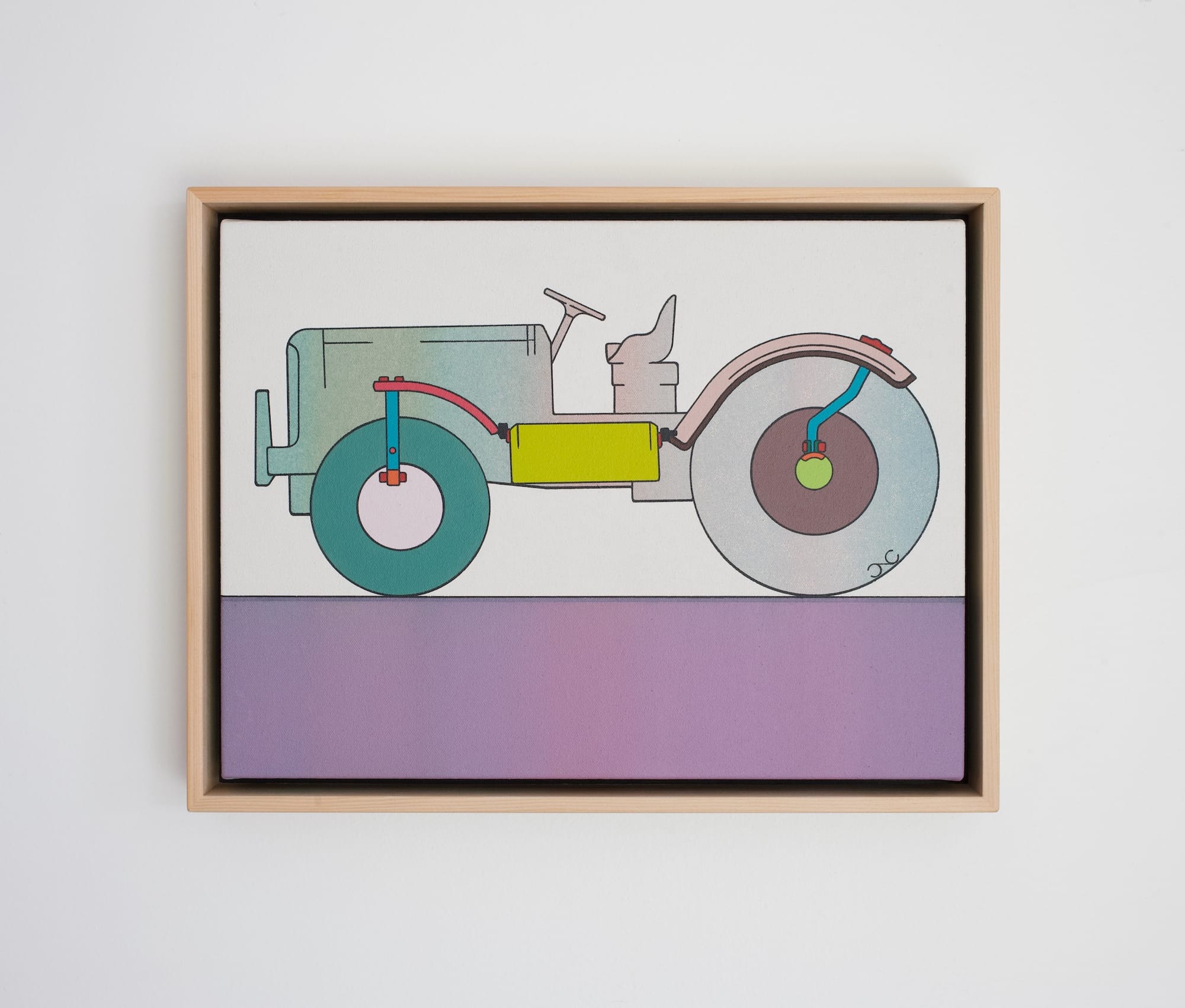
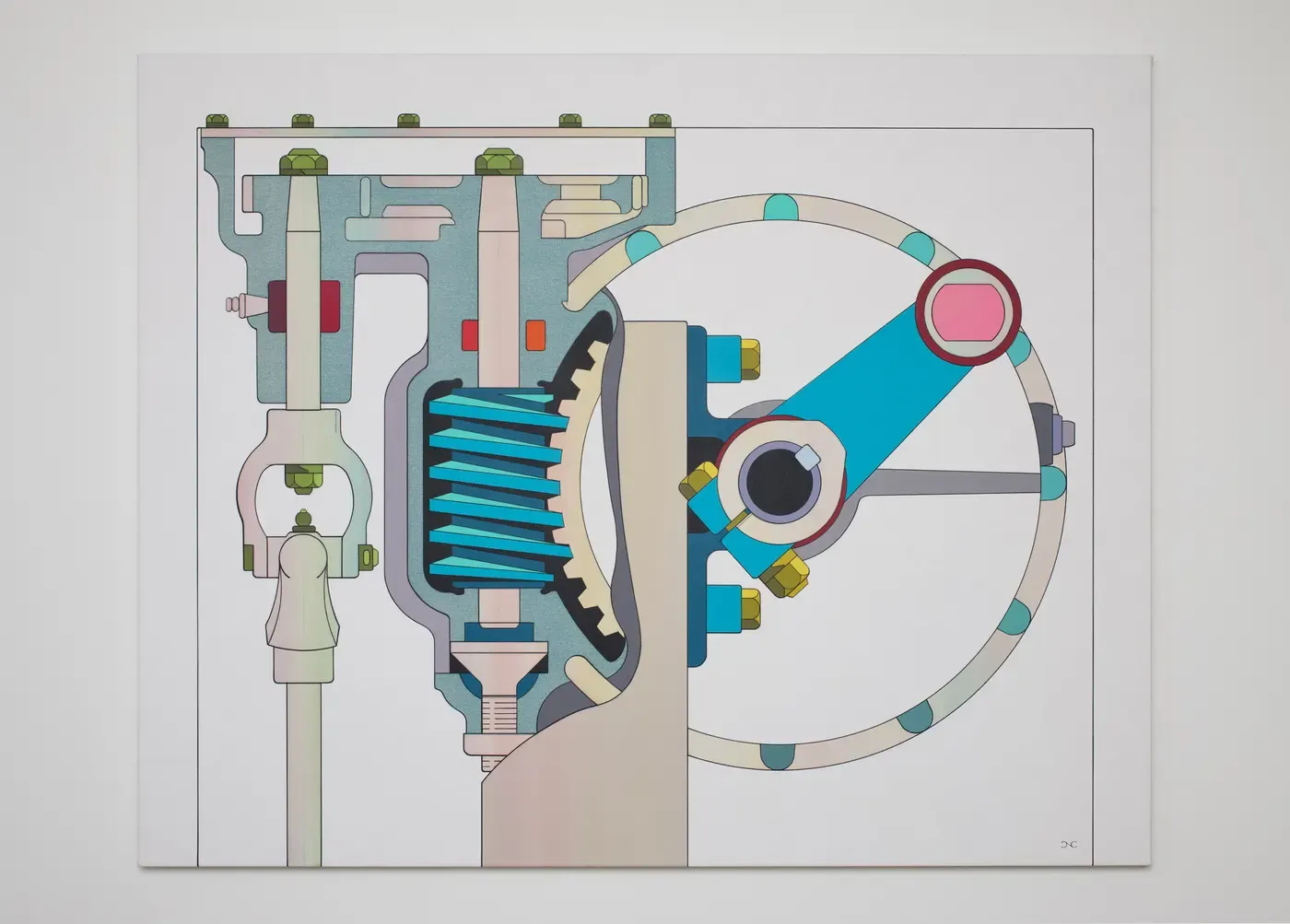
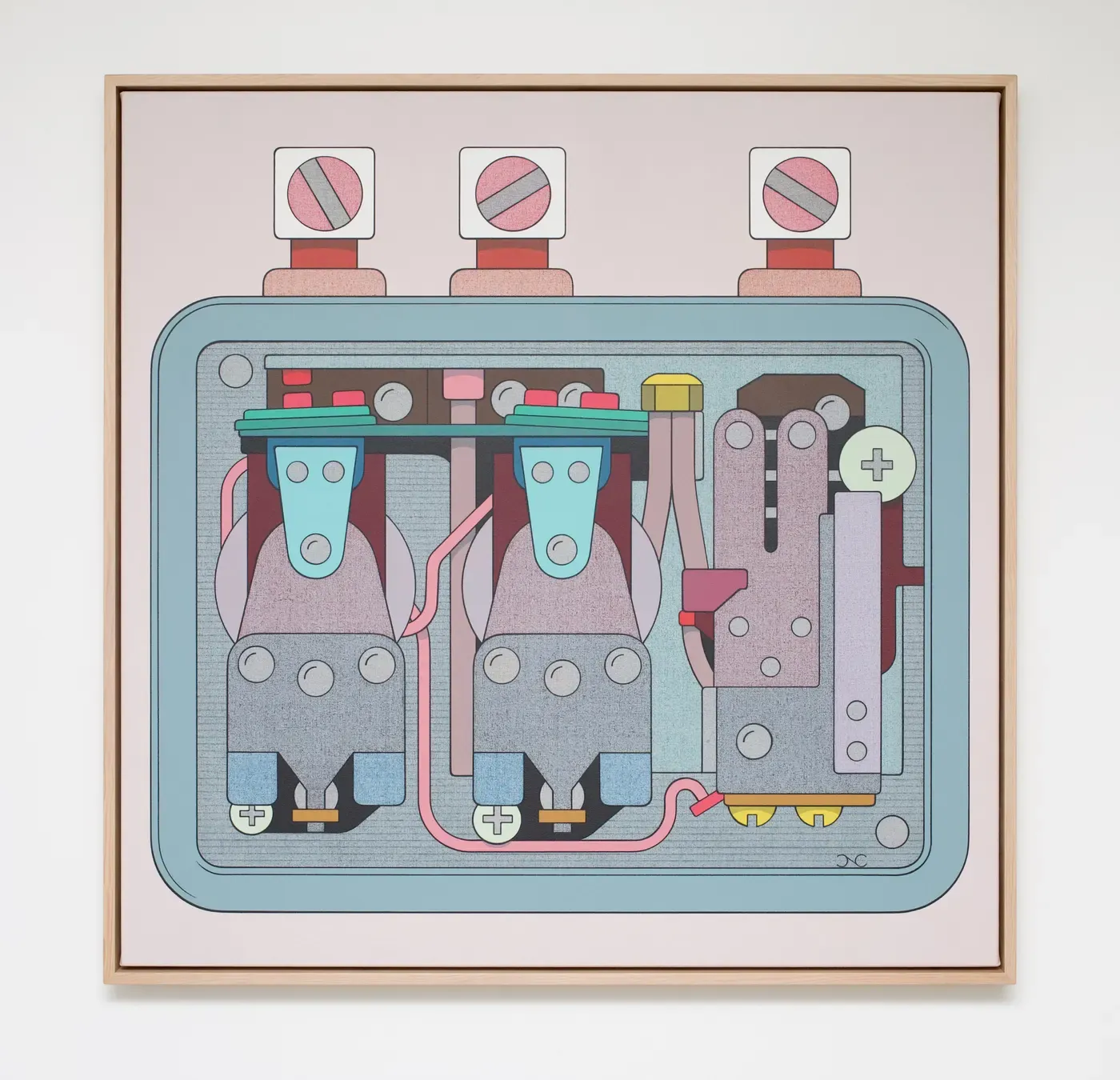
Chris Cassimatis 1. Cloud Stories, Acrylic on Canvas 18"x24". 2. Raintaker, Acrylic on Canvas 18"x24". 3. Calle Gral. Juan Cano, Acrylic on Canvas over panel 30"x40". 4. Rule of Three, Acrylic on Canvas 30"x40". Image Courtesy of the Artist.
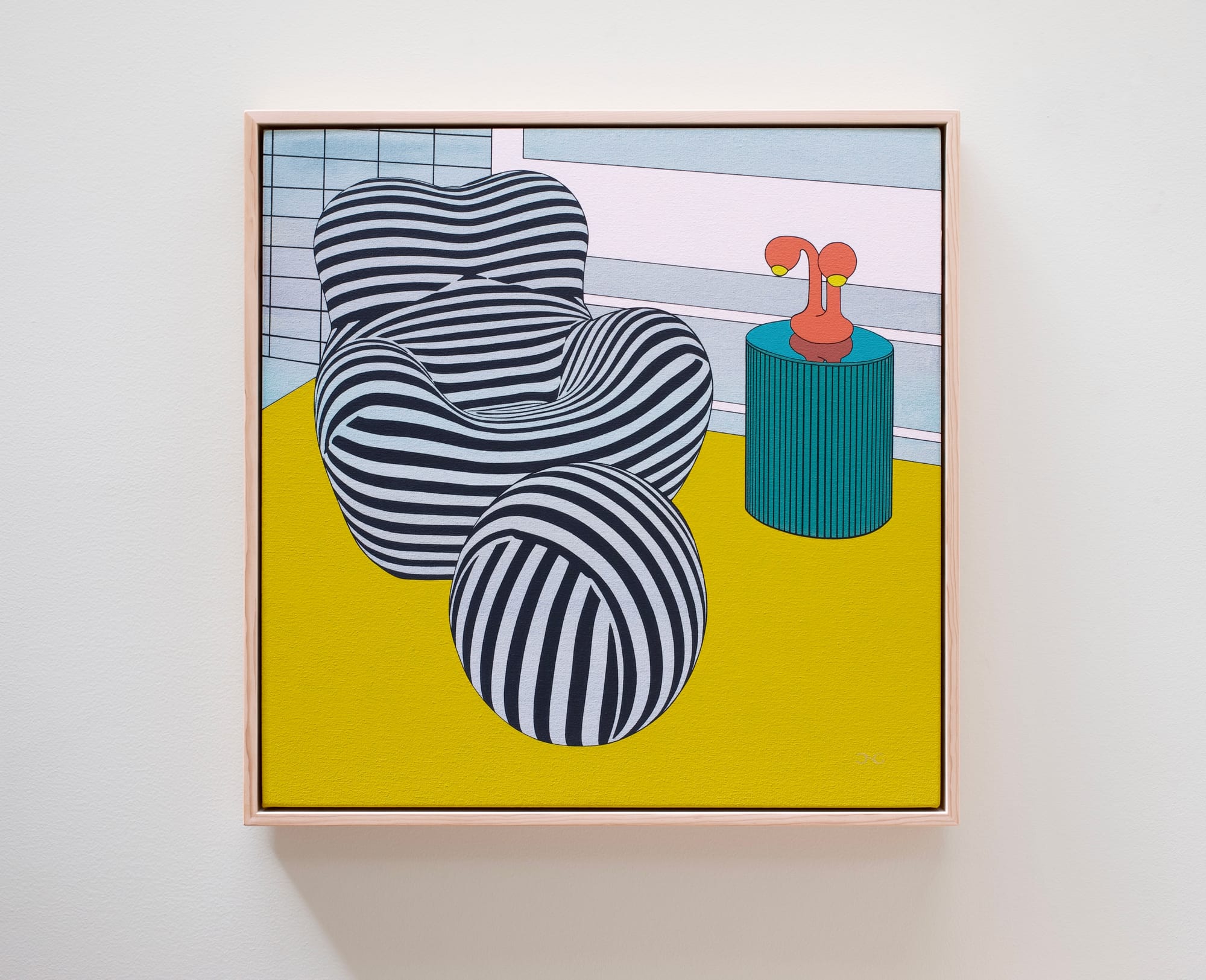
Your paintings have something almost sculptural about them, with all those planes and cuts. Have you ever thought about taking that language into three dimensions?
As I mentioned earlier, it was very important to me that my sculpture practice was carried through into my paintings. You asking this makes me feel successful in this pursuit.
Regarding the future, I do not ever plan to stop painting, but I have never ruled out adding sculpture back into the mix. The reason I gave up sculpture was economic; it became too expensive to keep an industrial studio and to store and move heavy work. Overhead began to feel like the antithesis of creativity.
If the math on this ever changes, I would love to see how the sculpture would be influenced by the painting, and vice versa.
There’s always a sense of calm in your pieces, a kind of silence. Is that something you aim for intentionally, or is it just your natural rhythm coming through?
This is certainly a quality that I am looking for in the work. If I am achieving it, then I would have to say that it arises out of the endless hours I spend staring at each piece, deliberating over which version sits the most still yet exciting.
My techniques for applying paint to canvas are all very time consuming, but a lot of time is spent just looking at the work and seeking out the perfect rhythm to end on.
What kind of references stay with you - artists, designers, architecture, music - what feeds your visual world?
On a day-to-day level, I really try to be open to inspiration coming from anywhere. I have two large dogs and go on at least three walks a day.
It is amazing how many new things of interest can be found on a simple loop around a neighborhood, even one that you have traversed hundreds of times.
In terms of painters that I am most influenced by: I think of Michael Craig Martin, Hillary Pecis, and Jonas Wood.
In terms of artists whom I admire: there are countless, but Charlotte Keats; Pedro Reyas; Phyllida Barlow; Pablo Merchante; Bisa Butler; Peter Mohall; Woody De Othello; Alicia Kwade; Eduardo Chillida would be the current tip of the iceberg.
It is such a very rich period visually – if you can find time to sift through it all. Outside of the fine art world, I am most inspired by modernist architecture.
Some favorites I have only experienced through images would be Oscar Niemeyer; Albert Frey; Marcel Breuer; Carlo Scarpa; Tivadar Balogh; and Ray Kappe.
I have had the privilege of visiting some homes designed by Luis Barragan and I consider these experiences to be almost religious in nature. Living in Portland, I feel fortunate to have superb examples of Northwest Regional Modernism close by.
I am constantly on the lookout for homes hitting the market that were designed by some of Portland’s local architects: Pietro Belluschi; Frank Shell; Van Evera Baily; and William Fletcher, to name a few. Touring these homes provides source images for my current work.
I find a house tour to be such an interesting subject, particularly when the home is not staged. Sometimes the furniture you see has lived in its spot for decades and witnessed an entire generation pass through.
It’s all dusted and primed to look its best. These will be some of the last moments that a house holds a certain character before the next owner replaces furniture and objects, creating entirely different memories.
Your colors have a unique energy, somewhere between pastel and industrial tones.
Do you have any color rules, or do you just mix until it feels right?
In the 15 years I was primarily a sculptor, I almost never thought about color. When I moved to painting, this is what caused the most anxiety. Around this time, I was reading a book by Michael Craig Martin, who coincidentally moved from sculpture to painting.
He discussed also being intimidated, until he realized that there are no actual rules about color.
That he could just feel that they worked, and that was enough. This pushed me to developed methods that constantly explore color rather than to follow any rules.
When you start a new piece, do you have a clear idea in mind, or do you let the process take you somewhere unexpected?
For the last two series, Parts and Edifice, I am working from either 1960’s technical drawings or photographs taken with my iPhone.
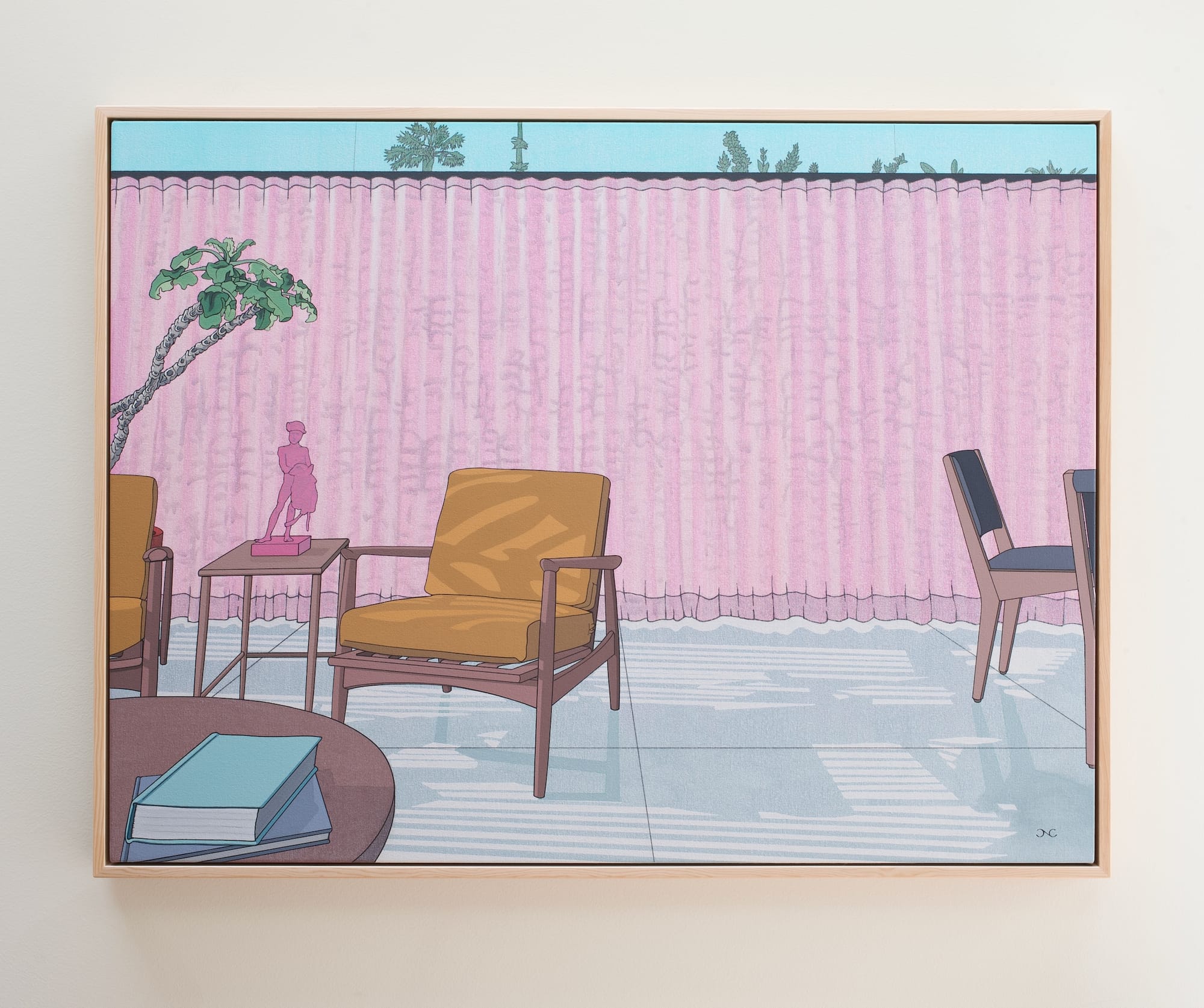
Each painting starts with a line drawing taken directly from the source material, but I let the color palette and the way the paint is applied, unfold in real time.
The color holds a lot of the emotion; so even though I know the subject quite clearly, it is still exciting to see how it presents in its final form. (As an aside, the linear nature of reality feels like a worthy subject right now)
What’s your studio like - super organized and clean, or more of a beautiful chaos where ideas happen?
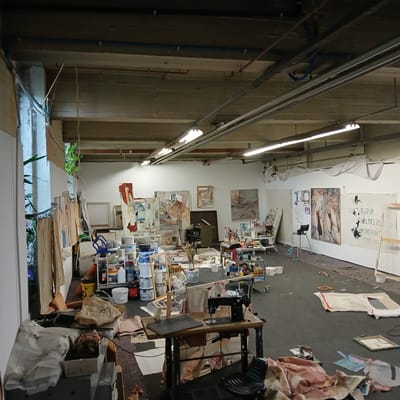
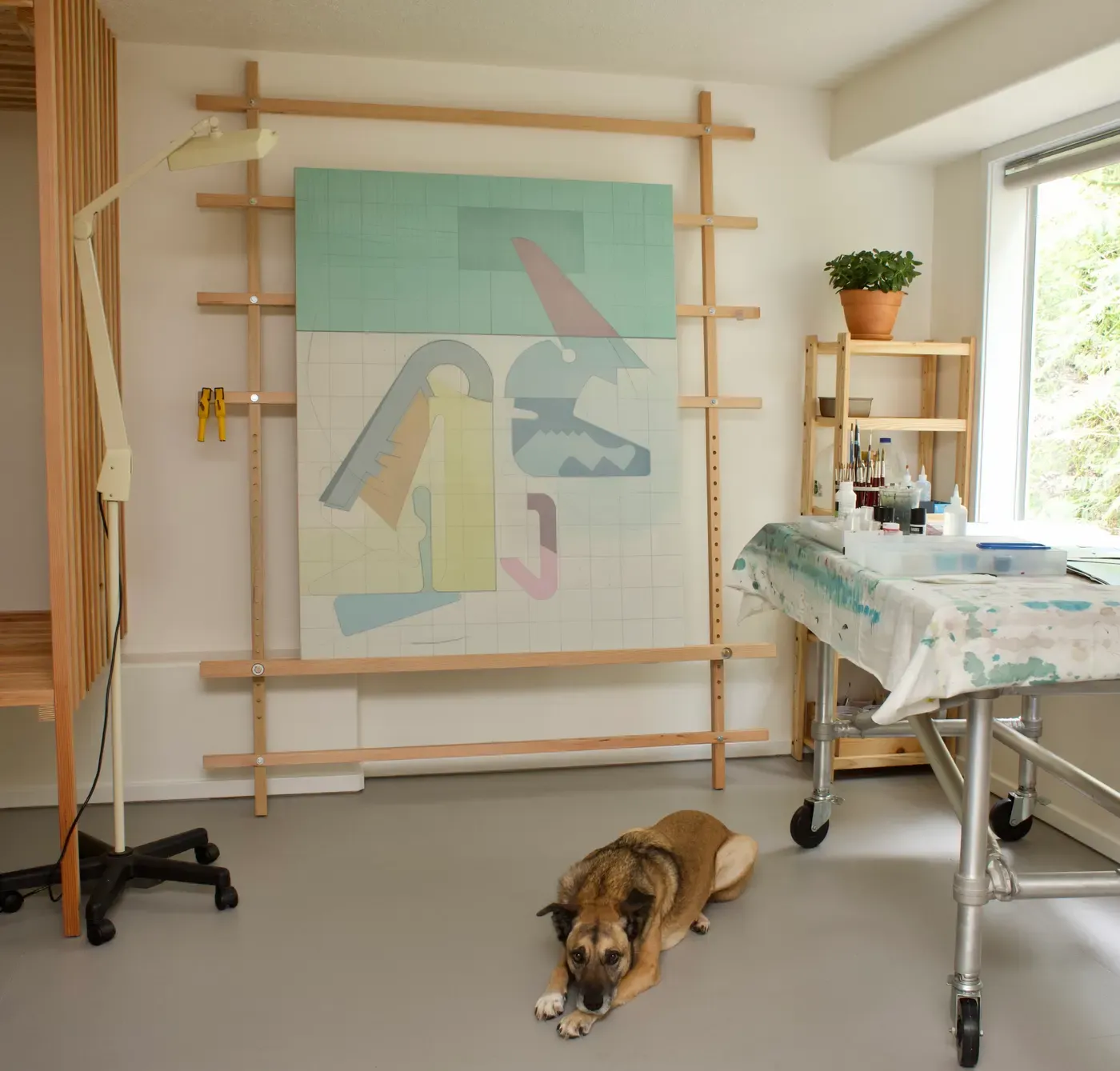
I paint in a spare bedroom, so it needs to be organized, both in terms of functionality and presentation.
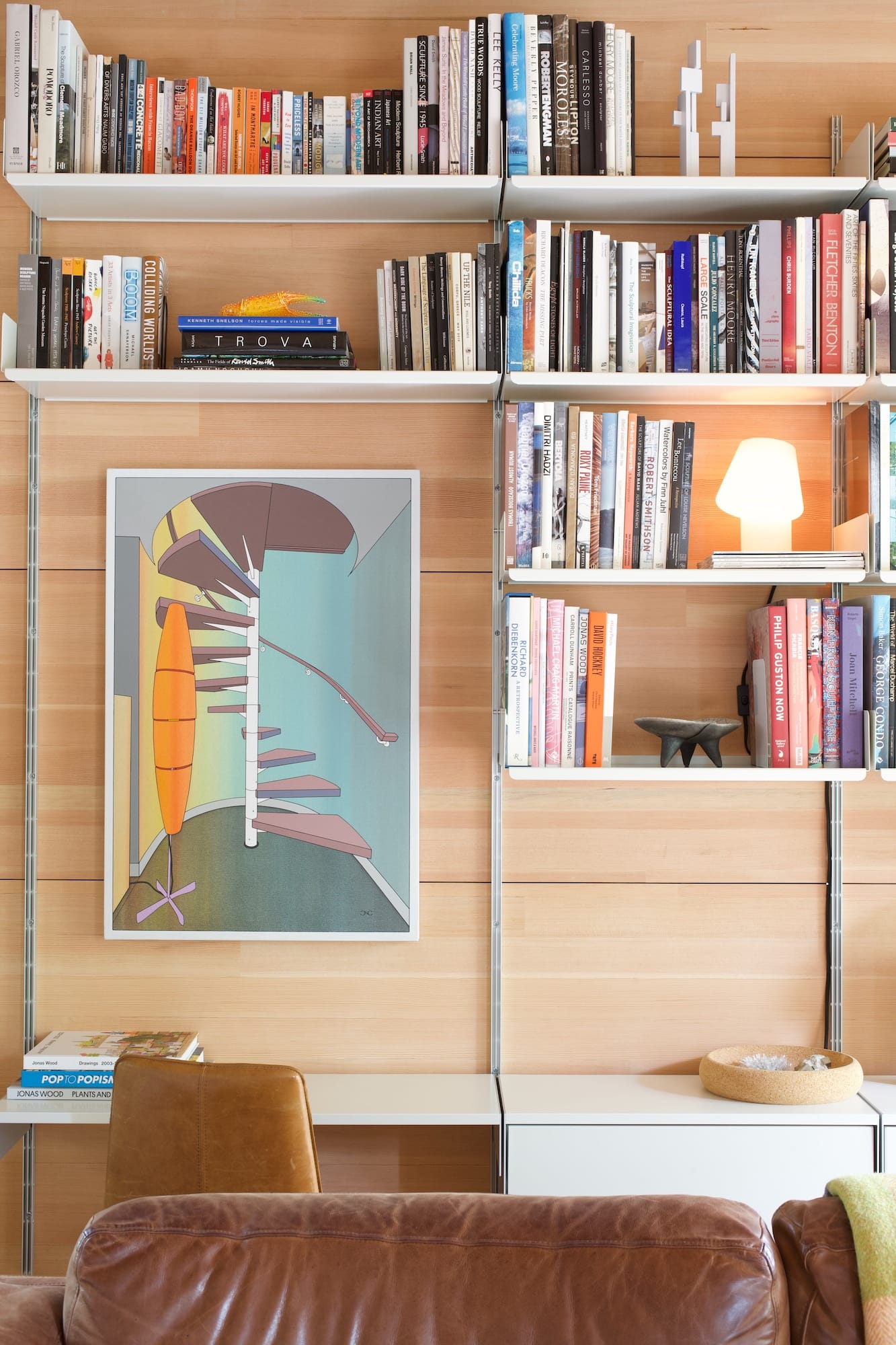
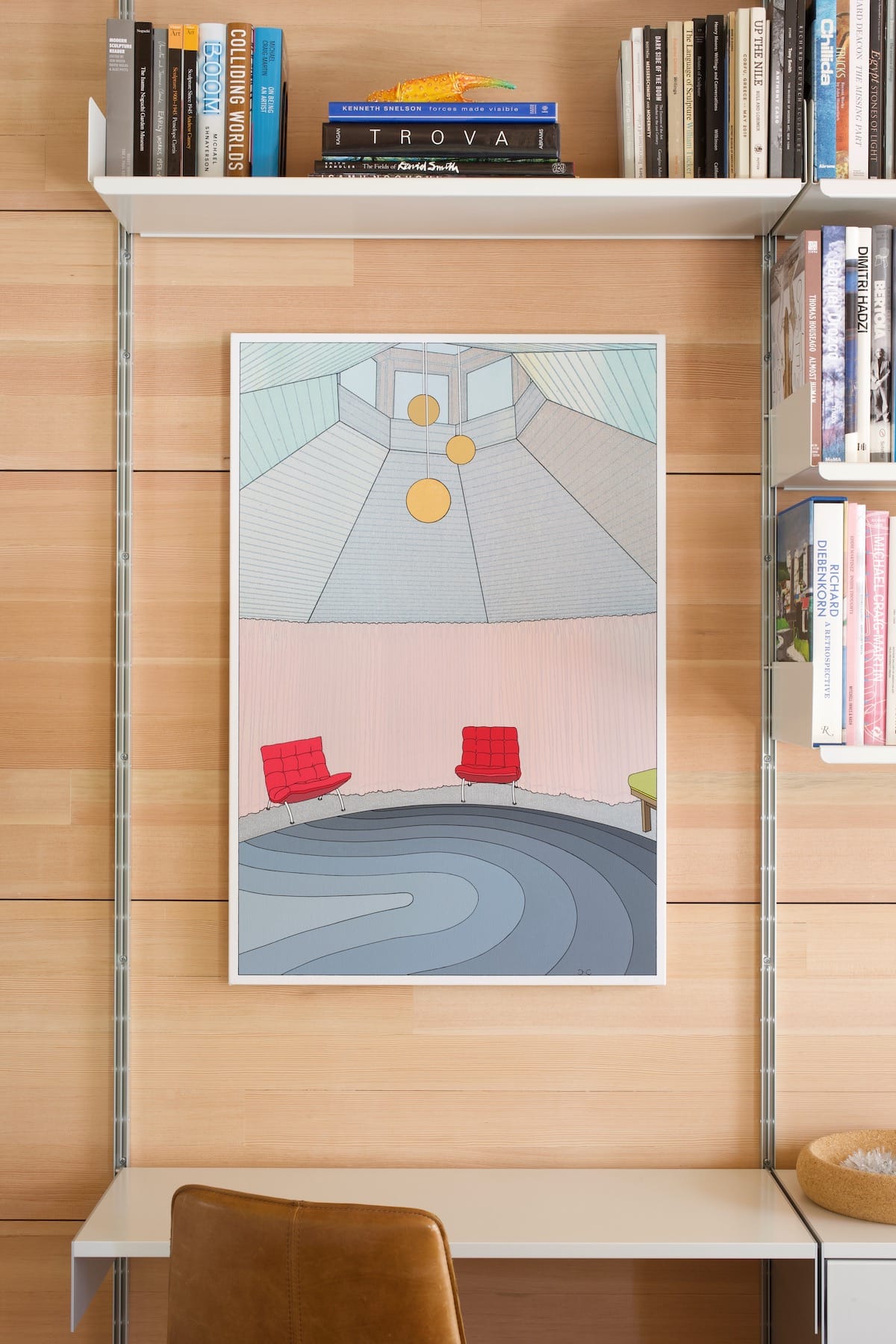
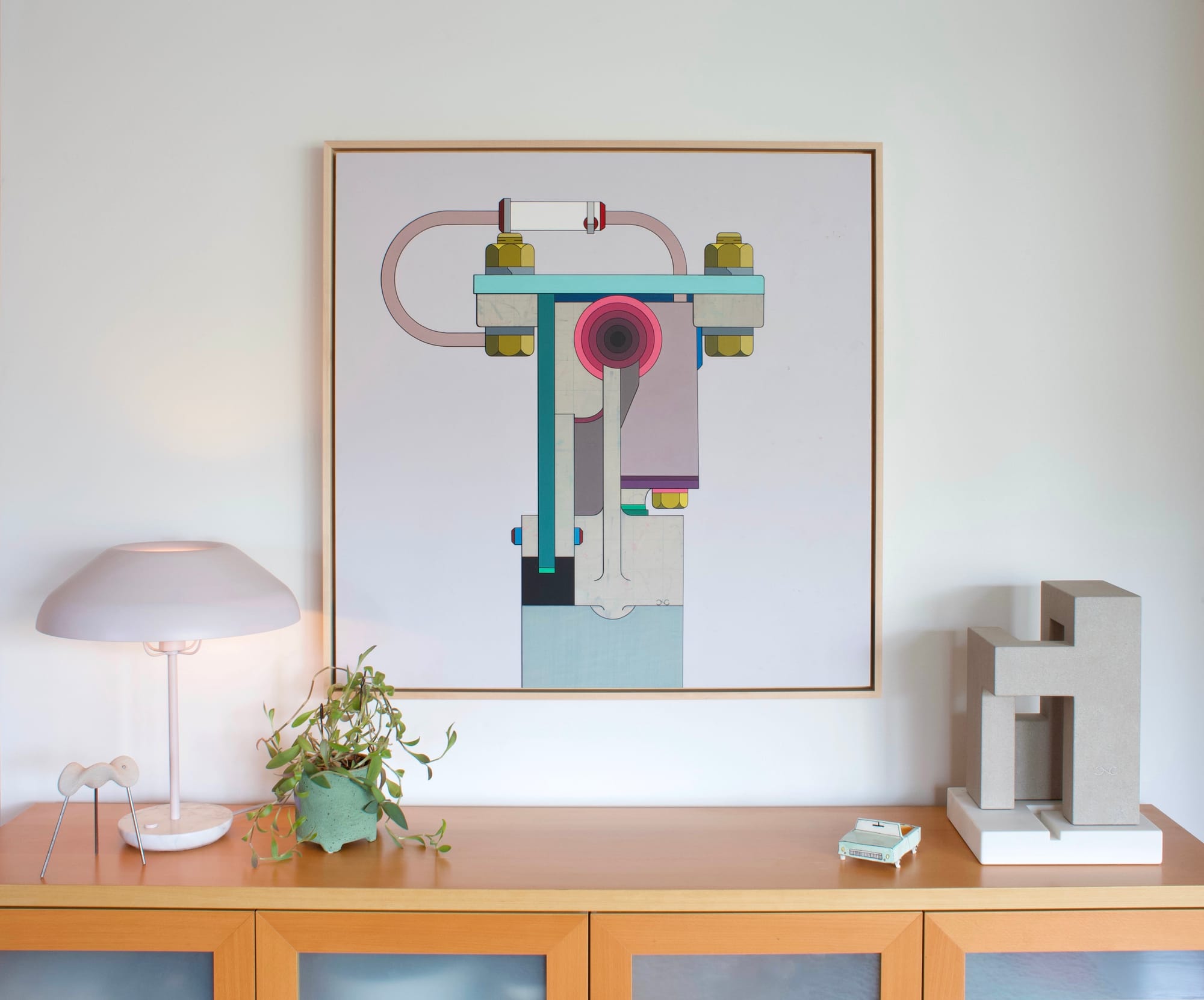
Two works by Chris Cassimatis installed in a private residence: Skyline and NW Hilltop. Acrylic on canvas over panel. Image Courtesy of the Artist.
I tend to work on one painting at a time, and the studio gets a little more chaotic over time. However, I won’t start something new without completely resetting my space.
Looking ahead, is there something new you want to explore bigger scales, new materials, or a totally different direction?
Nothing as ambitious as pivoting from sculpture to painting, but I would love to expand to a larger painting studio.
My last four studios have been a kitchen table in downtown Chicago, two basements, and a third-floor bedroom looking out towards Mt. St. Helens.
I have dreams of making a giant mess across multiple large canvases, which in all honesty, I could probably achieve in 300 square feet if it were not in my home.
The art market today seems to swing between trends and identity. How do you position yourself within that, do you resist those dynamics or play along with them?
I find the art world fascinating, and I read, watch, and listen to as much as possible to keep up with it. That said, I don’t really dwell on how I fit in it all.
The work has its own momentum, and my motivations for being in the studio have long since moved on from any dreams of being famous.
In truth, I just wish for enough success such that it continues to make sense for me to keep producing art. It is a privilege that I cherish.
And finally, do you think art can still have a political or transformative role, or is it more about personal expression these days?
Support for institutions is currently in crisis from many fronts. I hope that as this trickles down, there is still enough to keep all realms of art-making alive.
My work happens to fall more in the realm of personal expression, but I have endless respect for artists who tackle the big questions.
The arts and more broadly, humanity itself, is always worse off if artists are not free.
Team Catapult Projects says thank you to Chris Cassimatis and Di Franco for the Interview
Follow Chris Cassimatis on Instagram.
More Interview by Di Franco
 Home
Home
Di Franco - Catapult Munchies Art Club
 Di Franco
Taylor Anton White by Di Franco - Interview
 Di Franco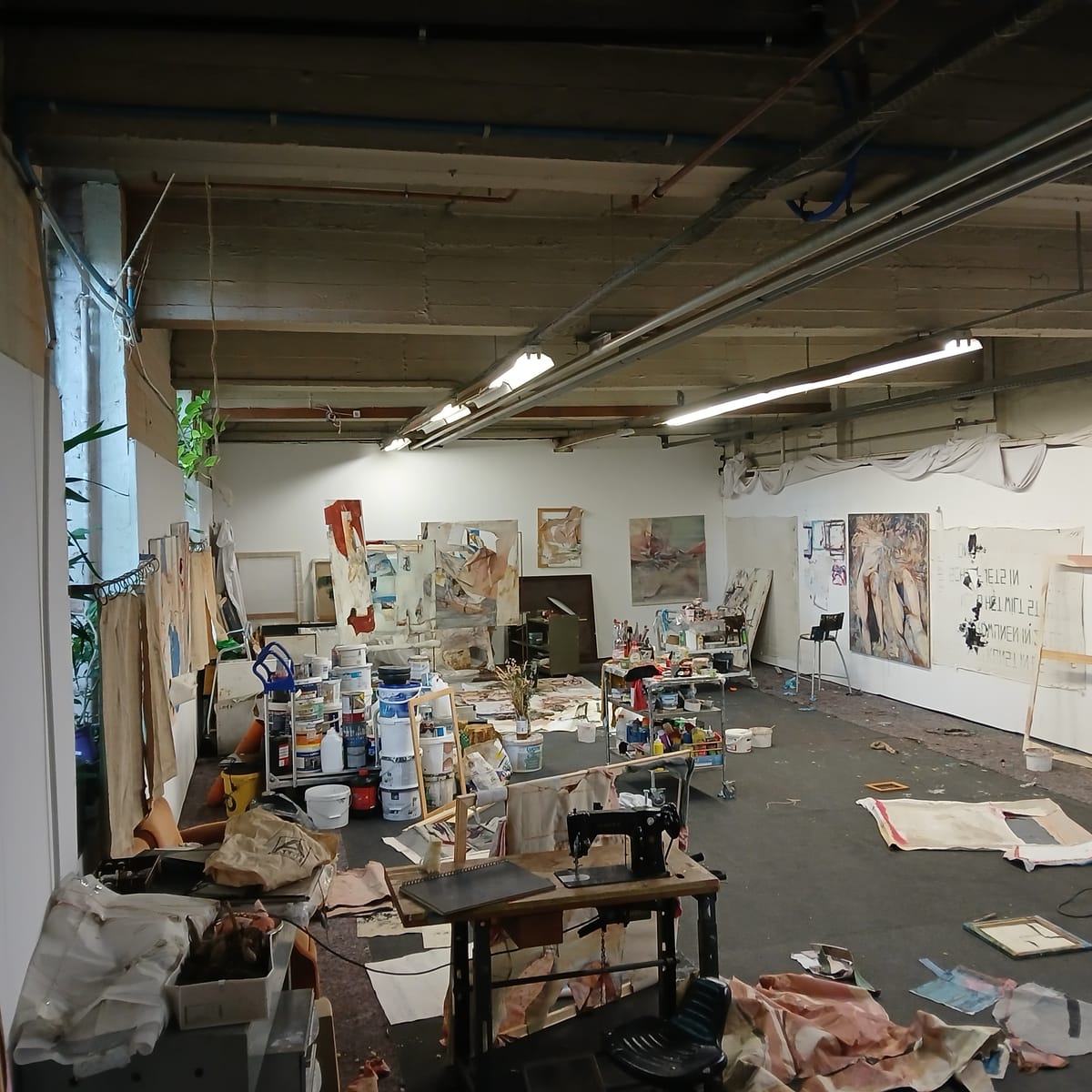
Ruth Devriendt Interview by Di Franco
No spam, no sharing to third party. Only you and me.