Still Life with Collapsed Ideology

Tudor Ciurescu
ELEGIA
VUNU Vienna
Vienna, Austria
-
Florianigasse 51A, Vienna
Aleksei Borisionok
Courtesy VUNU Vienna and the artist
VUNU Gallery Presents ELEGIA by Tudor Ciurescu in Vienna
Authority doesn't vanish cleanly. It drains out, slowly, unevenly, leaving the images behind. A portrait, a theory, a religious form: these persist after the certainty that generated them has been quietly withdrawn, and what remains is neither sacred nor dismissed but suspended, still circulating, still doing something.
What exactly it does when it circulates through the internet, through meme culture, through algorithmic noise. This is the question Tudor Ciurescu seems most interested in pressing on. The image of Freud doesn't disappear when psychoanalysis loses institutional dominance. It becomes something else: ambient, available, slightly ridiculous, still charged.
Desire and ideology share a structural problem: neither knows what to do with itself once the project to which it belonged has dissolved.
VUNU's Vienna space on Florianigasse, a narrow, high-ceilinged room with a pale green shopfront facade and herringbone parquet floors, carries the particular weight of bourgeois Viennese interior without being theatrical about it. Ciurescu leans into this.
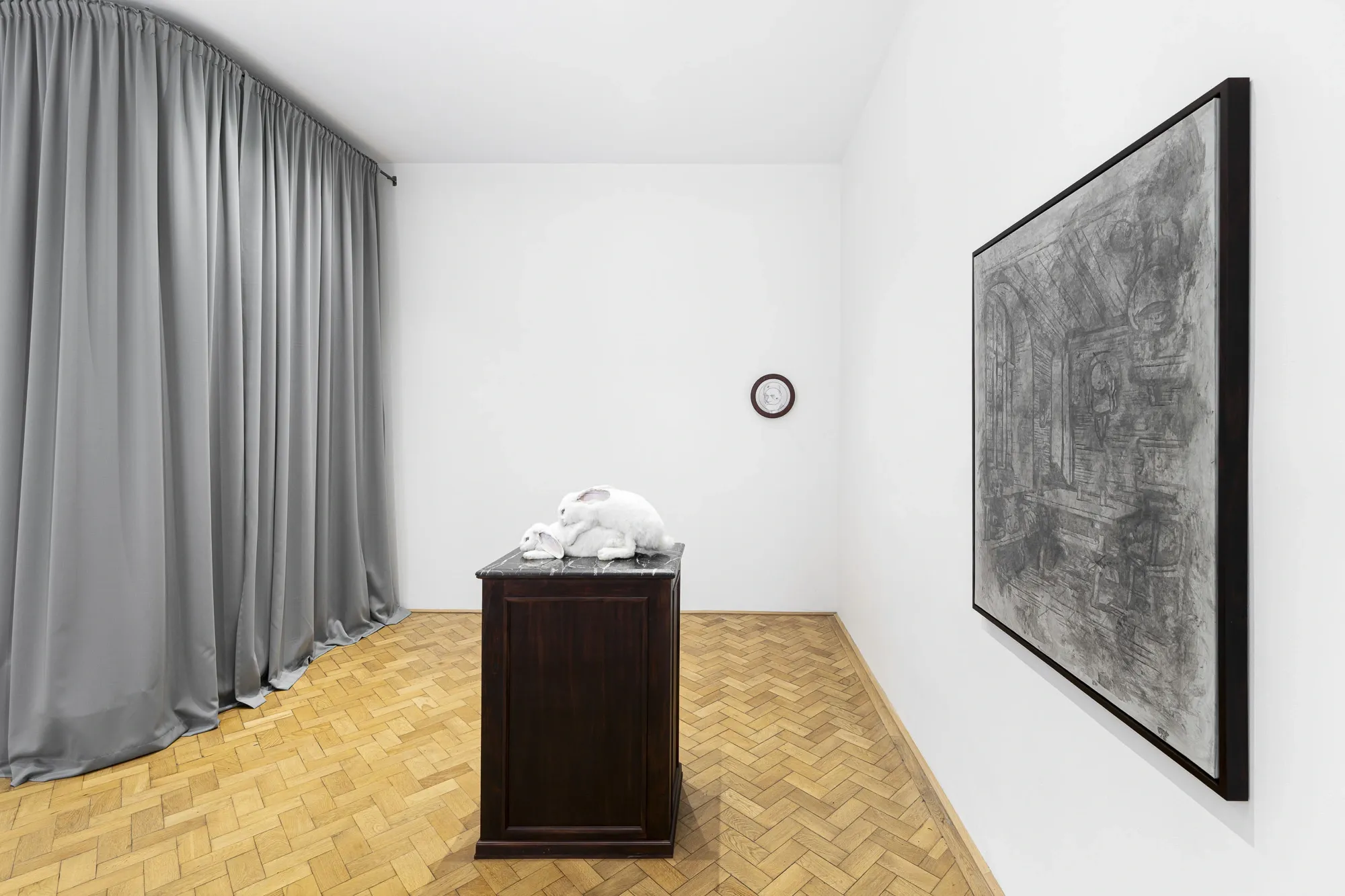
The dark brown wood of pedestals and frames reads as period furniture, cabinets, parlors, circular moldings, repurposed as a staging apparatus for images that have no comfortable home.
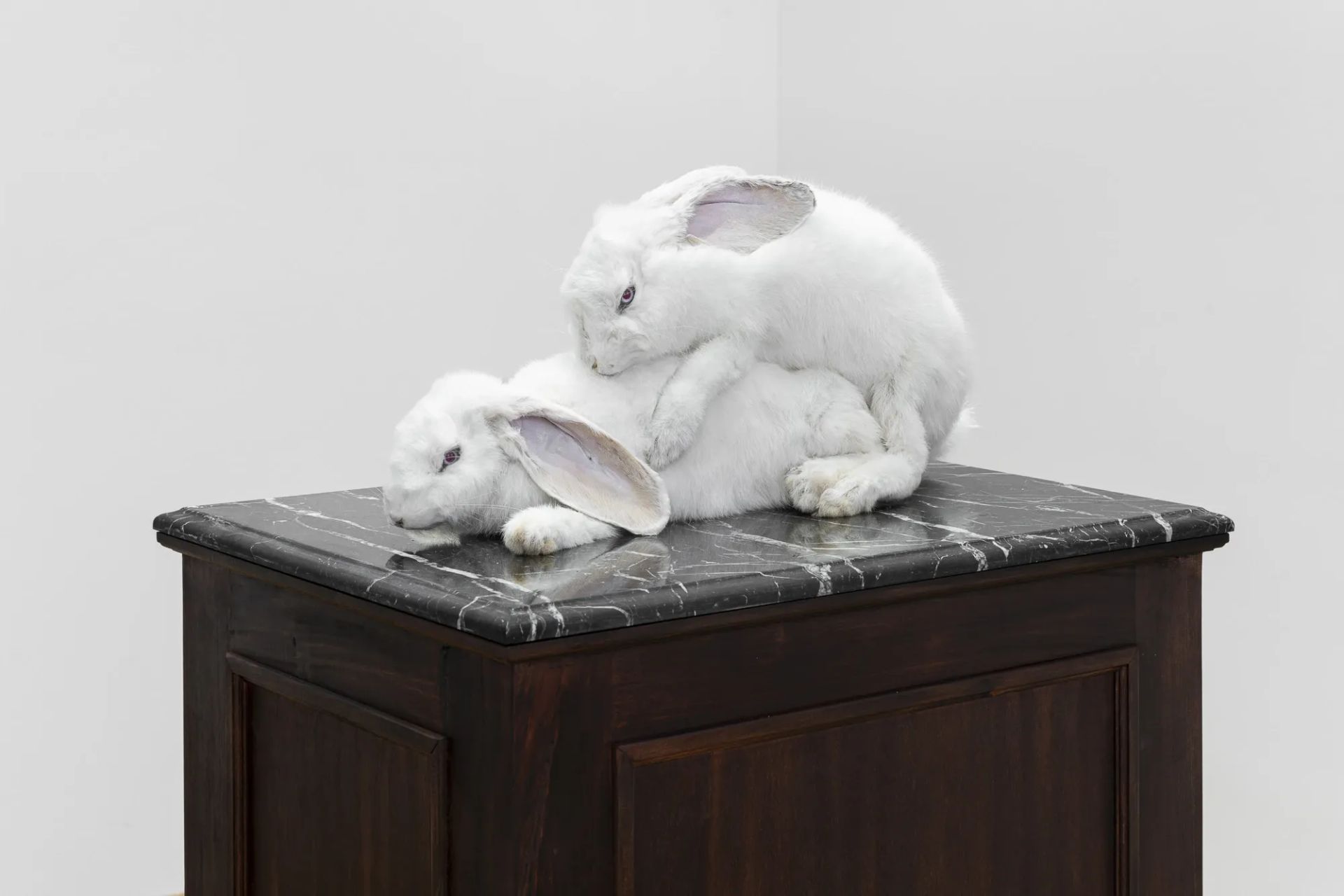
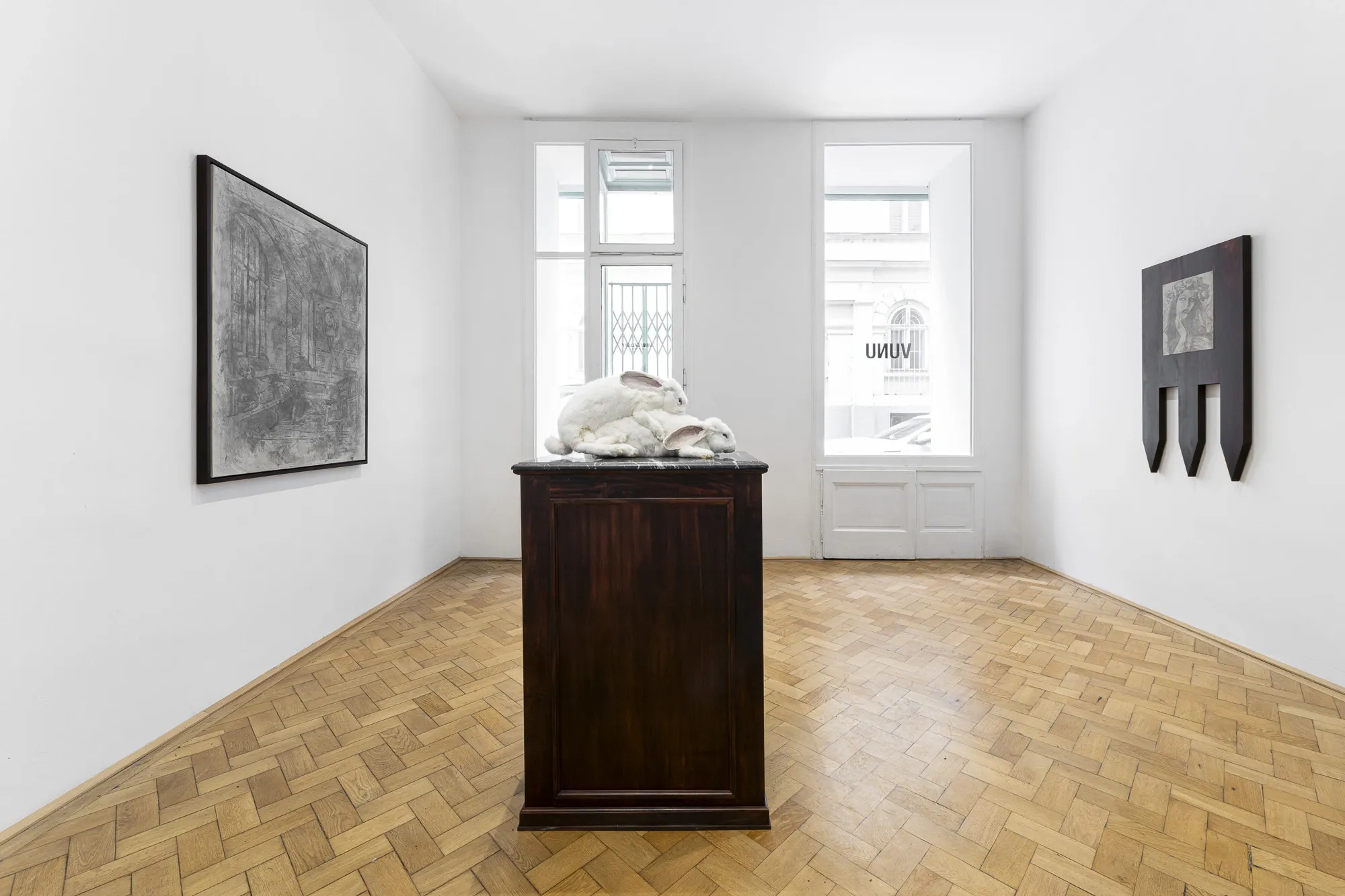
L'urgenza Eterna (2026) occupies the room's center. Two white taxidermied rabbits are fixed in the act of copulation on a marble surface atop a dark wood cabinet. The whiteness is clinical, almost laboratory, and the marble carries associations of anatomy tables and bourgeois domestic interiors simultaneously.
The act depicted is entirely mechanical, driven by instinct without intention, and Ciurescu places it at eye level on what functions formally as a display plinth. No irony is signaled. The work doesn't announce itself. It simply sits there, performing.
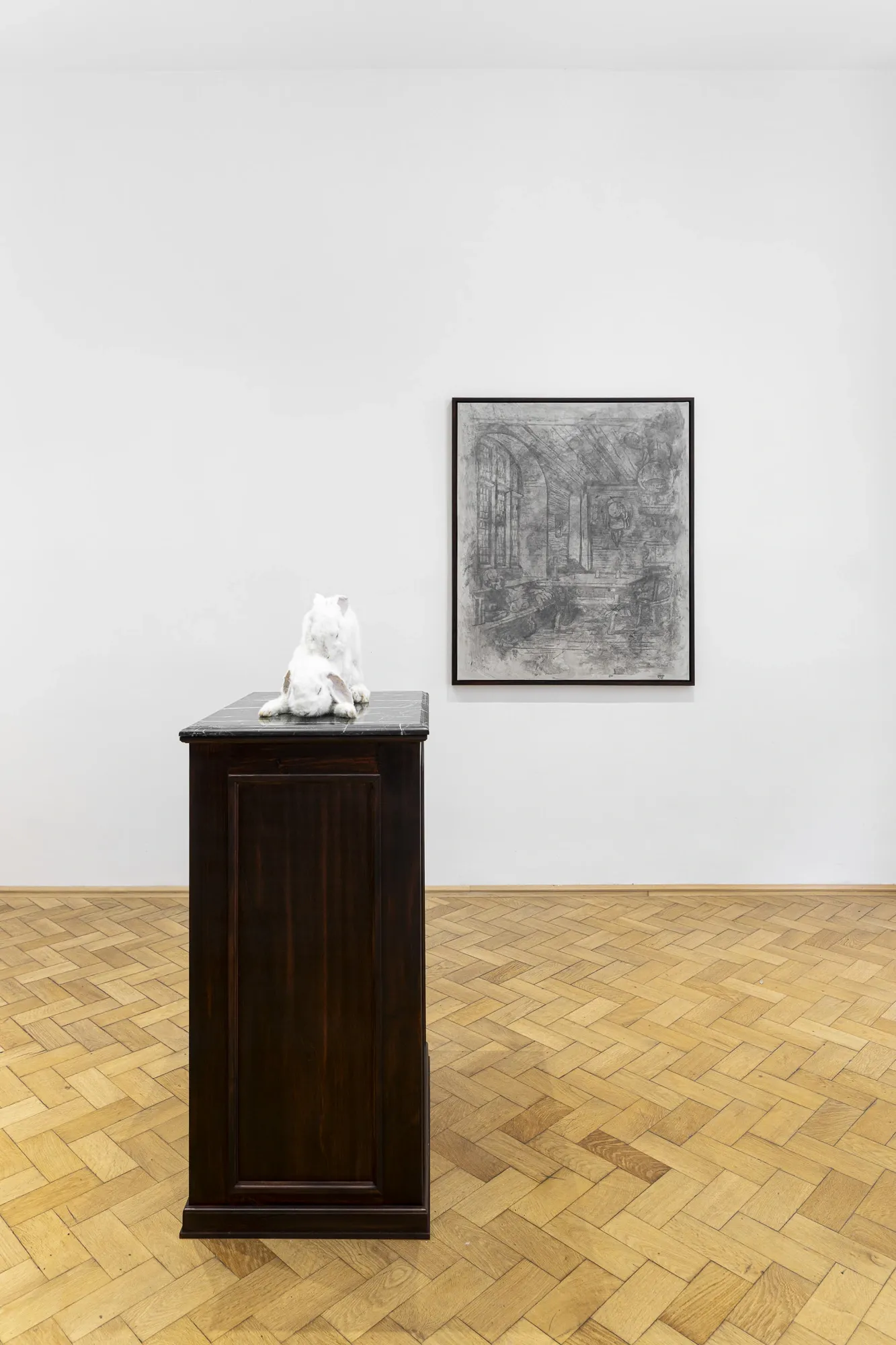
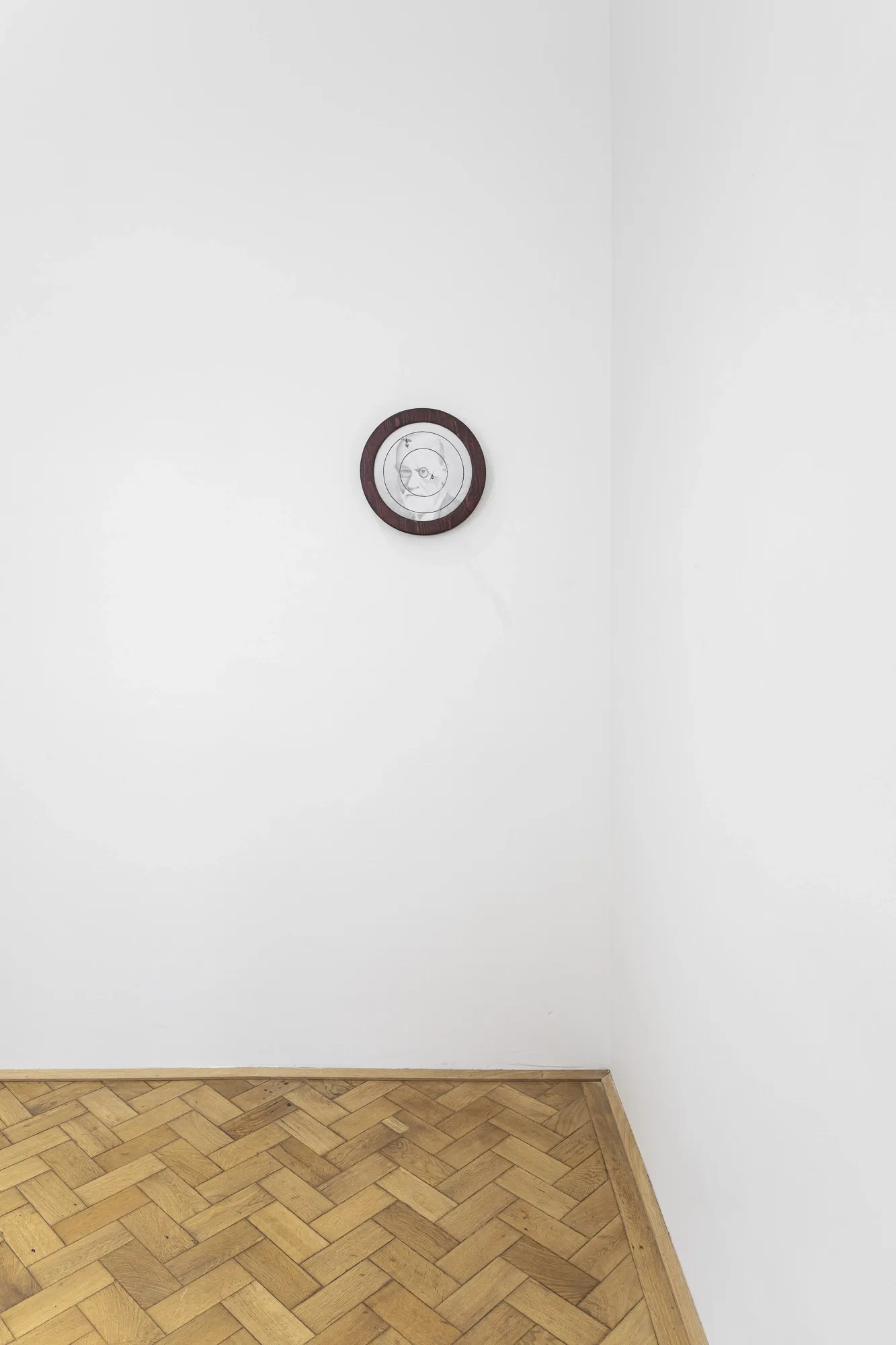
Installation view, ELEGIA, Tudor Ciurescu, VUNU Vienna, Vienna, 2026. Courtesy VUNU Vienna and the artist. Photo by Dominika Goralska.
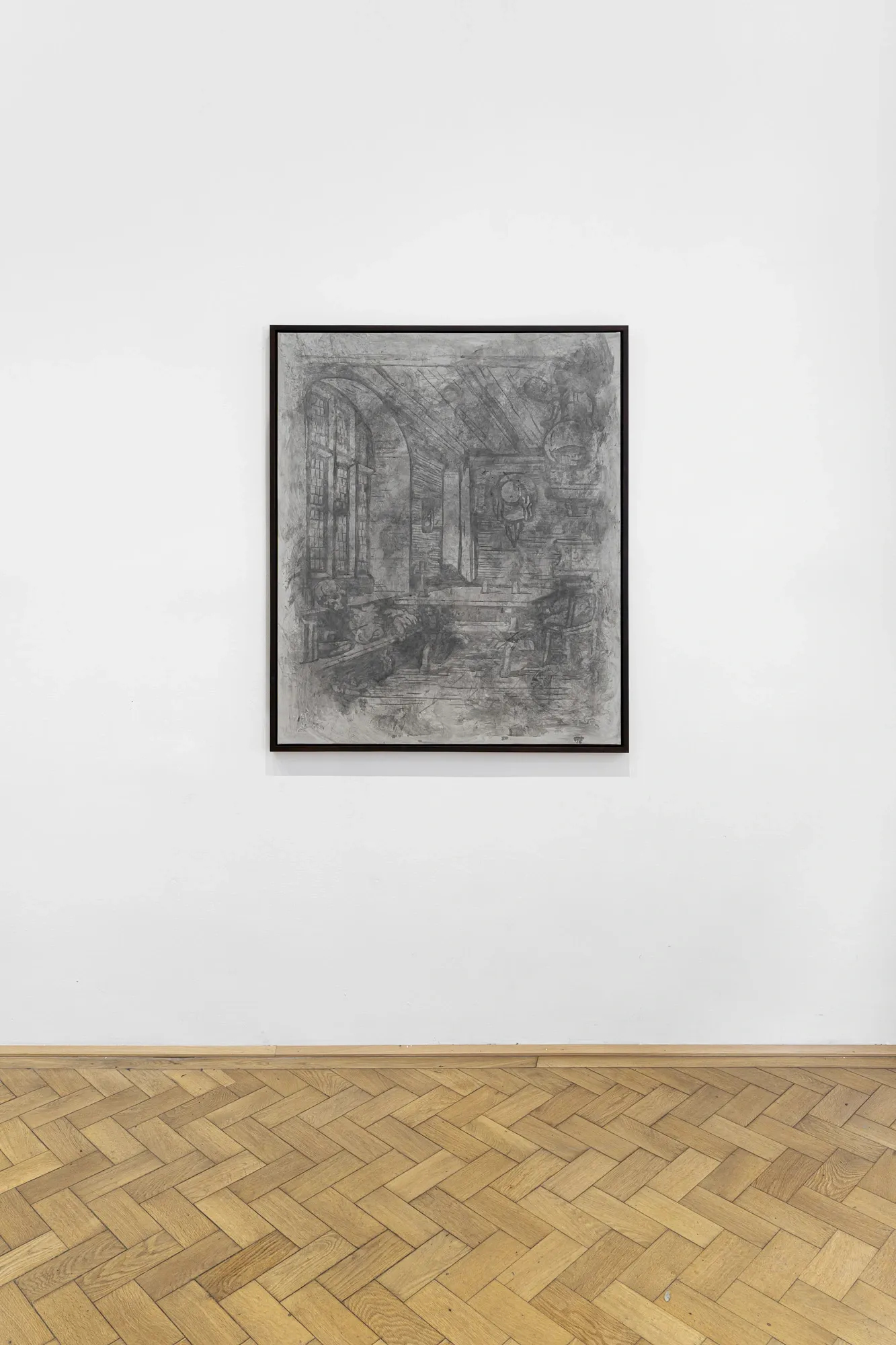
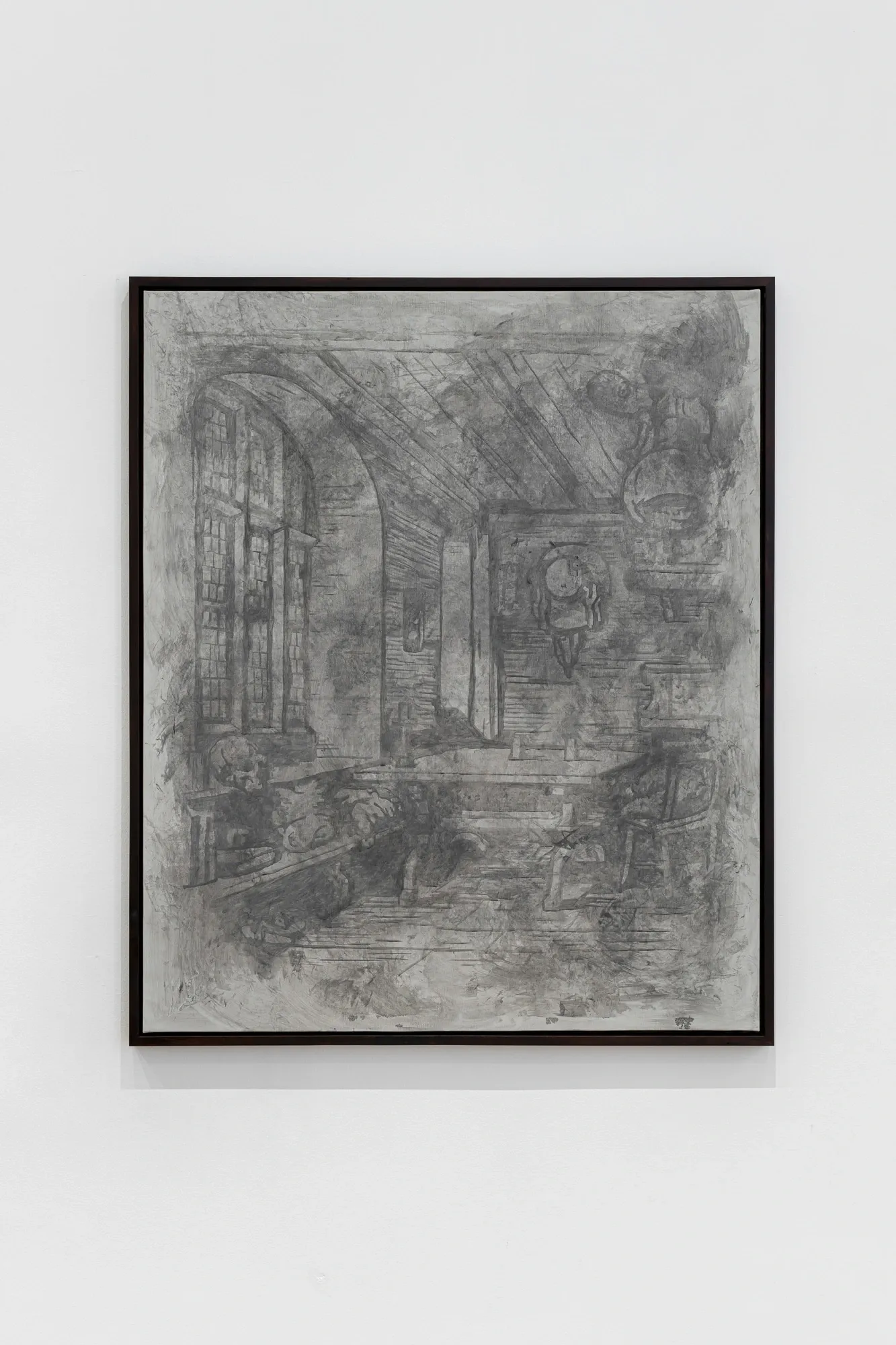
Sfantul Ieronim a Plecat (Saint Jerome Has Left), Tudor Ciurescu, 2026. Acrylic on linen, wood. Installation view, ELEGIA, VUNU Vienna, Vienna, 2026. Courtesy VUNU Vienna and the artist. Photo by Dominika Goralska.
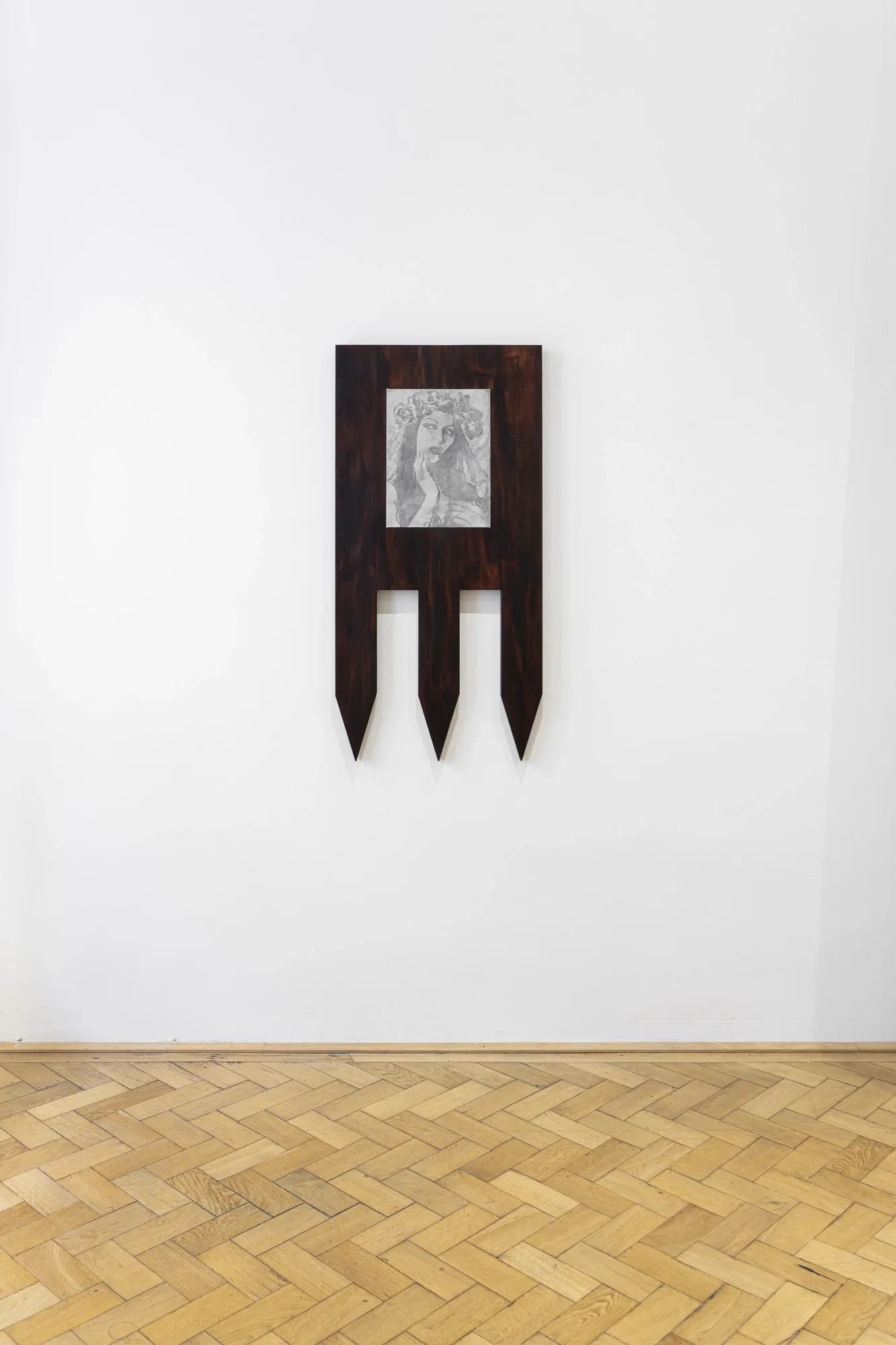
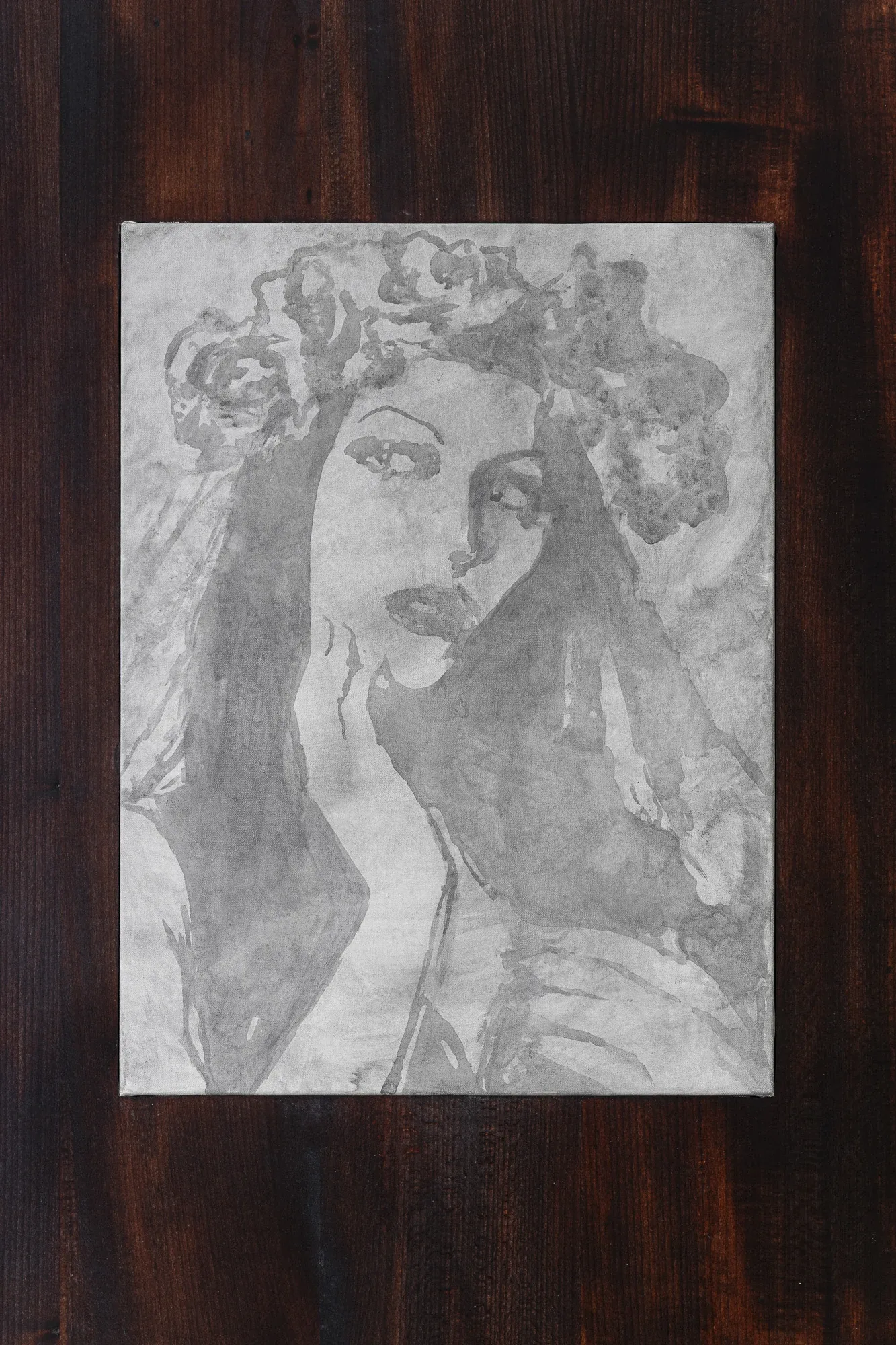
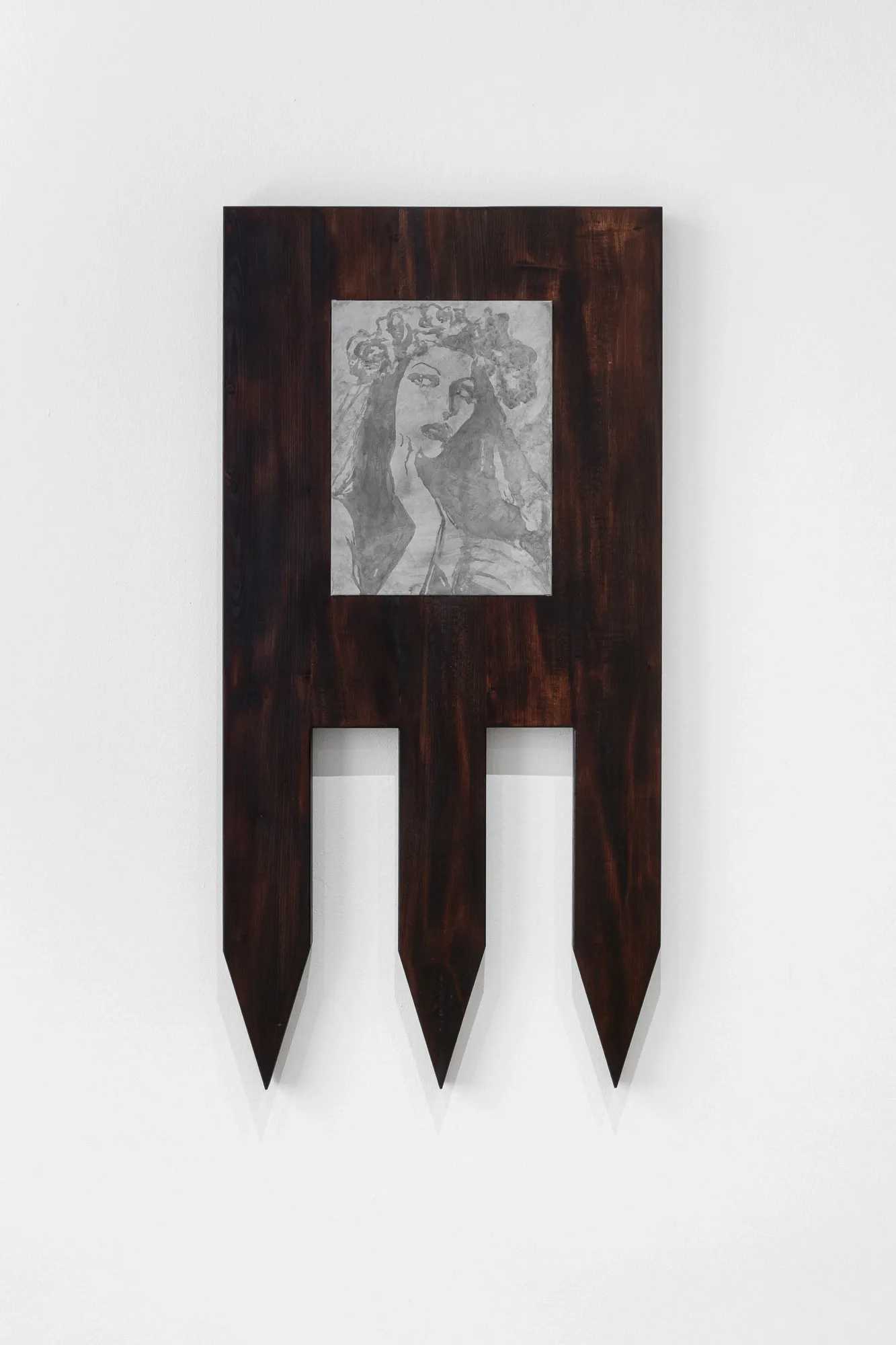
Prapor / Vera Renczi, Tudor Ciurescu, 2026. Acrylic on linen, wood. Installation view, ELEGIA, VUNU Vienna, Vienna, 2026. Courtesy VUNU Vienna and the artist. Photo by Dominika Goralska
Prapor / Vera Renczi (2026) introduces a figure whose authority is of a different order. Vera Renczi, a Romanian woman believed to have poisoned around thirty-five men beginning in the 1920s, appears here in acrylic on linen, her portrait rendered in monochromatic grey washes, set within a dark wood prapor: the liturgical banner form used in Romanian Orthodox processions.
The painting is loose, almost faded. The face partially dissolved into gesture. The frame structure, with legs extending downward rather than mounting flush to the wall, reads as both ecclesiastical object and something slightly unstable, as if the form were prepared to move.
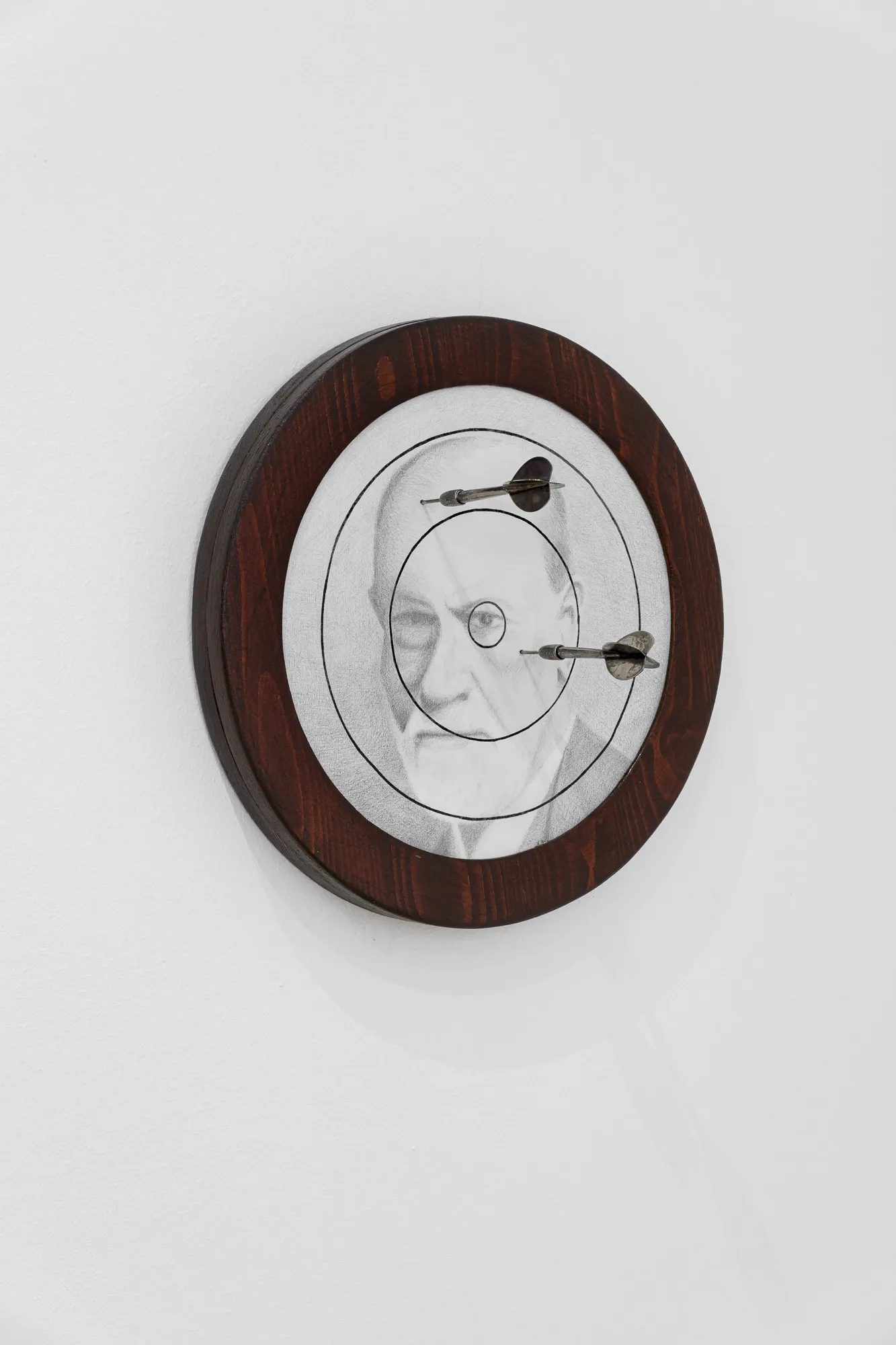
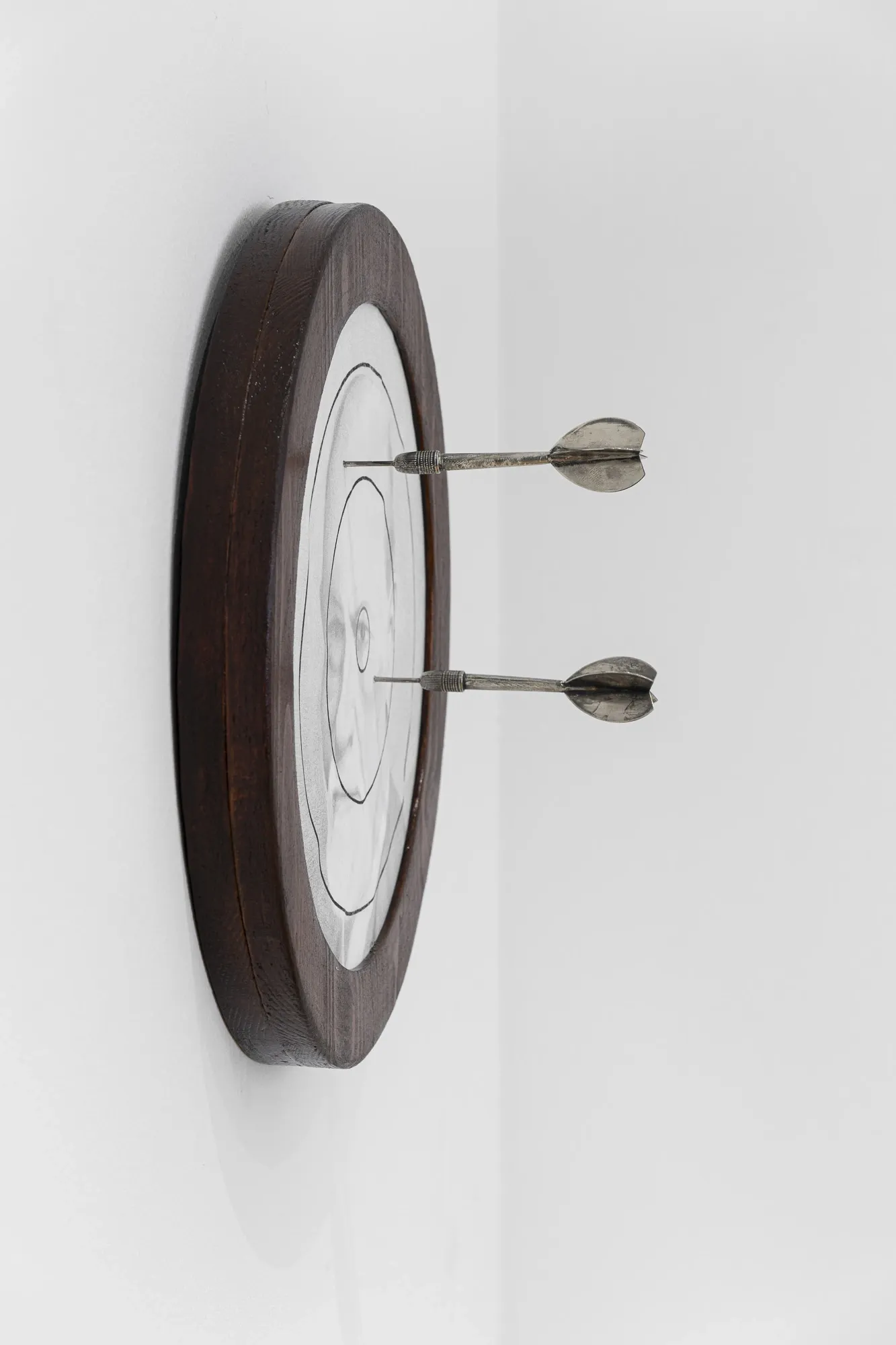
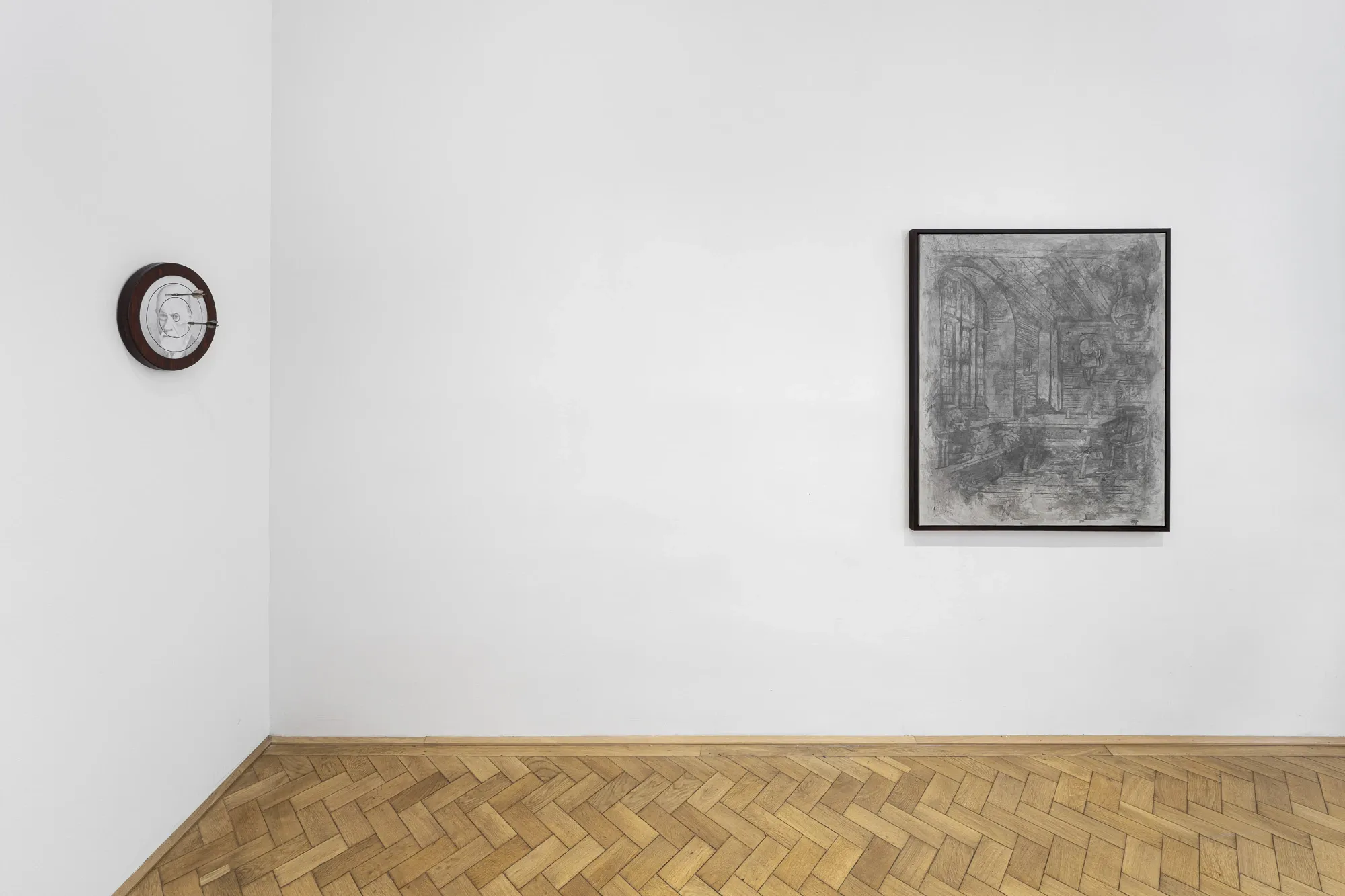
S.F. Dartboard, Tudor Ciurescu, 2026. Wood, charcoal on paper, 925 silver plated metal. Installation view, ELEGIA, VUNU Vienna, Vienna, 2026. Courtesy VUNU Vienna and the artist. Photo by Dominika Goralska.
S.F. Dartboard (2026) hangs nearby: Freud's face rendered in charcoal on silver-plated paper, framed in dark wood scored with concentric rings, two darts embedded in the image, one at the eye, one at the forehead. The work holds its reference lightly.
It derives from a scene in Dušan Makavejev's W.R.: Mysteries of the Organism (1971), where a dartboard portrait of Freud appears alongside Reich's photograph in communist domestic life. Ciurescu imports the image without commentary. The image already carries its own freight: the deflation of psychoanalytic authority into a leisure object, violence half-disguised as a game.
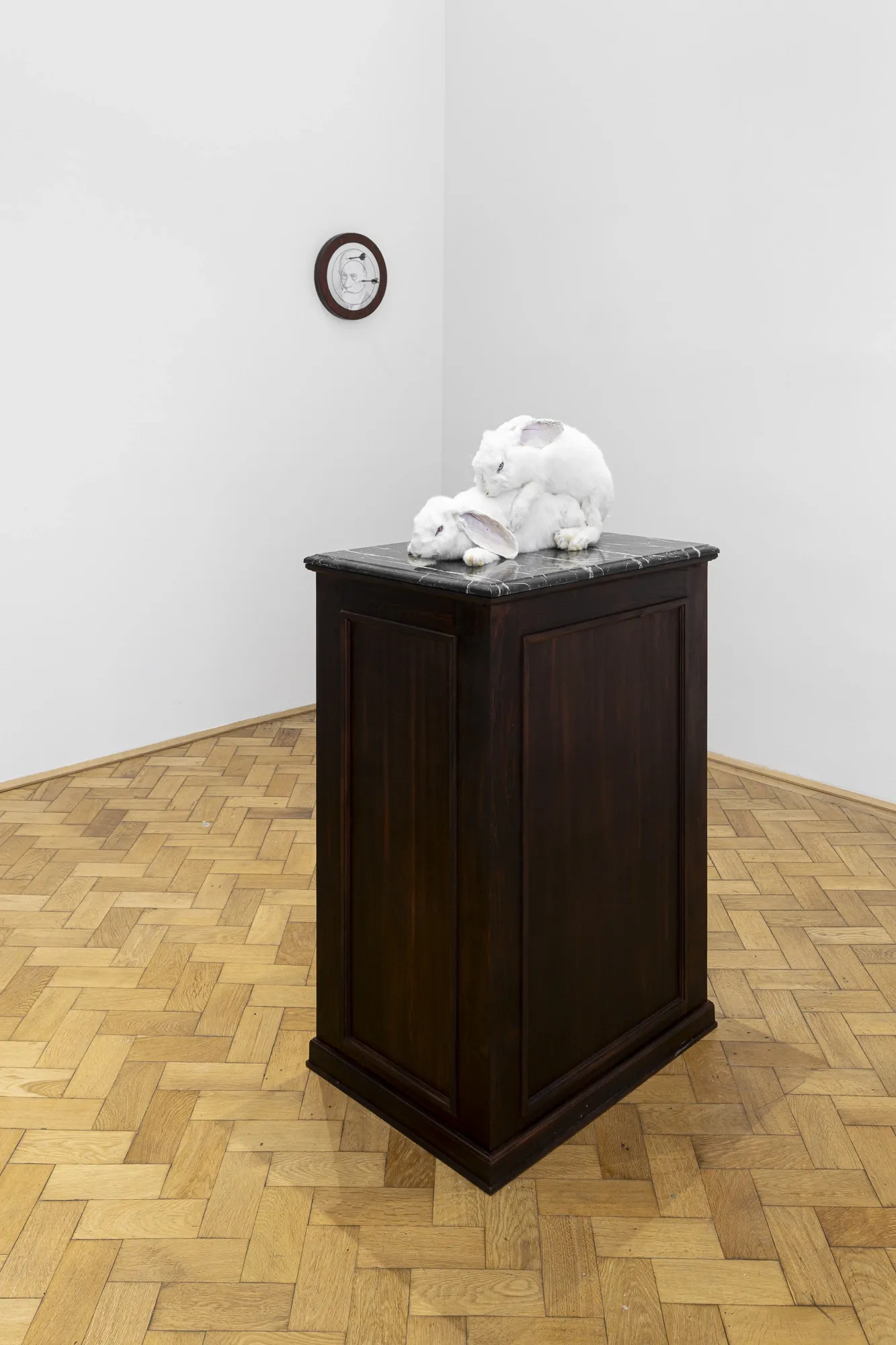
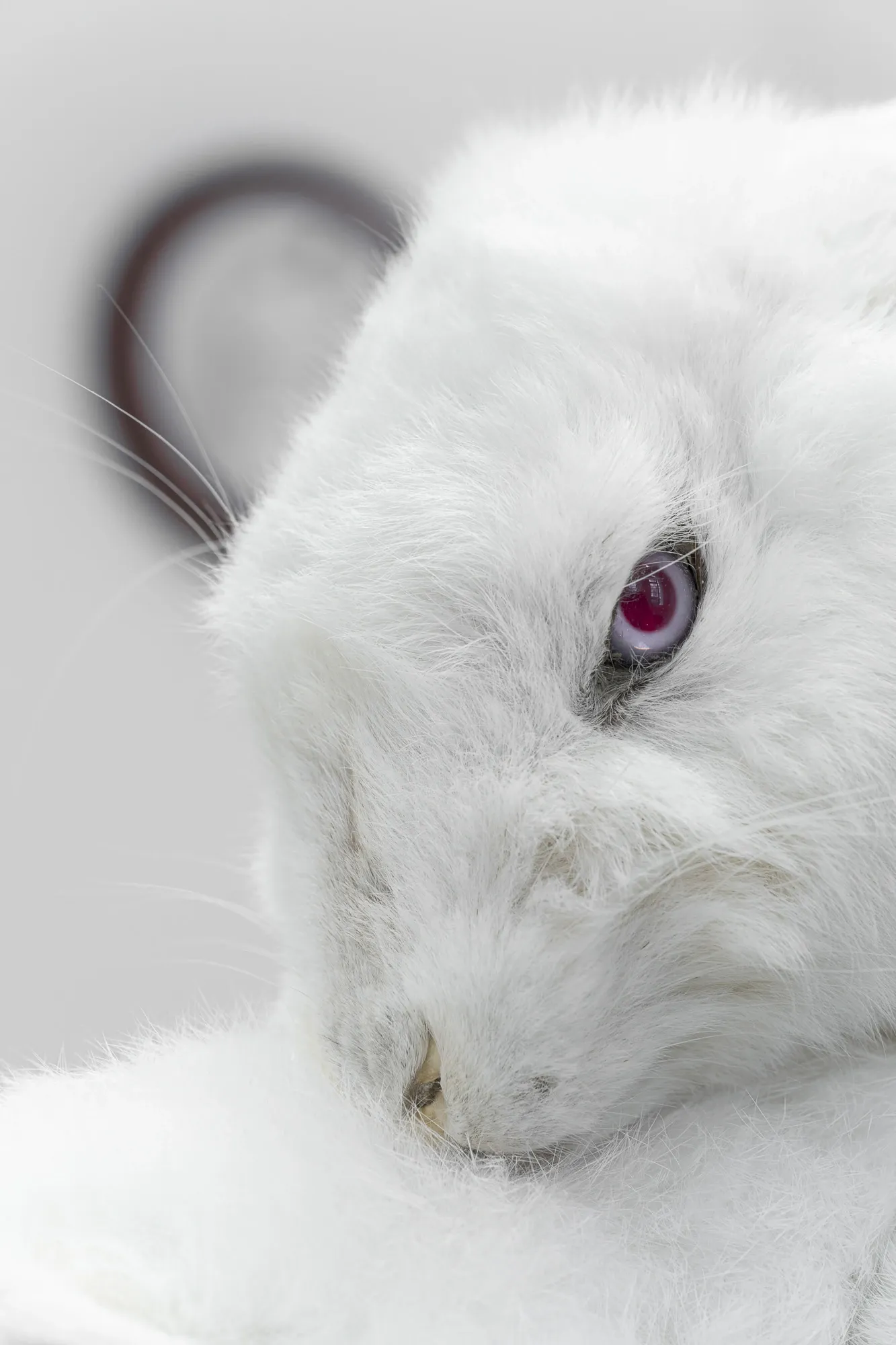
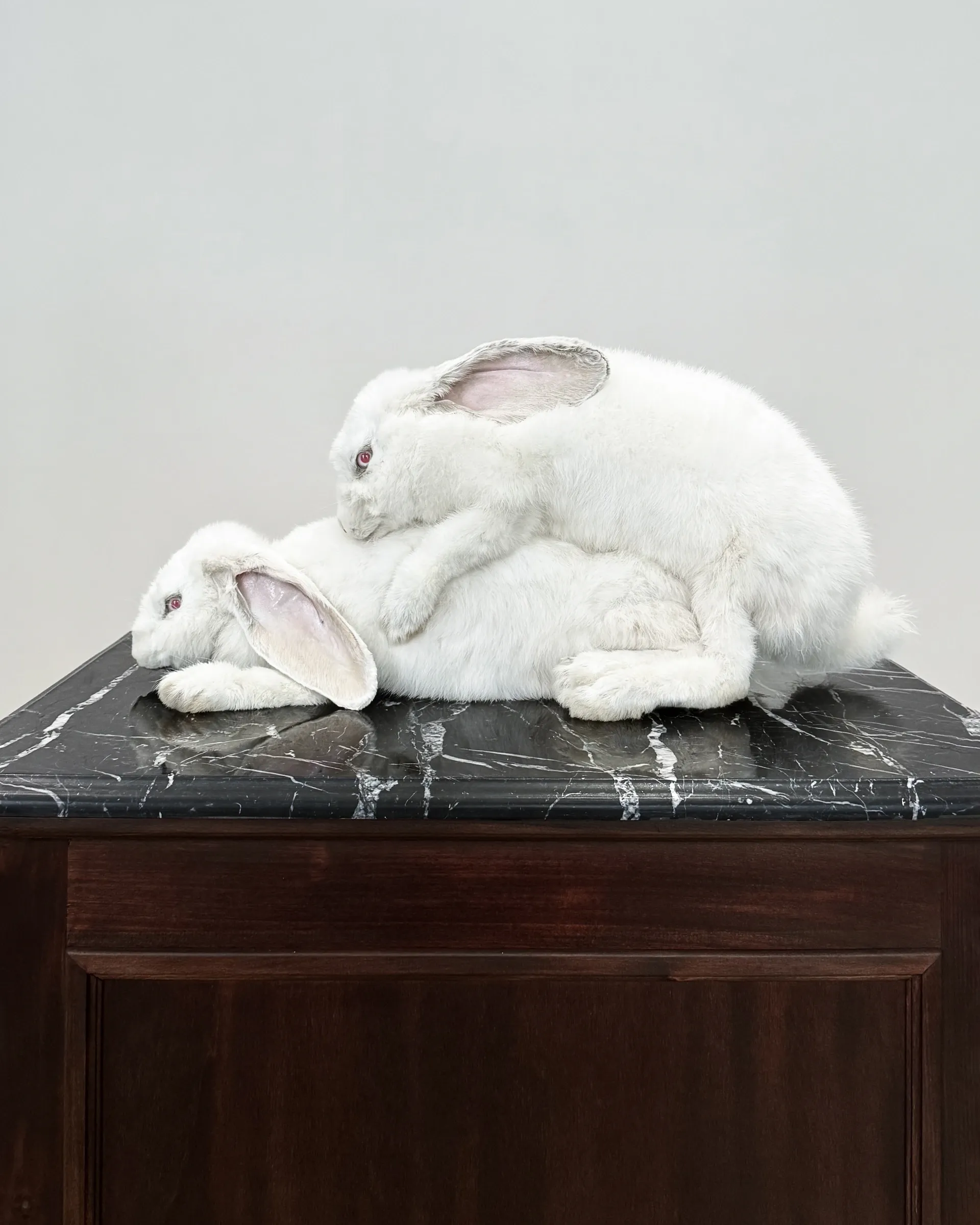
Installation view, ELEGIA, Tudor Ciurescu, VUNU Vienna, Vienna, 2026. Courtesy VUNU Vienna and the artist. Photo by Dominika Goralska
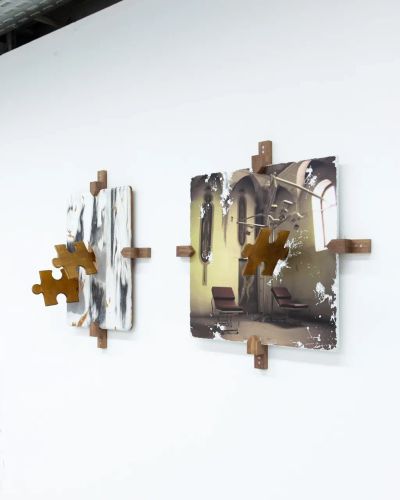
Sfântul Ieronim a Plecat (Saint Jerome Has Left) (2026) offers the exhibition's most precise structural statement. After Albrecht Dürer's 1514 woodcut of the scholar in his study, Ciurescu renders the space without the saint. The vaulted room, the shelves, the accumulated objects of study, all present. The disciplined figure who organized the scene has been removed. What remains is a room whose purpose is no longer legible. Labor without a laborer. Research without a subject.
These works arrive at a moment when authority, institutional, intellectual, sexual, political is visibly struggling to maintain coherence. Ciurescu doesn't argue a position on this. He treats it as a condition: a dark forest, in Aleksei Borisionok's framing, its terrain shaped by algorithms and historical sediment in equal measure. What the map shows isn't resolution. The images remain magnetic after their arguments have weakened, attracting and repelling, holding their shapes in the absence of what once justified them.
The Freud dartboard keeps its darts. The rabbits continue.
𝙏𝙪𝙙𝙤𝙧 𝘾𝙞𝙪𝙧𝙚𝙨𝙘𝙪 on Instagram
VUNU Gallery on Instagram
About Catapult
This is a exhibition review published by Catapult — an independent editorial platform for contemporary art, based in Vienna. We publish exhibition reviews, artist features, interviews, and critical context, with a focus on emerging and mid-career practices from Europe and beyond.
catapult.art
Want to be featured? Submit your work →