The Organism Was Never the Exception
Karim Boumjimar
Bodies Under Construction
Frederiksberg, Denmark
-
Andebakkesti 5, 2000 Frederiksberg, Denmark
Mikkel Kaldal
Courtesy Møstings, The Frederiksberg Museums
Møstings Presents Karim Boumjimar's Bodies Under Construction in Frederiksberg
The boundary between the body and what surrounds it has always been assumed rather than demonstrated. For a long time, and across many disciplines, the human figure has been treated as the exception: the organism that observes, names, and intervenes, rather than the one being shaped and decomposed alongside everything else. Karim Boumjimar's exhibition at Møstings begins from a different assumption and takes it seriously, not as ecological argument but as physical fact.
What the work asks is harder than it first appears: what does a body look like when it has already begun to dissolve at the edges? Boumjimar approaches this not through reduction or austerity but through accumulation, surfaces dense with hybrid figures, every wall and every vessel a site of simultaneous becoming and undoing.
Boumjimar treats the body not as origin point but as transitional state, shaped, worn, and eventually folded back into the processes it was always part of. The works exist as if they were already artifacts of a future we don't yet have language for.
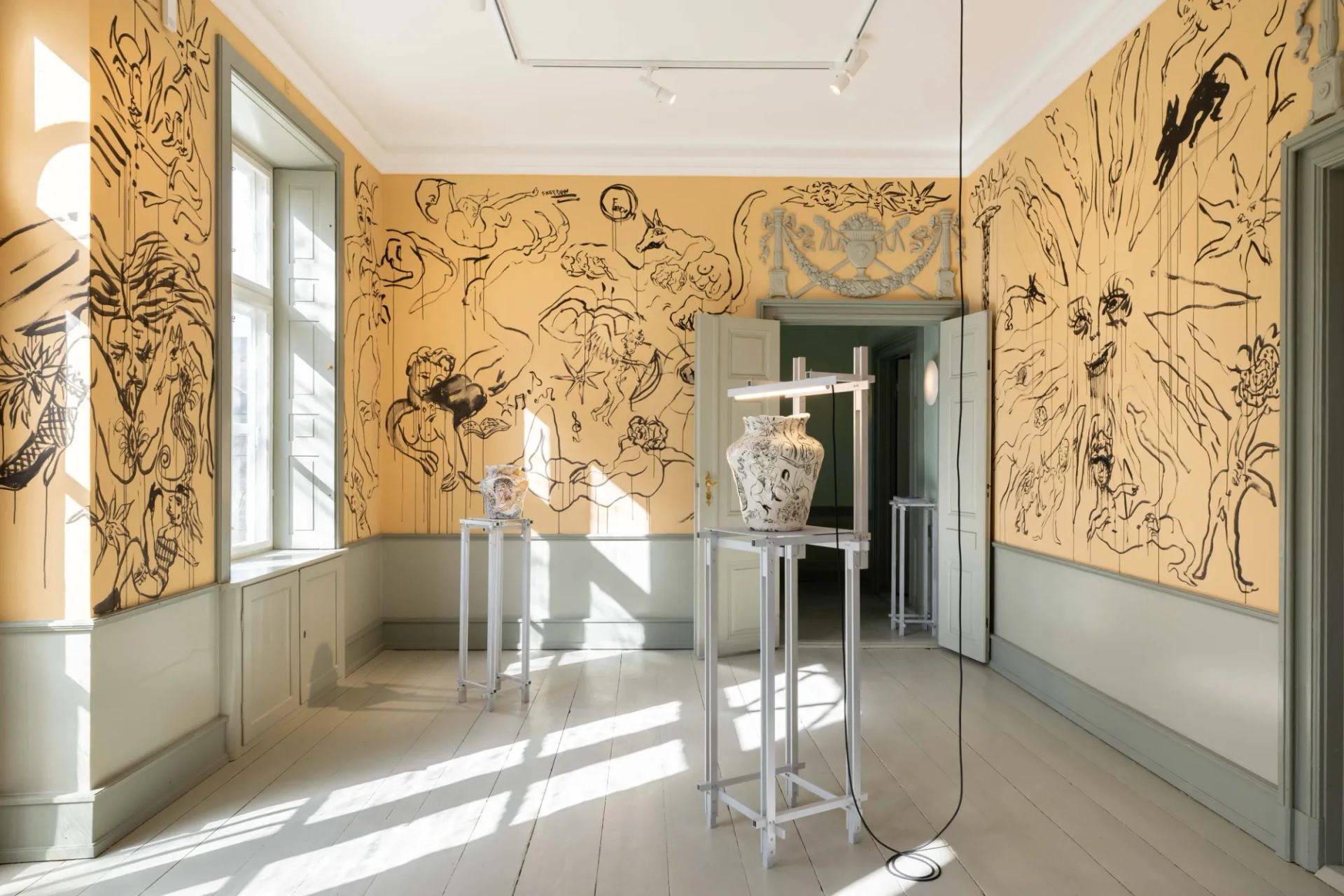
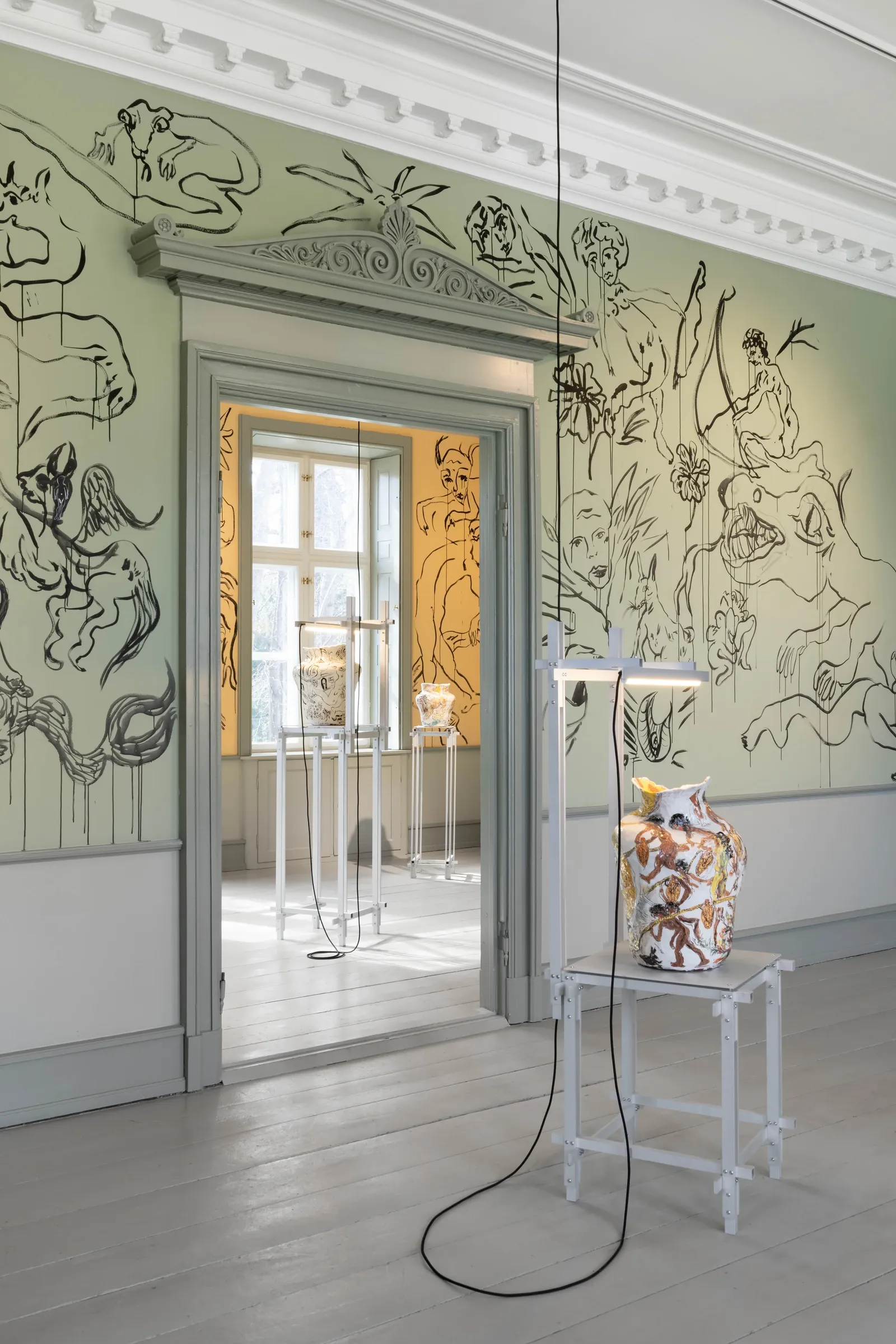
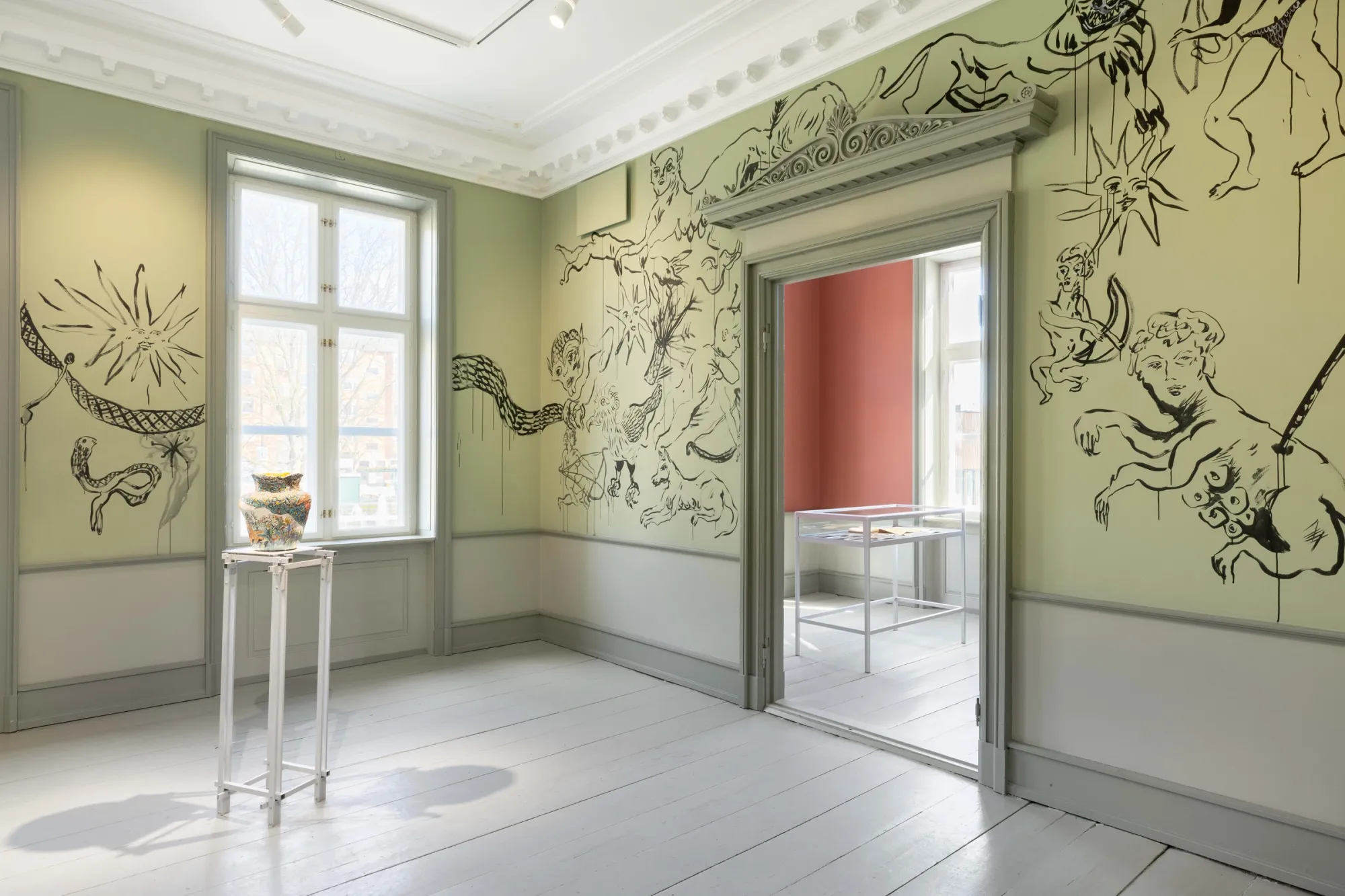
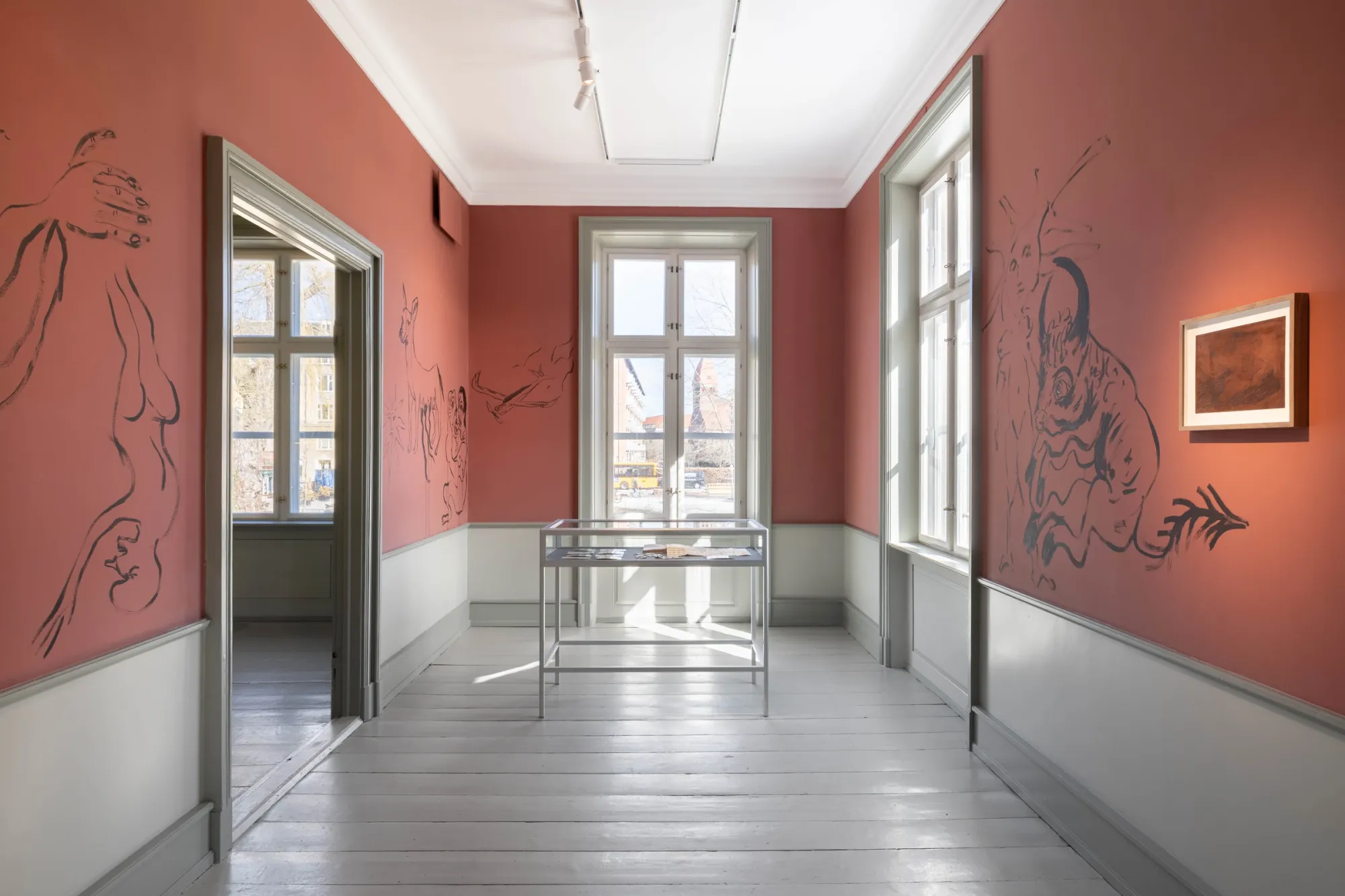
Møstings occupies a historic villa in Frederiksberg, late nineteenth-century rooms with painted ceilings, ornate plasterwork, tall windows overlooking bare winter trees. The architecture isn't neutral. Its domestic formality carries the assumption of the house as sealed space, civilization kept apart from what grows and rots outside. Boumjimar has covered the walls of each room with large-scale drawings painted directly onto colored surfaces: sage green in one room, warm amber in another, a muted dusty rose in a third. The building doesn't disappear, it becomes part of the argument.
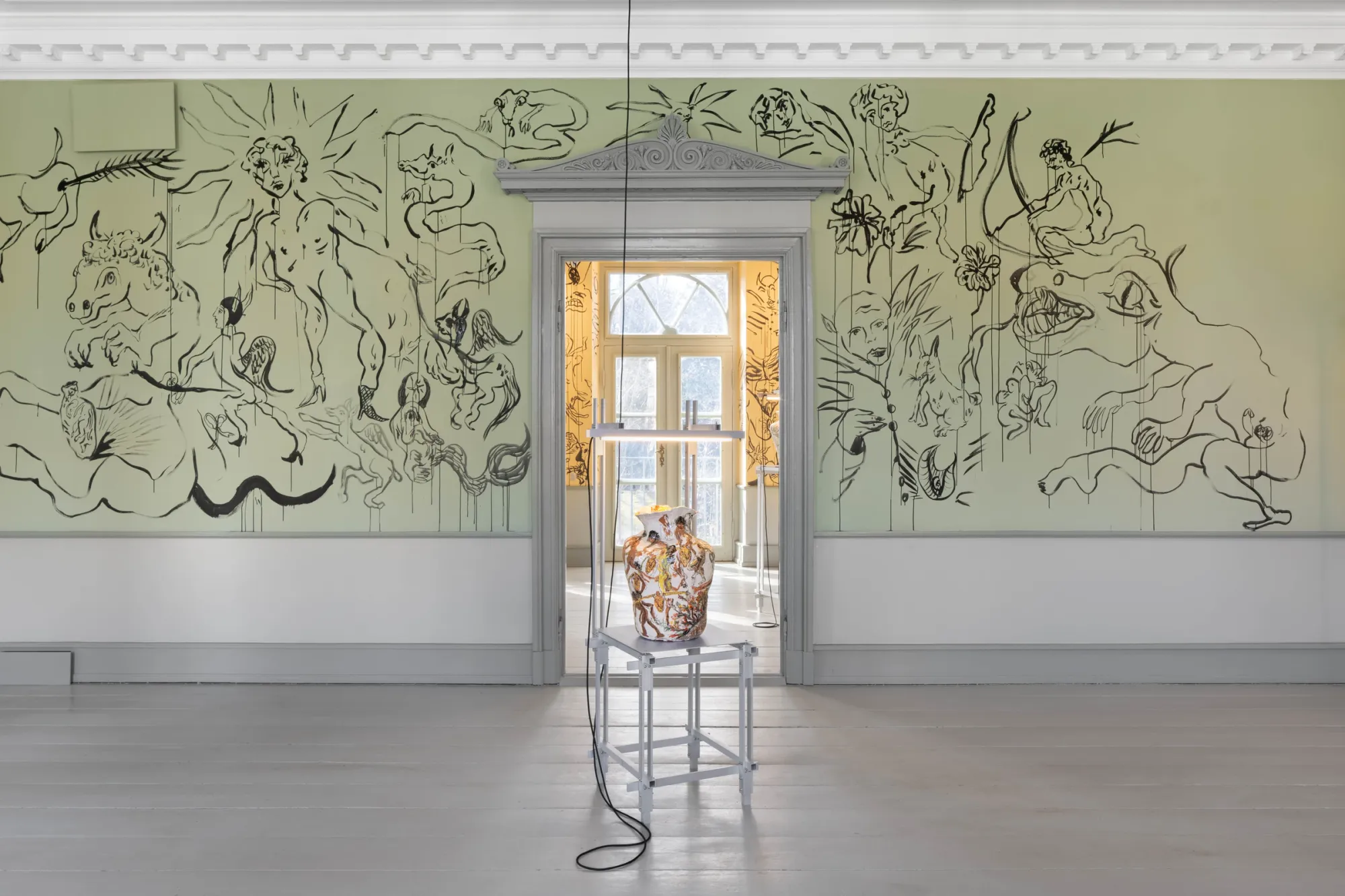
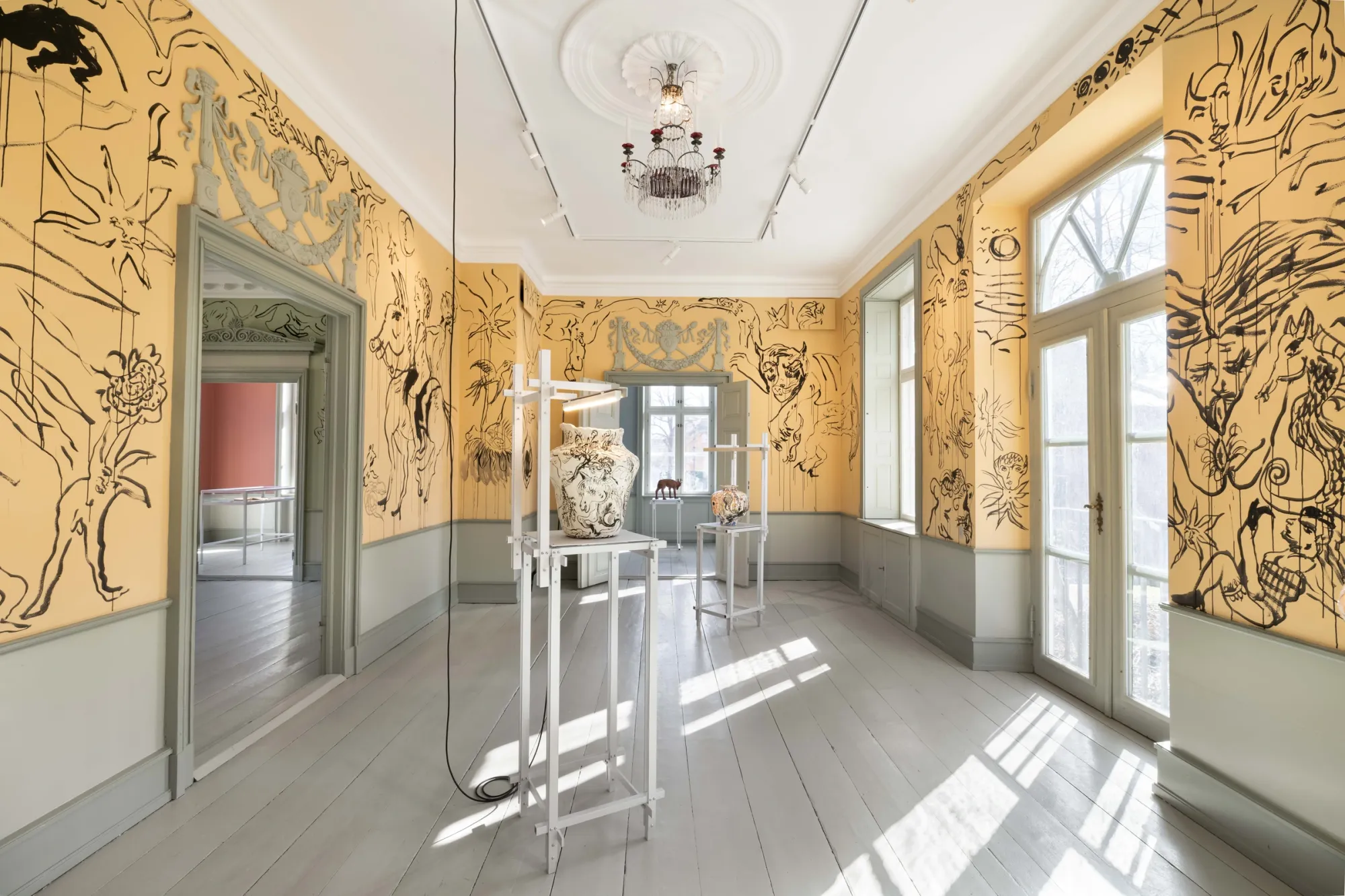
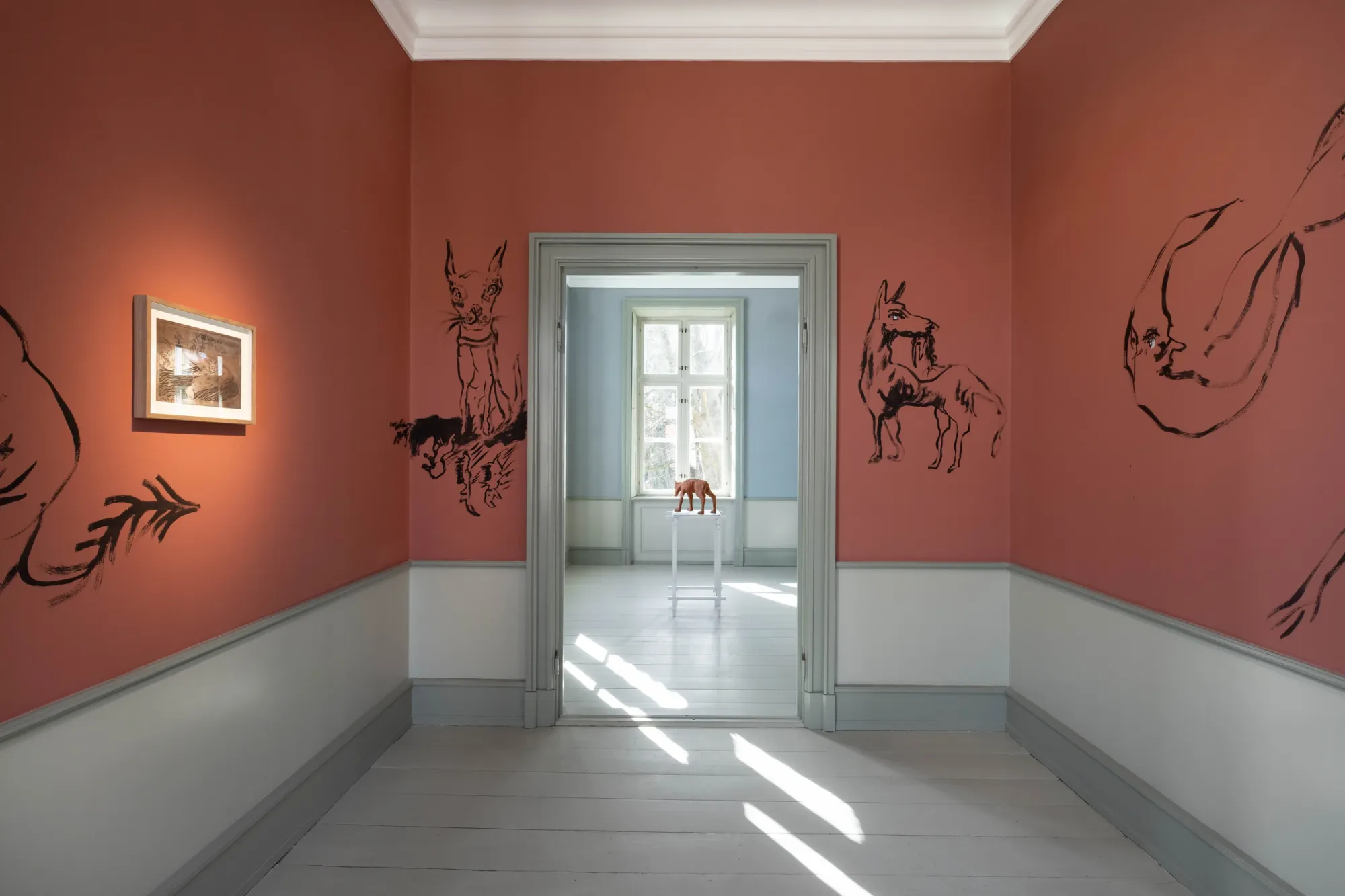
The wall paintings run from floor to wainscoting across every room, fluid black lines tracing hybrid figures that refuse to resolve into a single species. Torsos become fish tails, human heads sit on animal bodies, plants merge with limbs, figures seem to dissolve at one edge and reform at another. The vocabulary draws on ancient forms, votive relief, cave wall, early devotional marks, but the images don't feel archival. They feel imminent, as if the walls are still in the process of dreaming them into existence.
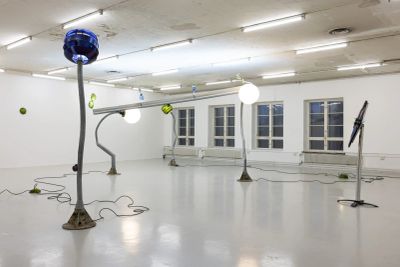
The ceramics occupy these rooms on scaffolding structures of white metal, each fitted with a horizontal fluorescent tube. Works such as Life Still Goes On (2026), Deep Leopard (2025), and Oracle (2025) carry the same drawn figures as the walls, but compressed onto curved surfaces: what stretches across an entire room here wraps around a vessel in dense, rotating form.
The scaffolding removes any pretense of the finished object. Under fluorescent light, the pots look mid-examination, specimens caught between assembly and display, not yet declared complete.
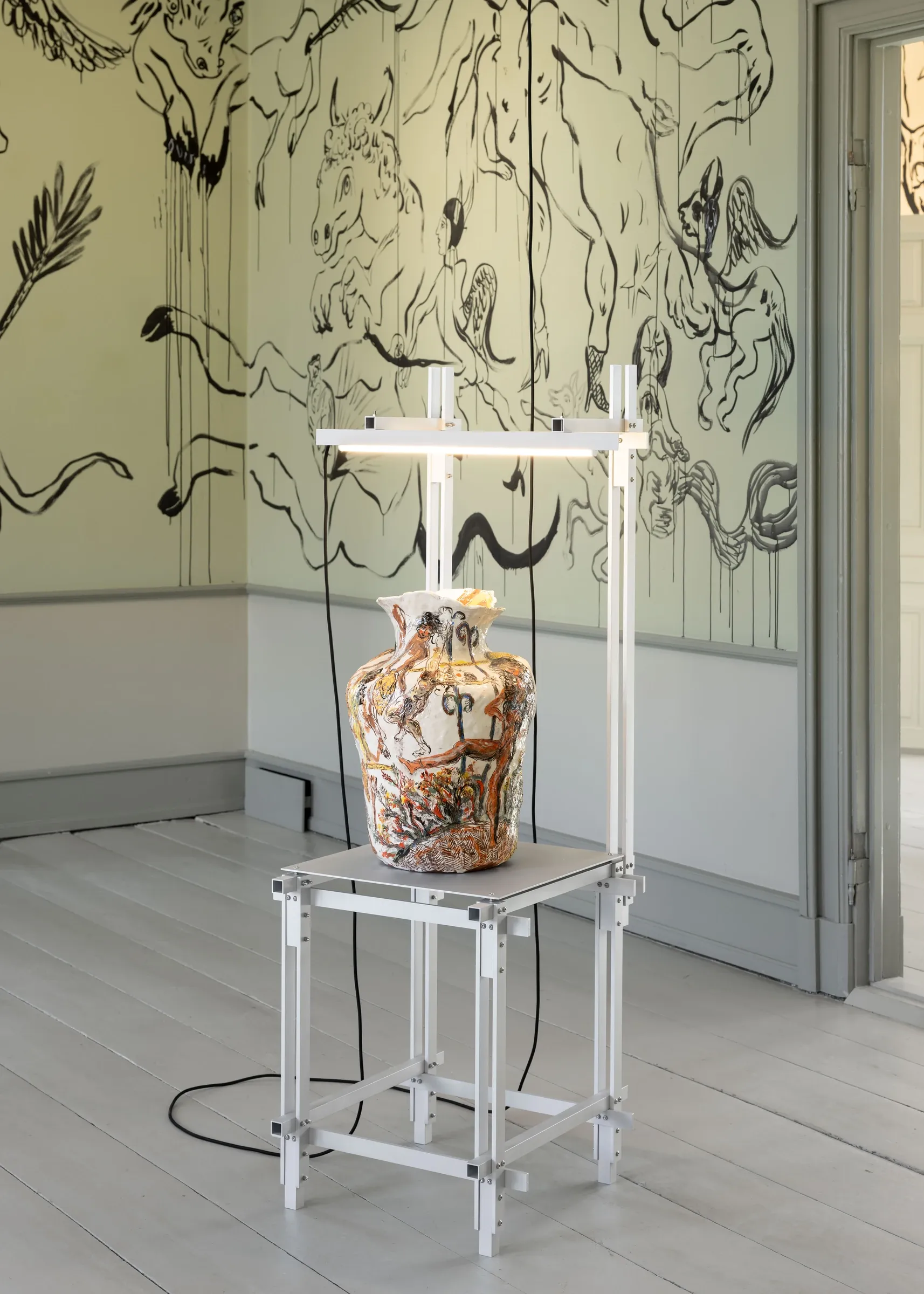
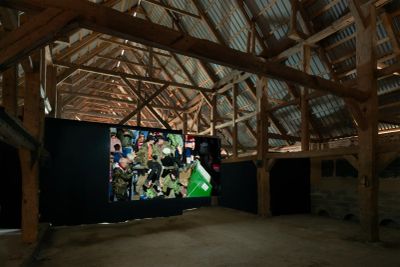
Karim Boumjimar, ceramic vessel from Bodies Under Construction, 2026, exhibited at Møstings, The Frederiksberg Museums, Frederiksberg. Hand-painted ceramic with figurative motifs on white metal scaffolding under fluorescent light. Photo by Mikkel Kaldal. Courtesy Møstings, The Frederiksberg Museums.
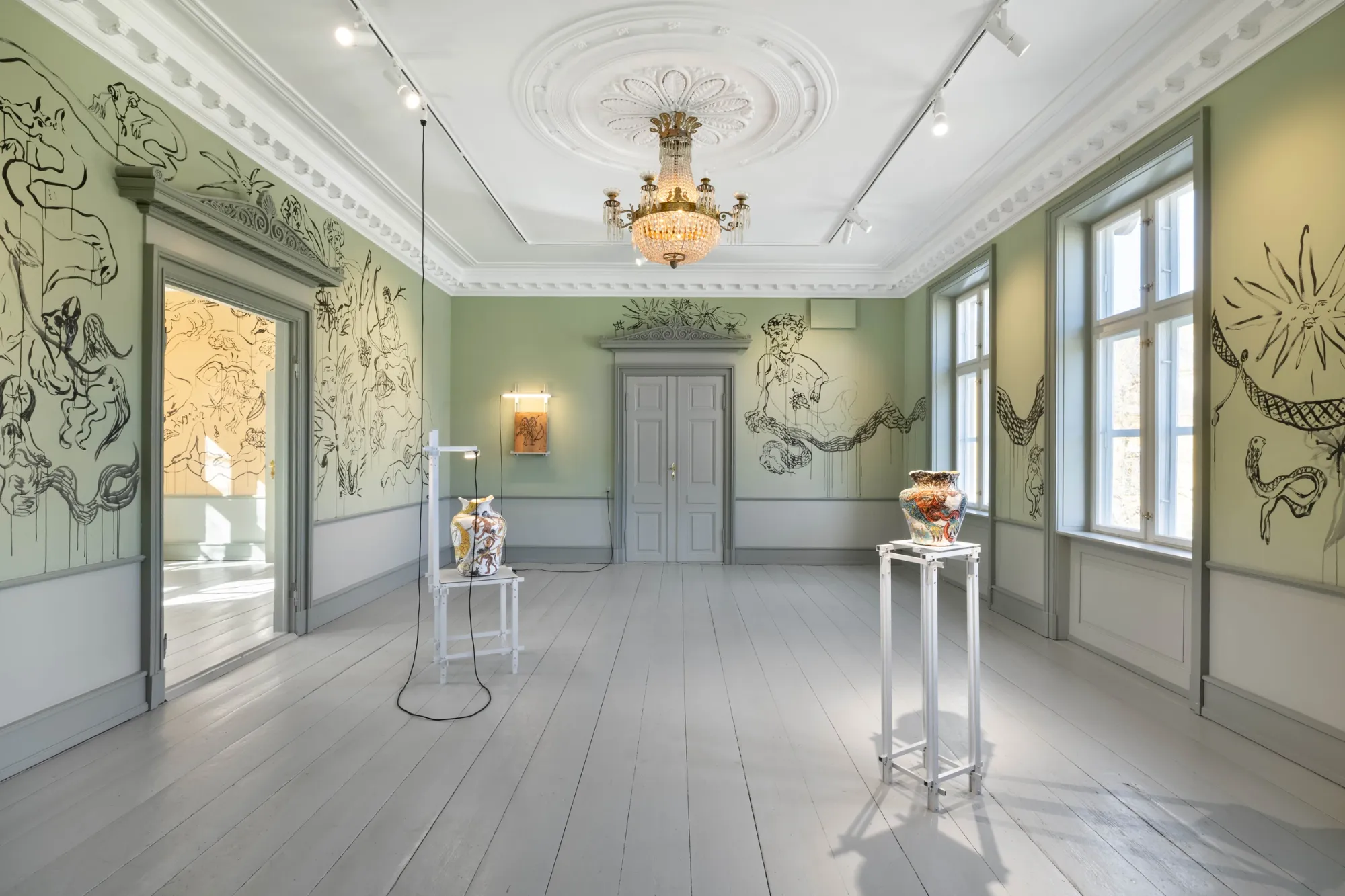
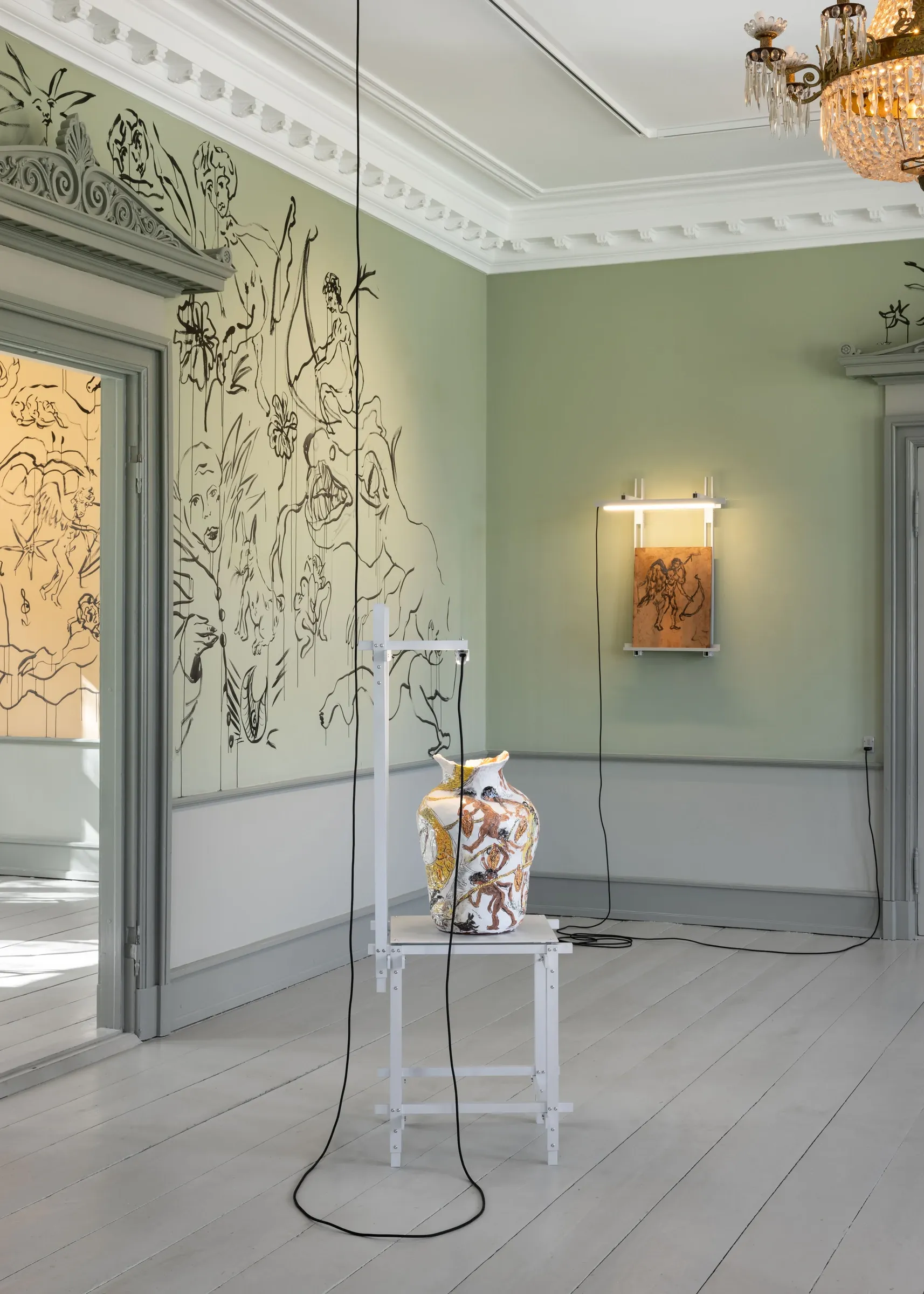
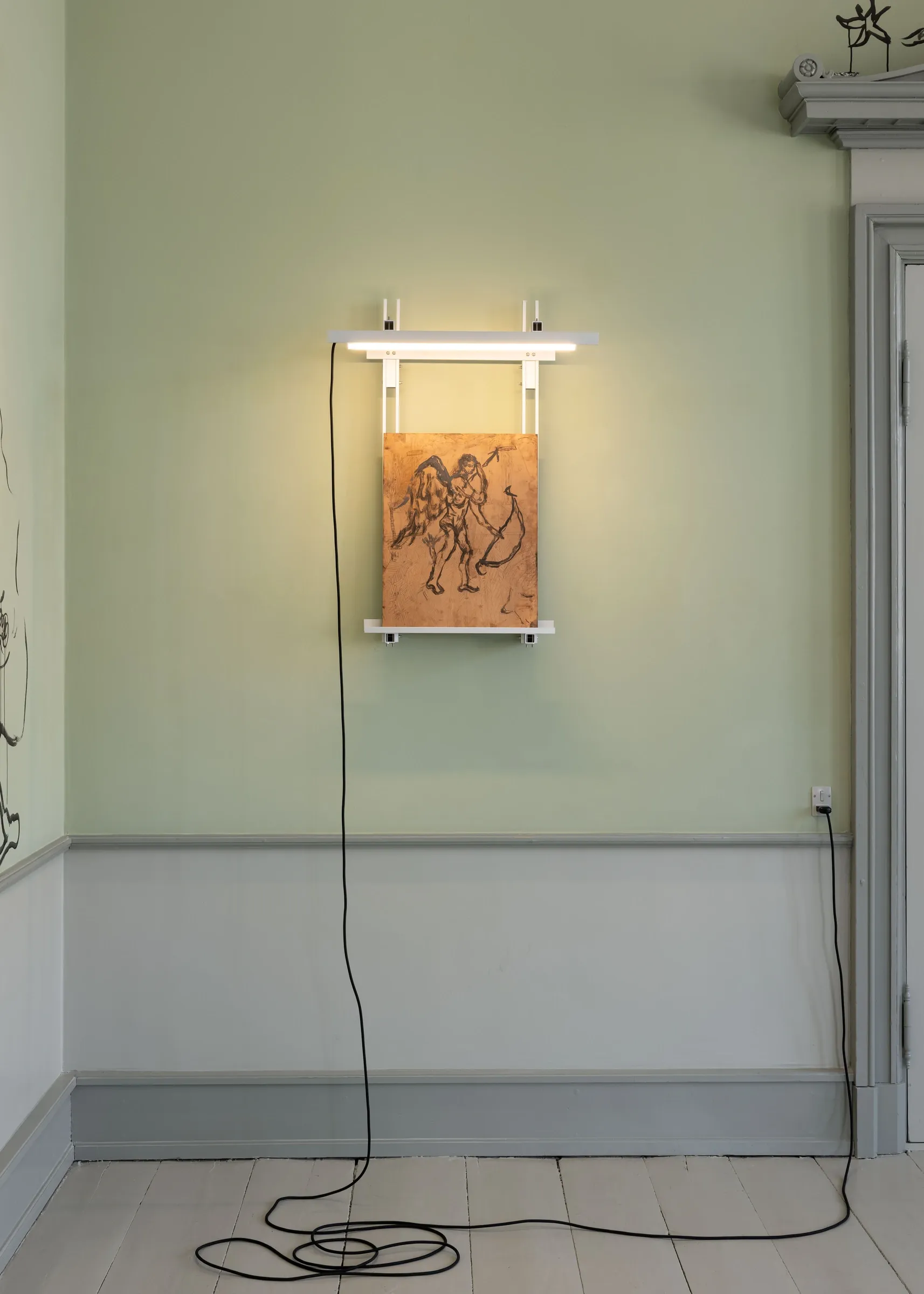
Karim Boumjimar, Bodies Under Construction, 2026, installation view at Møstings, The Frederiksberg Museums, Frederiksberg. Wall drawing and mounted work under fluorescent light within green room installation. Photo by Mikkel Kaldal. Courtesy Møstings, The Frederiksberg Museums.
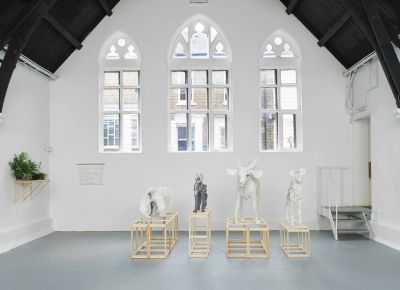
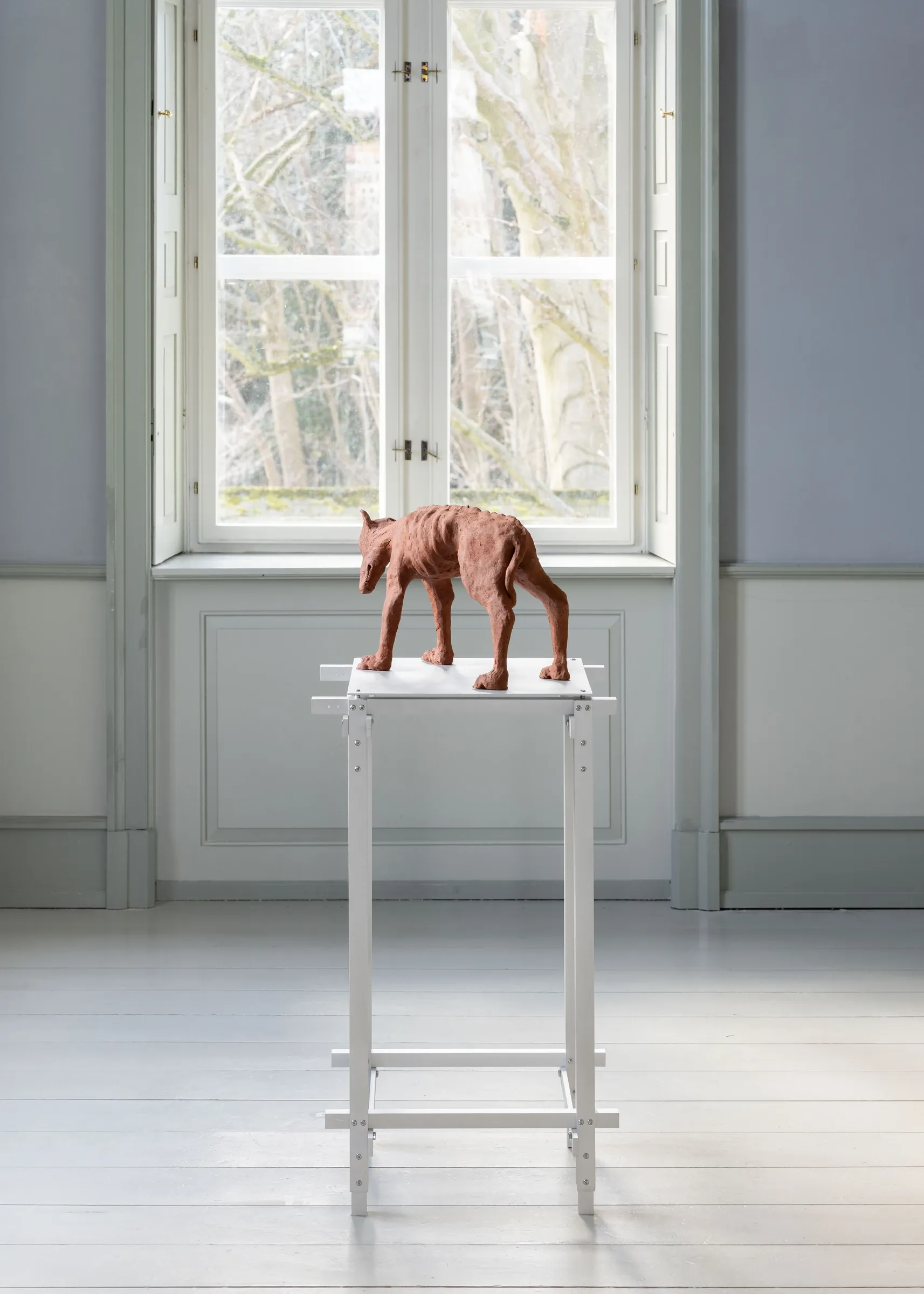
Separate from the main installation, in a pale blue room, a clay quadruped stands alone on a white pedestal before a tall window. Zaatar (2025), rough and unglazed, terra cotta red against the grey light, seems to belong to a different timeline than the decorated vessels nearby, rawer, less resolved, more anatomically present. Its title names a Mediterranean herb mixture: botanical, edible, culturally loaded. A body that carries another ecology entirely.
In the coral-toned room, a display case holds Silverware #1–13 (2026), silver casts of bodily fluids, arranged alongside paper and photographs. The material choice is precise: what the body produces in its least controlled, most private moments, here preserved in the most formally precious substance available. The display case frames them as museum objects, as heritage, as things worth keeping. The logic of the whole exhibition compresses into one case, the body's outputs as artifact, as evidence, as something that will outlast the body that made them.
The timing of this work matters without being obvious. Conversations about ecological grief, posthuman bodies, and what it means to be a species among species have moved from academic to mainstream over the last decade. But art that actually changes how a body feels when it stands in a room, that makes the porous boundary between self and environment felt rather than argued, remains rare.
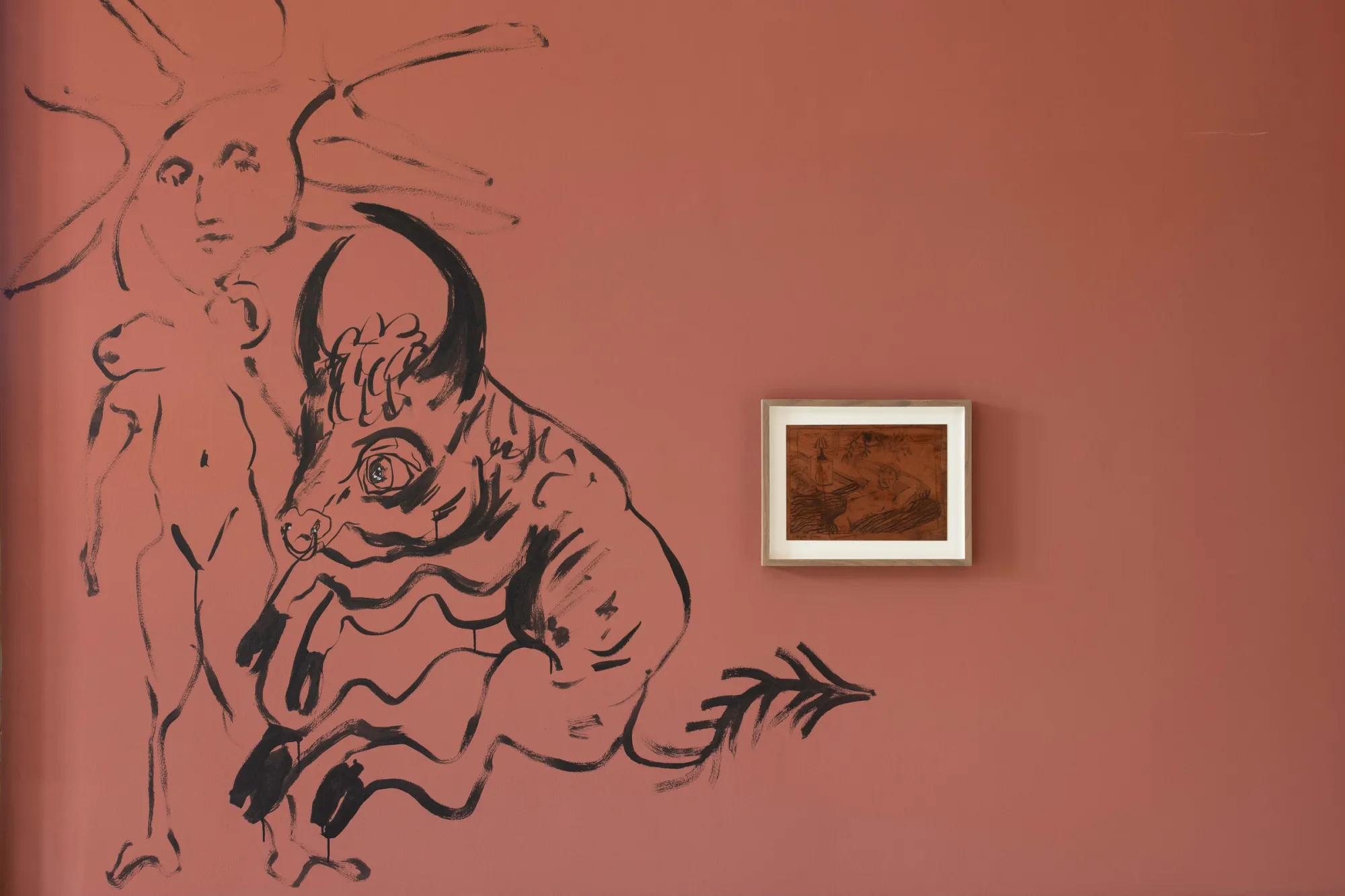
Boumjimar is twenty-seven years old and working across painting, ceramics, sculpture, performance, and drawing simultaneously, as if no single medium could contain the claim. What Møstings holds, distributed across its color-saturated rooms, is closer to a total position than a themed exhibition: this is what a body looks like when you stop treating it as the viewer and start treating it as the viewed.
The clay animal stands at the window, looking out, no longer clearly the one observing, but another body among others, held in the same system it once seemed to face.
Instagram Karim Boumjimar
Instagram Møstings Frederiksberg
About Catapult
This is an artist interview published by Catapult — an independent editorial platform for contemporary art, based in Vienna. We publish exhibition reviews, artist features, interviews, and critical context, with a focus on emerging and mid-career practices from Europe and beyond.
catapult.art
Want to be featured? Submit your work →