Every Fresh Start Carries the Last One Inside It - Review Josefine Schulz

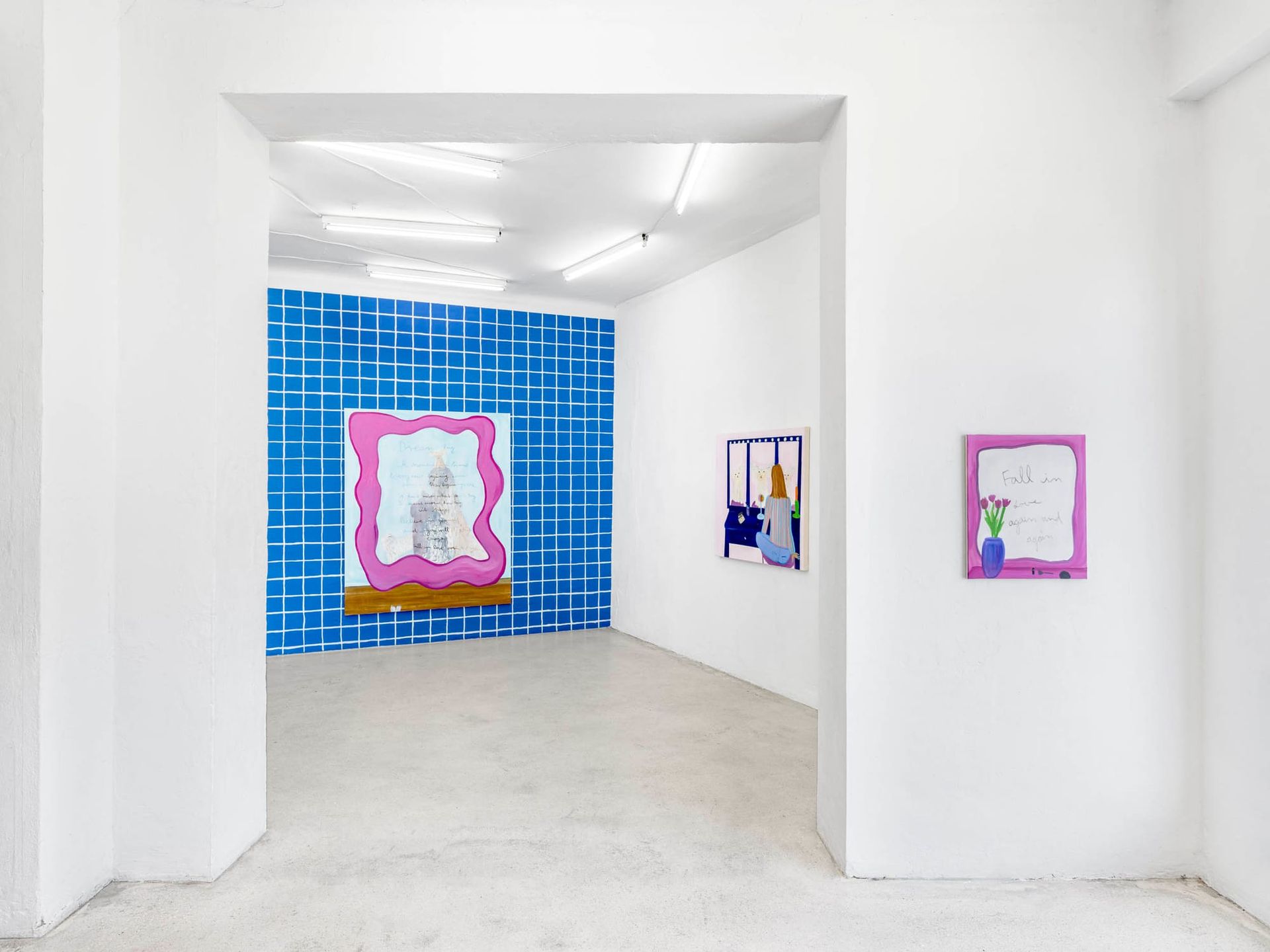
Kunstraum Ortloff Presents Josefine Schulz -Makeover in Leipzig
Kunstraum Ortloff presents Makeover (fall in love again and again), a solo exhibition by Josefine Schulz with a text by Carolin Kralapp, through May 9, 2026.
The makeover is one of contemporary culture's most persistent formats, not because transformation is actually possible, but because the demand keeps returning. The logic is clean, a before, an after, and a legible distance between them. What Josefine Schulz seems interested in is where that logic starts to hold differently.
Josefine Schulz
Makeover (fall in love again and again)
Kunstraum Ortloff
Leipzig, Germany
–
Saturdays 2-6 PM & by appointment
Jahnallee 73, 04177 Leipzig
dotgain.info
Courtesy Kunstraum Ortloff
galerie@ortloff.org
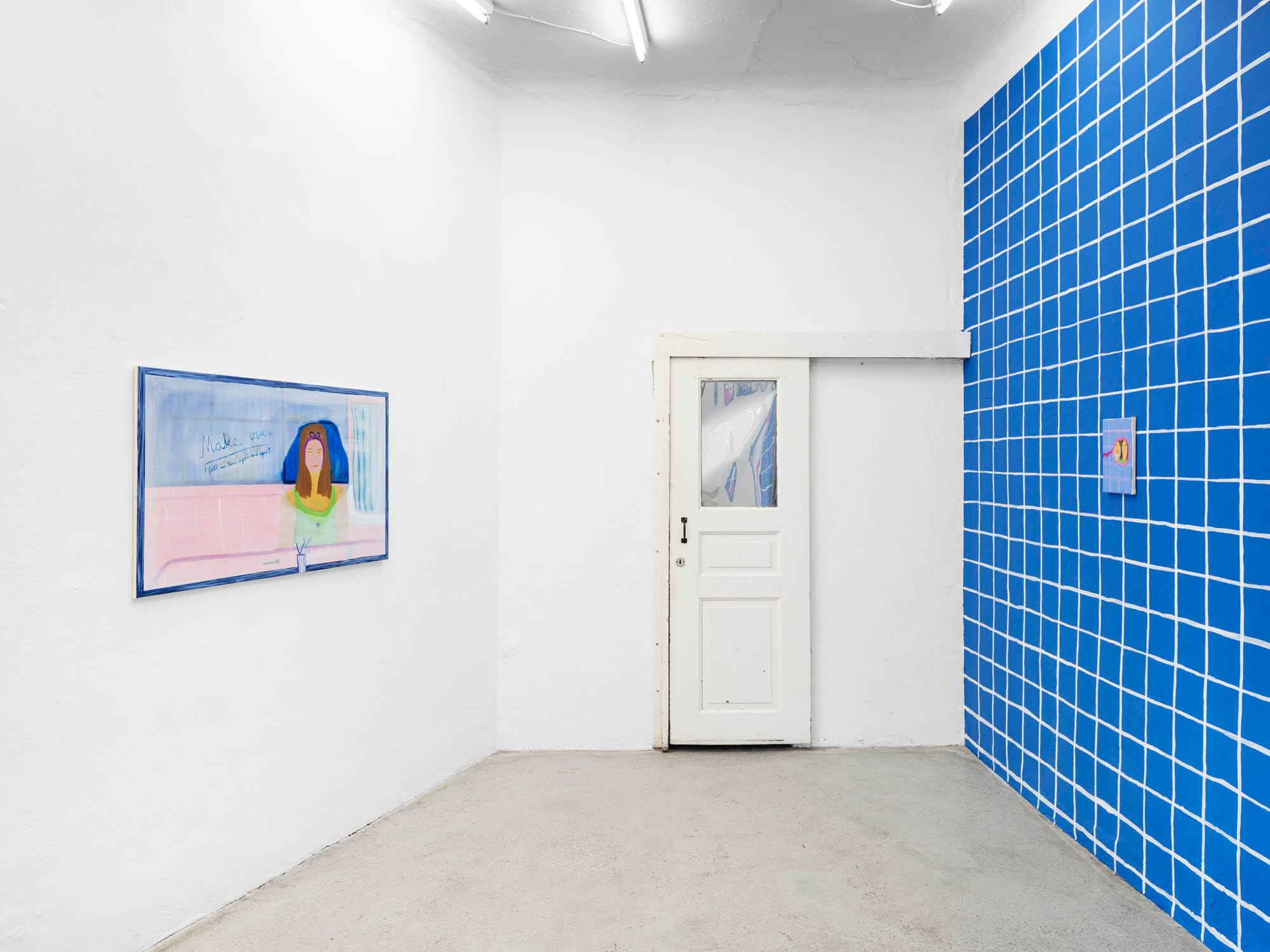
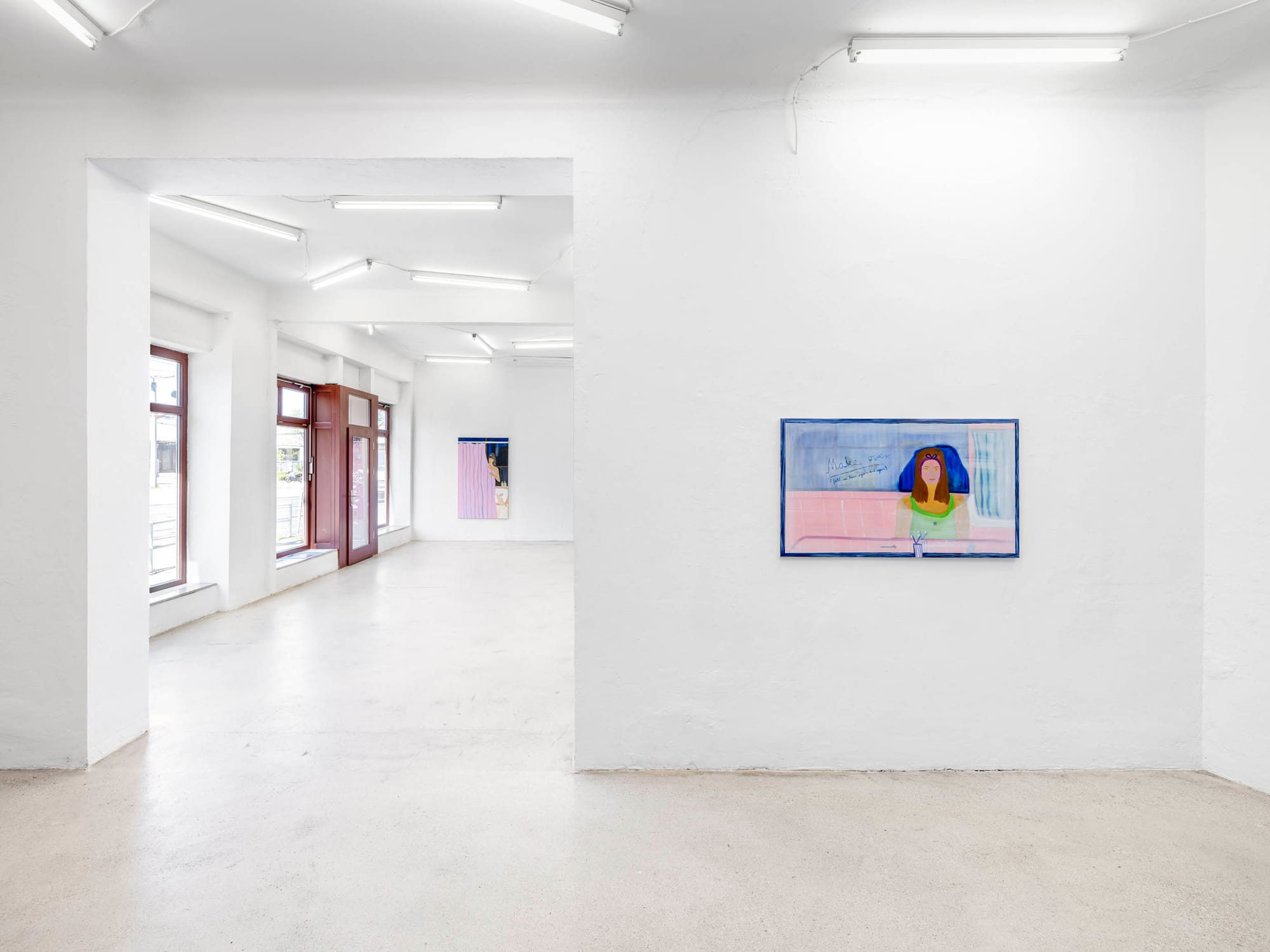
Mirrors appear throughout the exhibition, but they don't quite do what mirrors are supposed to do. Figures look into them and find other faces. Reflections double without resolving. The surface keeps returning something that isn't quite the image the protagonist was looking for, and the paintings hold that discrepancy without explaining it.
The makeover promises a clean break. Schulz's paintings suggest the break never fully comes — and that this might not be the failure it sounds like.
Kunstraum Ortloff is a former residential space in Leipzig-Lindenau, high ceilings, large double-framed windows, connecting rooms that give the exhibition room to breathe and accumulate.
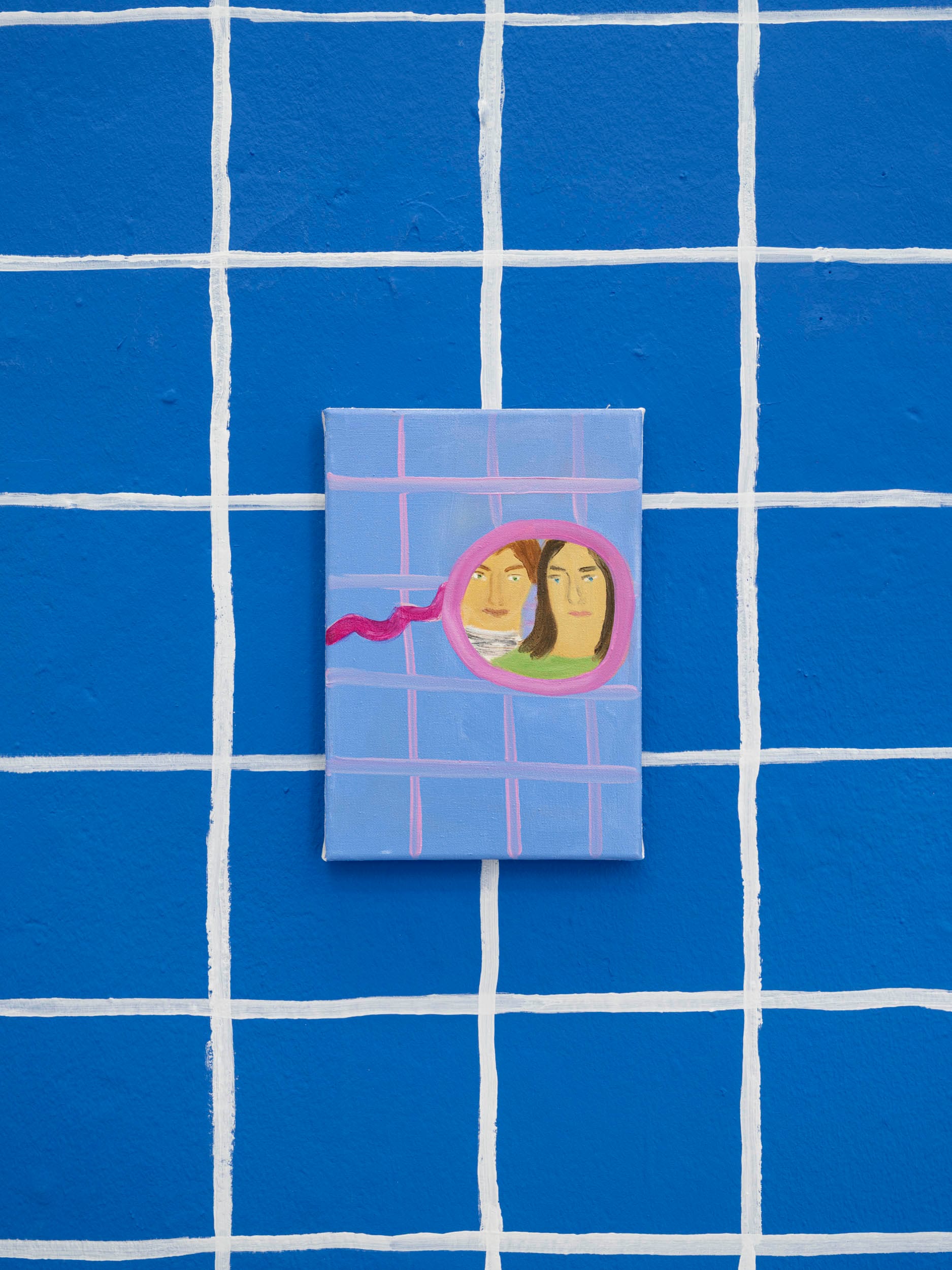
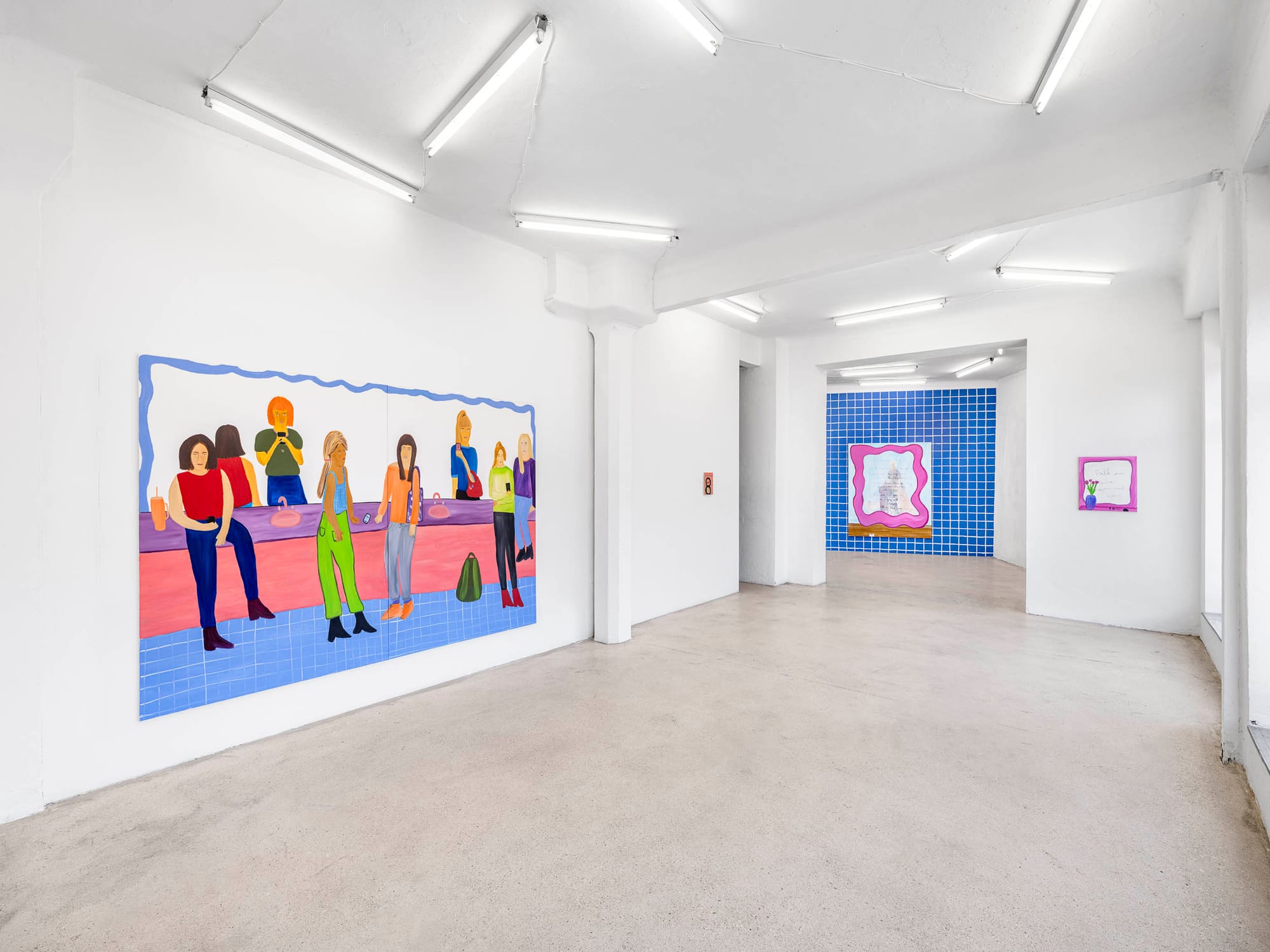
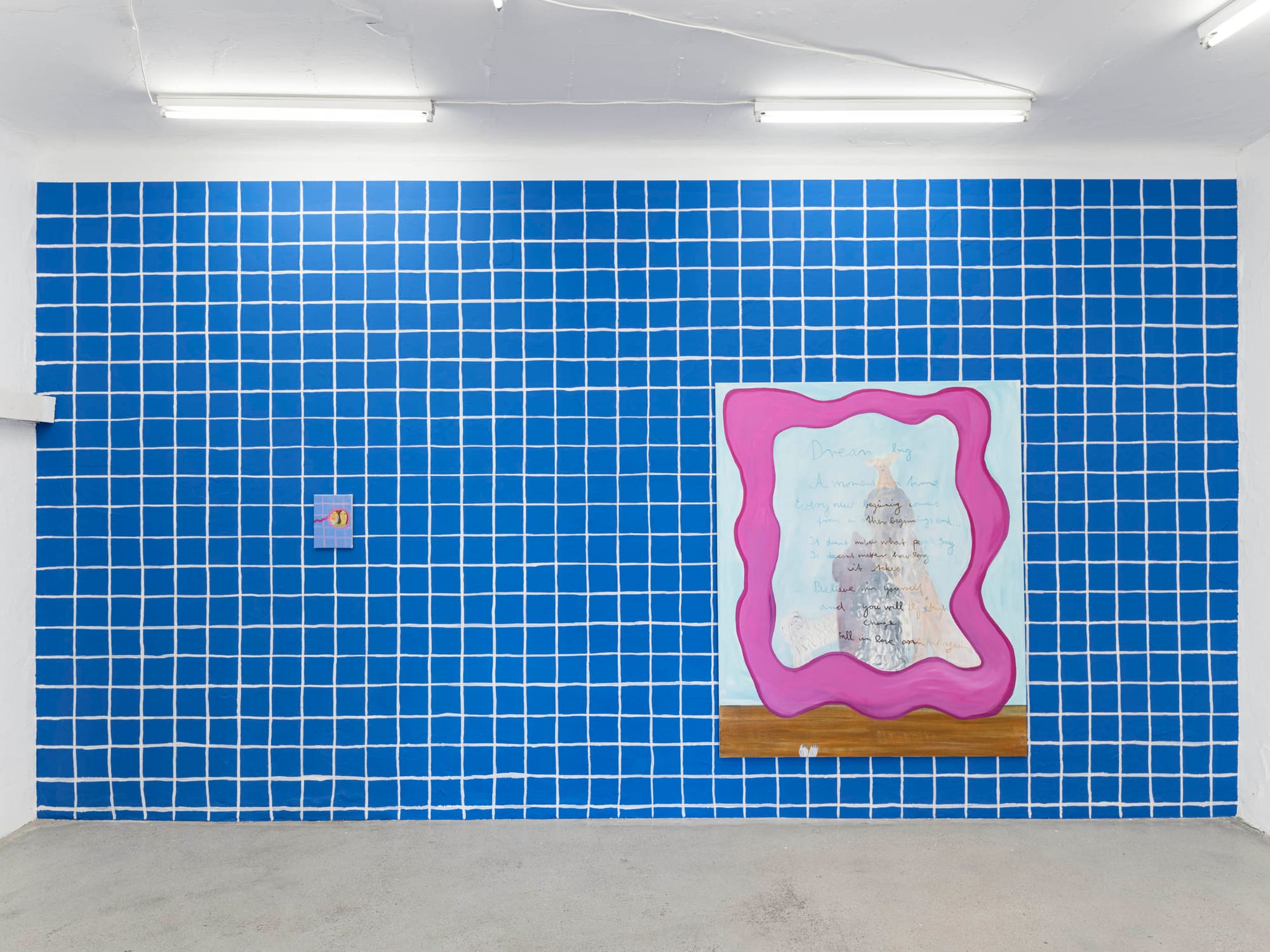
For Makeover, Josefine Schulz has extended the work directly onto the architecture, one wall painted entirely in a flat grid of blue squares, turning the gallery into something between a domestic bathroom and a film set, the tiled surface setting conditions for the works installed against and within it, a ground that mirrors the content without underlining it.
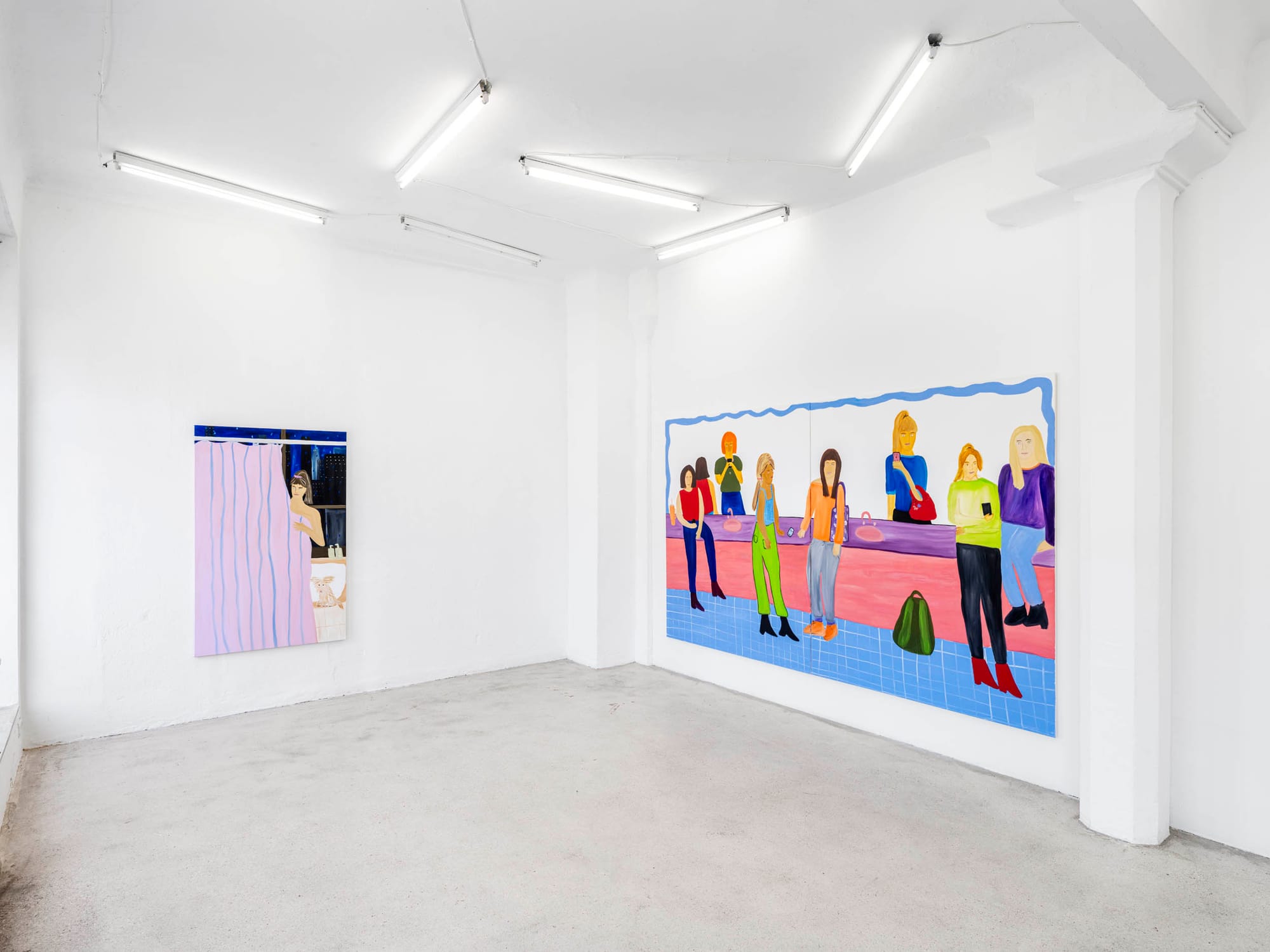
The largest painting in the exhibition depicts a group of women along a public restroom counter. Flat, unmodeled figures in vivid color, neon green overalls, a red top, a purple jacket, an orange turtleneck, stand at a tiled sink, phones held loosely, a wavy blue frame enclosing the scene as if mimicking the restroom mirror itself.
At the top of the canvas, the reflections of their backs appear, while the viewer occupies the position facing them, creating a scene of collective intimacy, the one semi-private space where strangers perform self-adjustment side by side, and where the mirror functions as shared infrastructure.
On the tiled gallery wall, a small canvas shows a pink compact mirror opening to reveal two faces, not a face and its reflection, but two faces together, side by side, as if the object had declined its designated function. The scale is precise. Against the expanse of blue tile, the painting holds its ground through concentration rather than size.
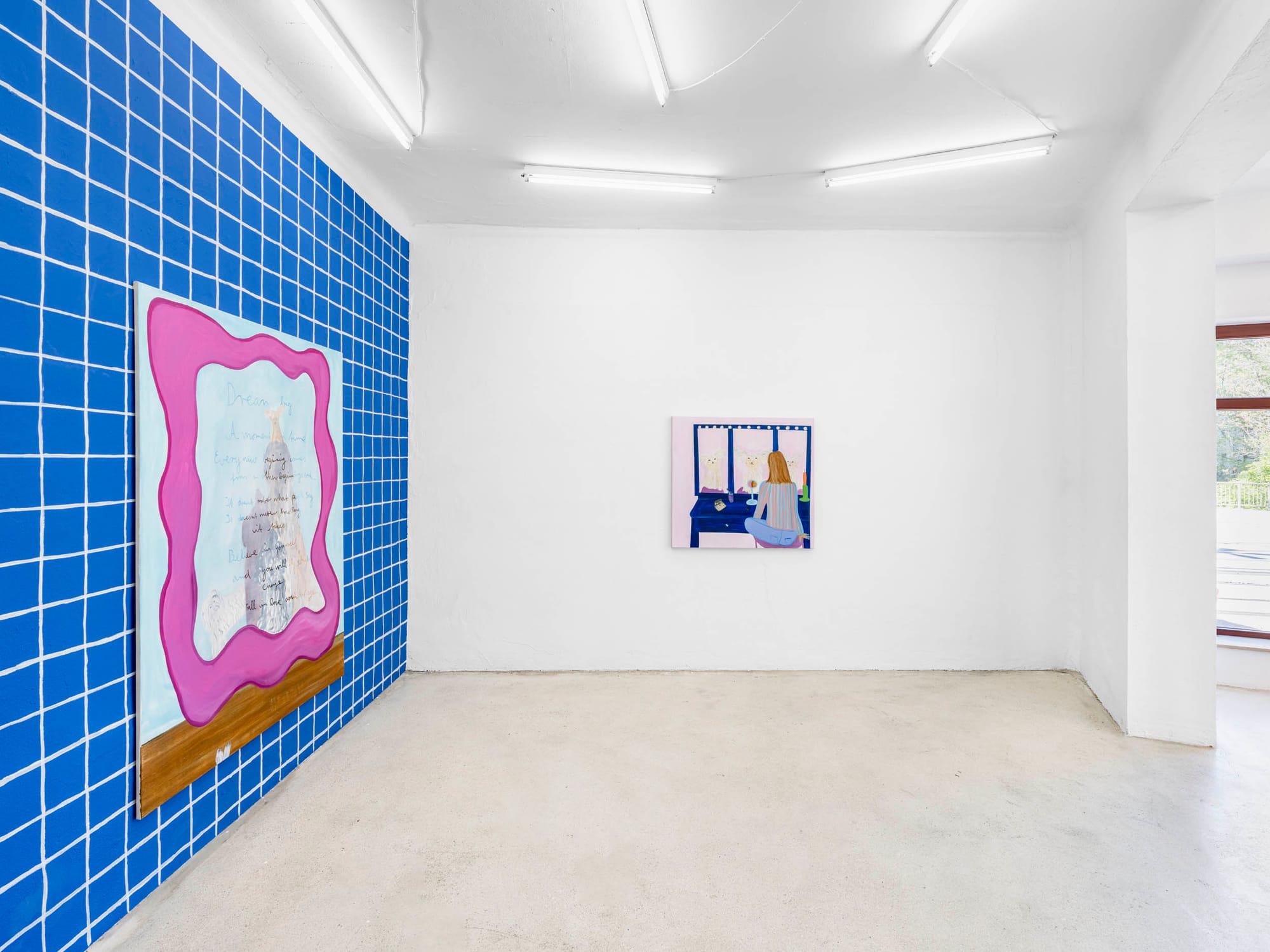
A third work dominates the adjacent room, a large canvas set within a wavy pink-magenta frame that reads simultaneously as vanity mirror and decorative cartouche. Inside it, handwriting and a faint architectural image, a tower, a castle, coexist with text that has been painted over, partially erased, and overwritten again.
Earlier states of the picture don't disappear, they remain legible beneath the surface, the way a previous self stays readable through a current one. This is the formal argument the exhibition keeps returning to, revision as method, overpainting as a kind of honesty.
The early 2000s films that run through the exhibition's references, Clueless screens at the finissage, have returned with some force in recent years, less as nostalgia than as codes a younger generation is now processing as history rather than autobiography.
The glow-up, the before-and-after, the makeover video, these formats migrated from cinema to social media without losing their structural logic, and they keep mutating. Schulz doesn't critique that logic so much as inhabit it from within, tracing where it holds and where it quietly doesn't.
A flip phone appears in one painting, an iPhone, a Stanley Cup, in others, the present and the recent past occupying the same pictorial time without resolving into each other.
What revision leaves behind isn't failure, it's the record of every version that came before, still there in the surface, not quite gone.
Josefine Schulz on Instagram
Kunstraum Ortloff Instagram
About Catapult
This is a exhibition review published by Catapult — an independent editorial platform for contemporary art, based in Vienna. We publish exhibition reviews, artist features, interviews, and critical context, with a focus on emerging and mid-career practices from Europe and beyond.
catapult.art
Want to be featured? Submit your work →
Anne-Joelle Tan: Humiliation as Image Logic
Clauda Presents Paula Gogola: soft_sighs synthesis
Tom Król on The Visible Trace of the Invisible Map
Read More