What the Body Inherits Before Language Can Name It

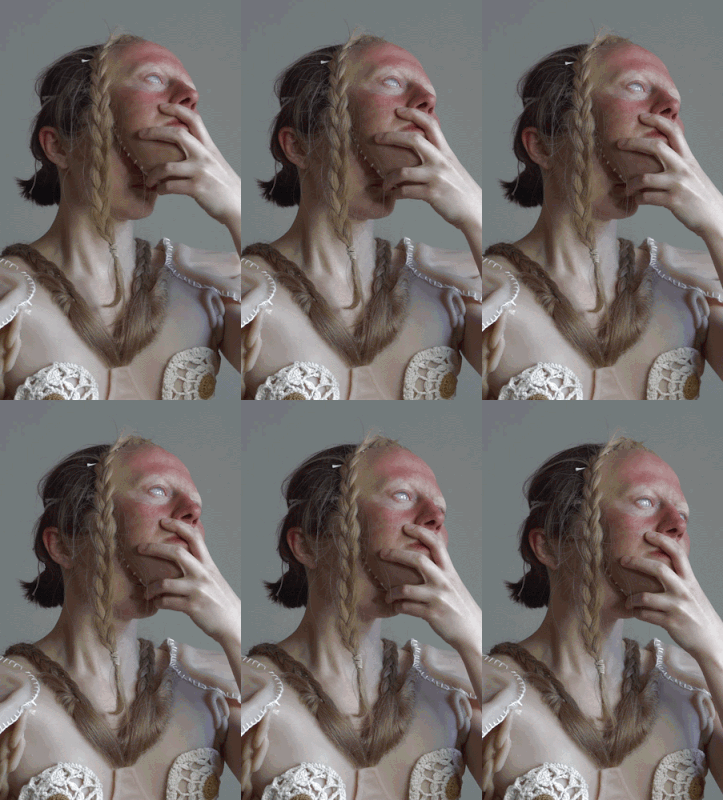
Agata Jarosławiec
We Speak in Echoes
Fundacja Galerii Piana
Kraków, Poland
-
Długa 15, Kraków
Courtesy Fundacja Galerii Piana
fundacjagaleriipiana@gmail.com
Galeria Piana Presents Agata Jarosławiec: We Speak in Echoes in Kraków
There are kinds of knowledge that don't move through words. They move through hands, the specific pressure of a needle through fabric, the rhythm of fingers working a crochet hook, a stitch repeated until the body knows it without instruction. This is not nostalgia, it is the precise way a practice survives when the conditions for its survival are hostile.
Inheritance, in this reading, is not a transfer but a residue, something that persists not because it was chosen, but because it was inscribed. The question Agata Jarosławiec asks is what happens when that residue takes the form of silicone, a material that imitates skin without carrying its history, that can be pressed, cast, and formed into echoes of a body it has never inhabited.
An echo does not return what was said, it returns a difference. Jarosławiec locates that difference in the body itself, in gestures that pass between generations without being named, and in the silicone that holds the impression without holding the memory.
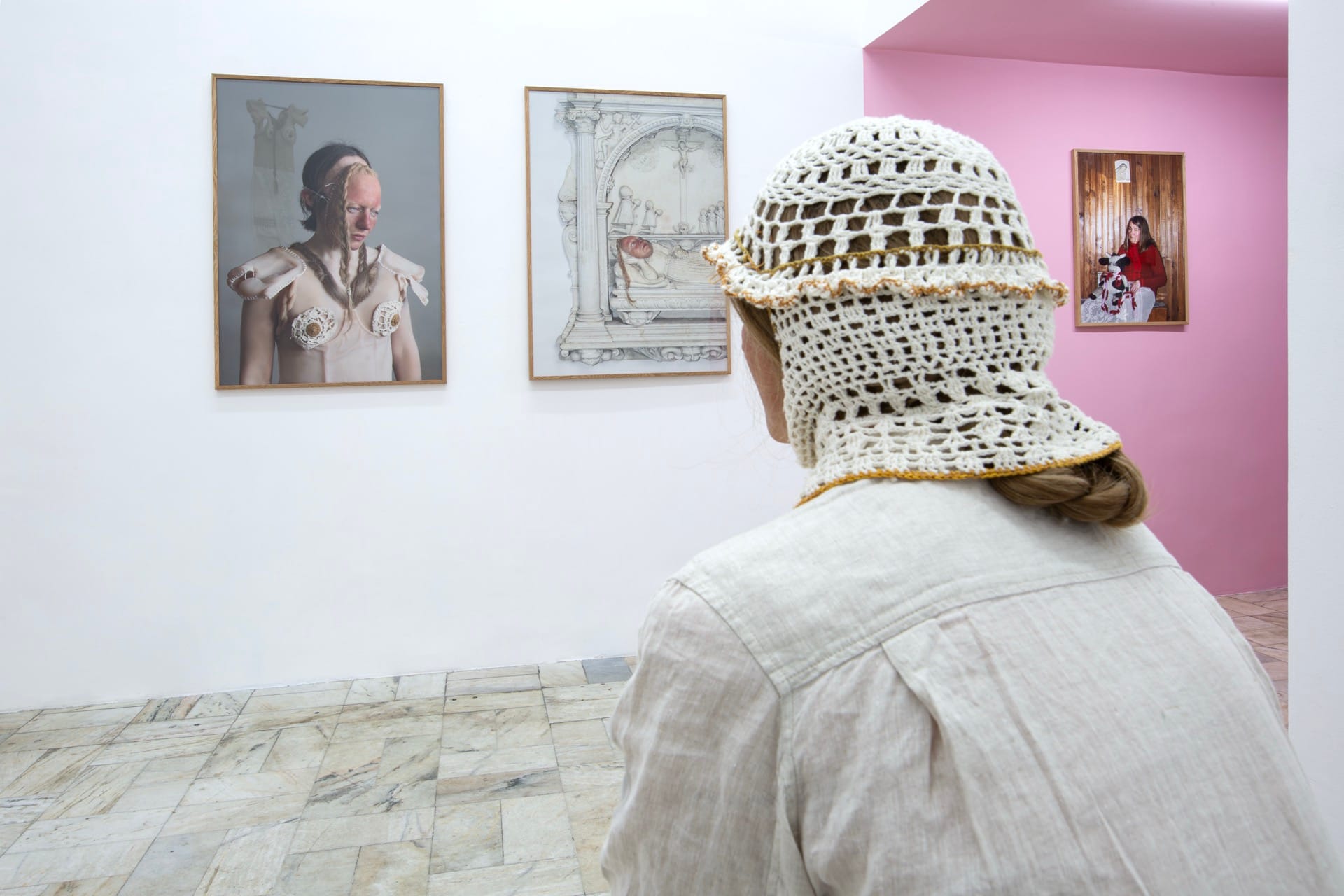
Galeria Piana in Kraków occupies a layered space: white-tiled floors on the ground level, a pink-painted staircase corridor rising to a second room above.
Jarosławiec treats this architecture as a structure of enclosure, the hortus conclusus, the enclosed medieval garden, becomes a spatial argument about who is afforded access to visibility, to language, to the possibility of being recognized as having labored at all.
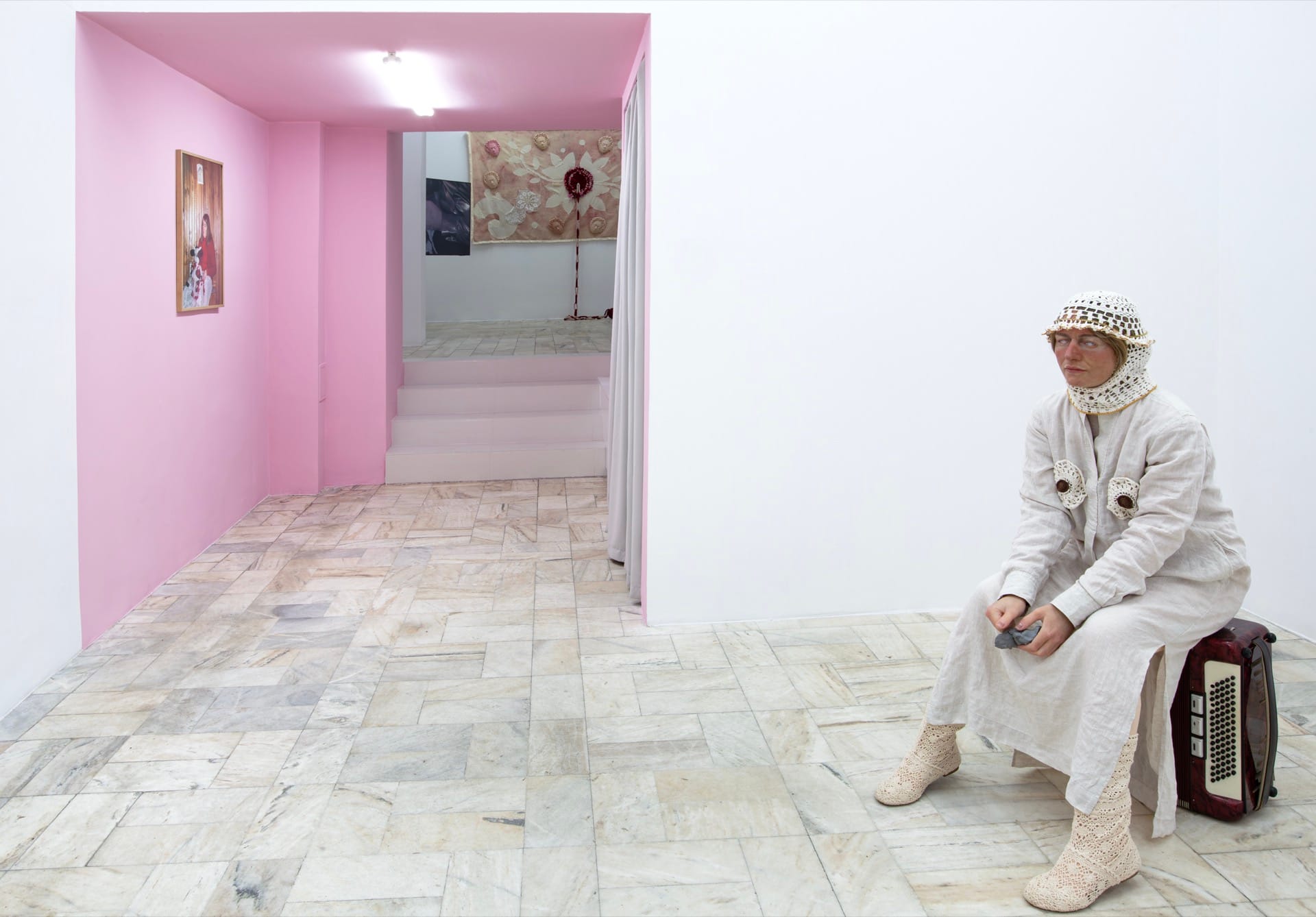
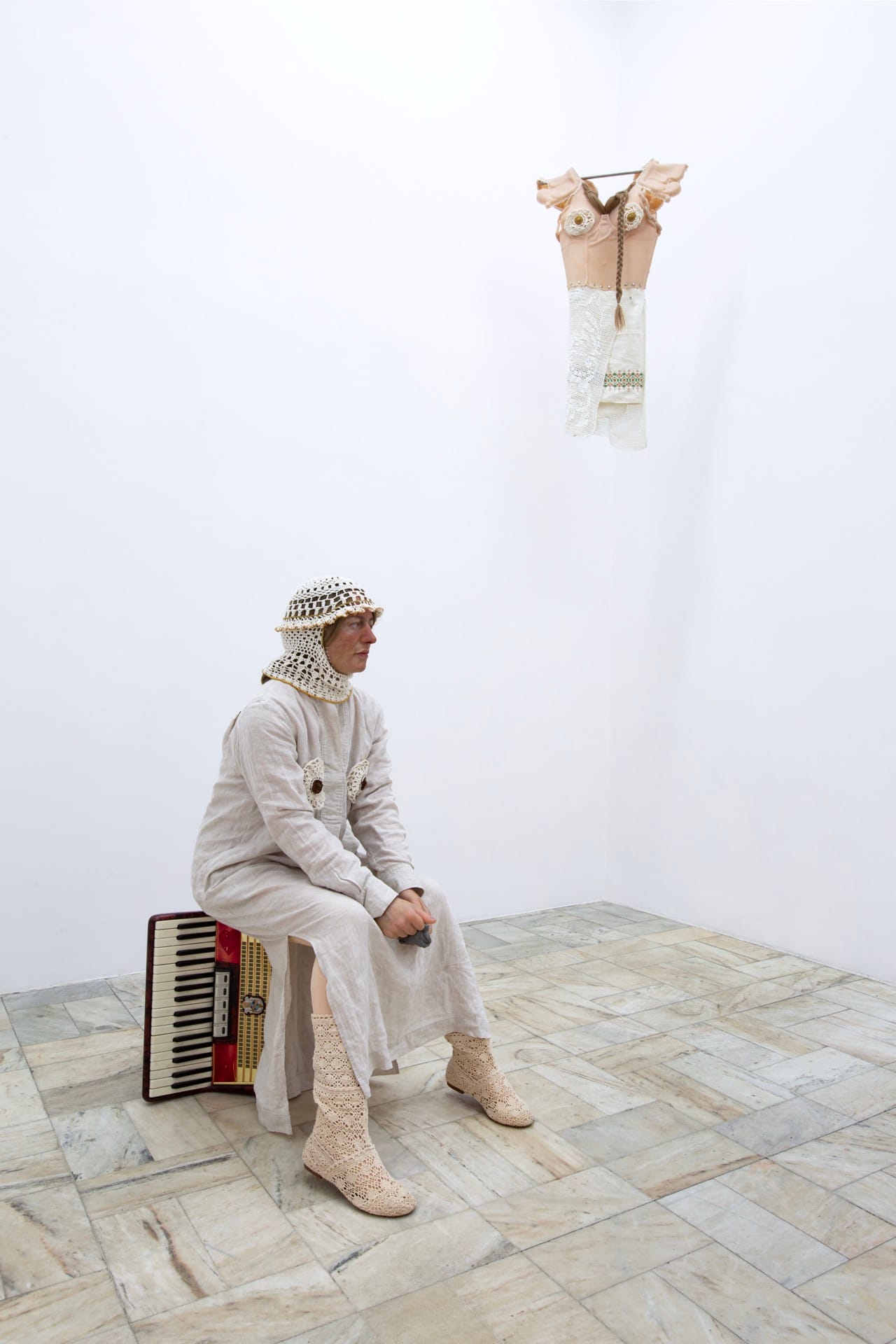
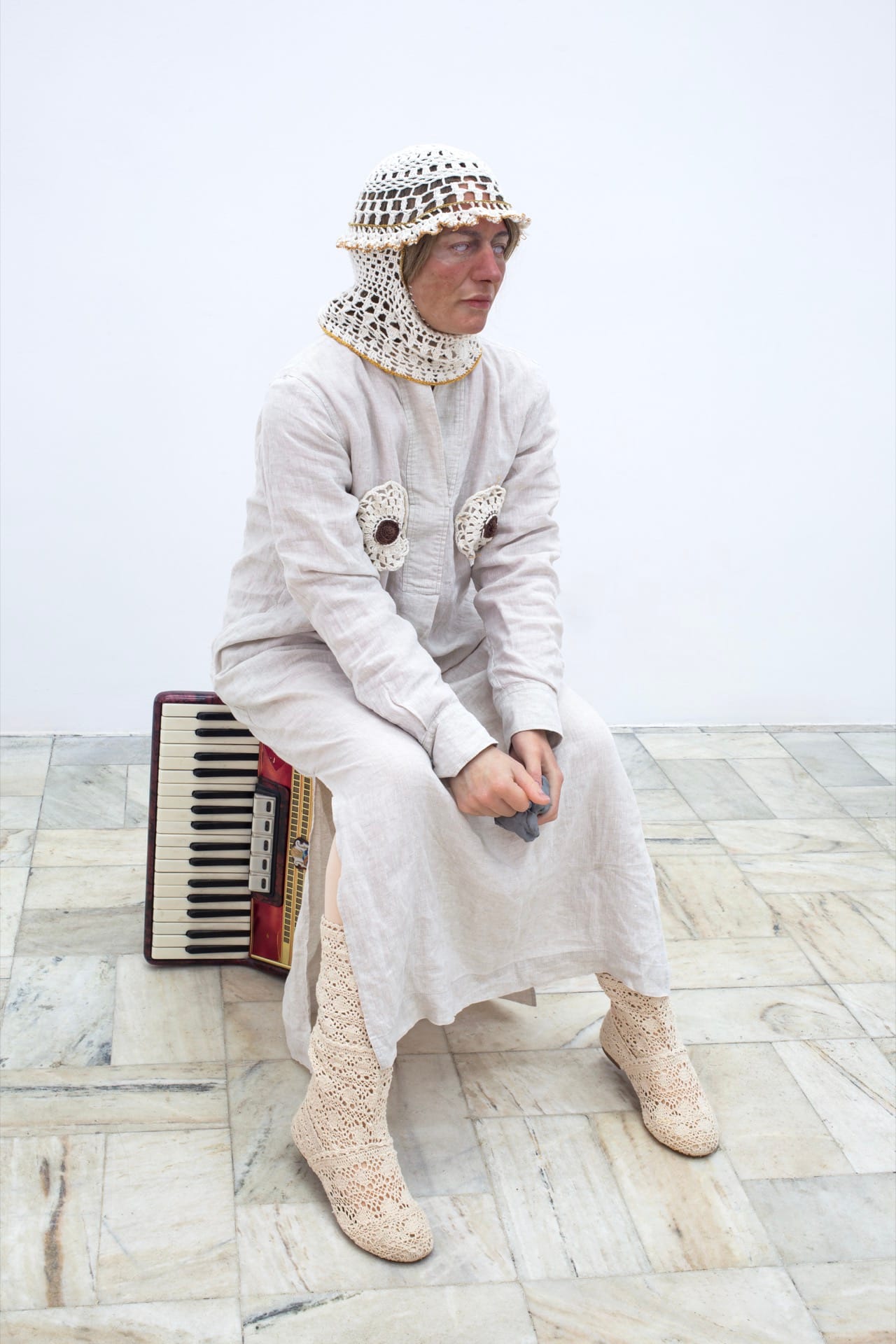
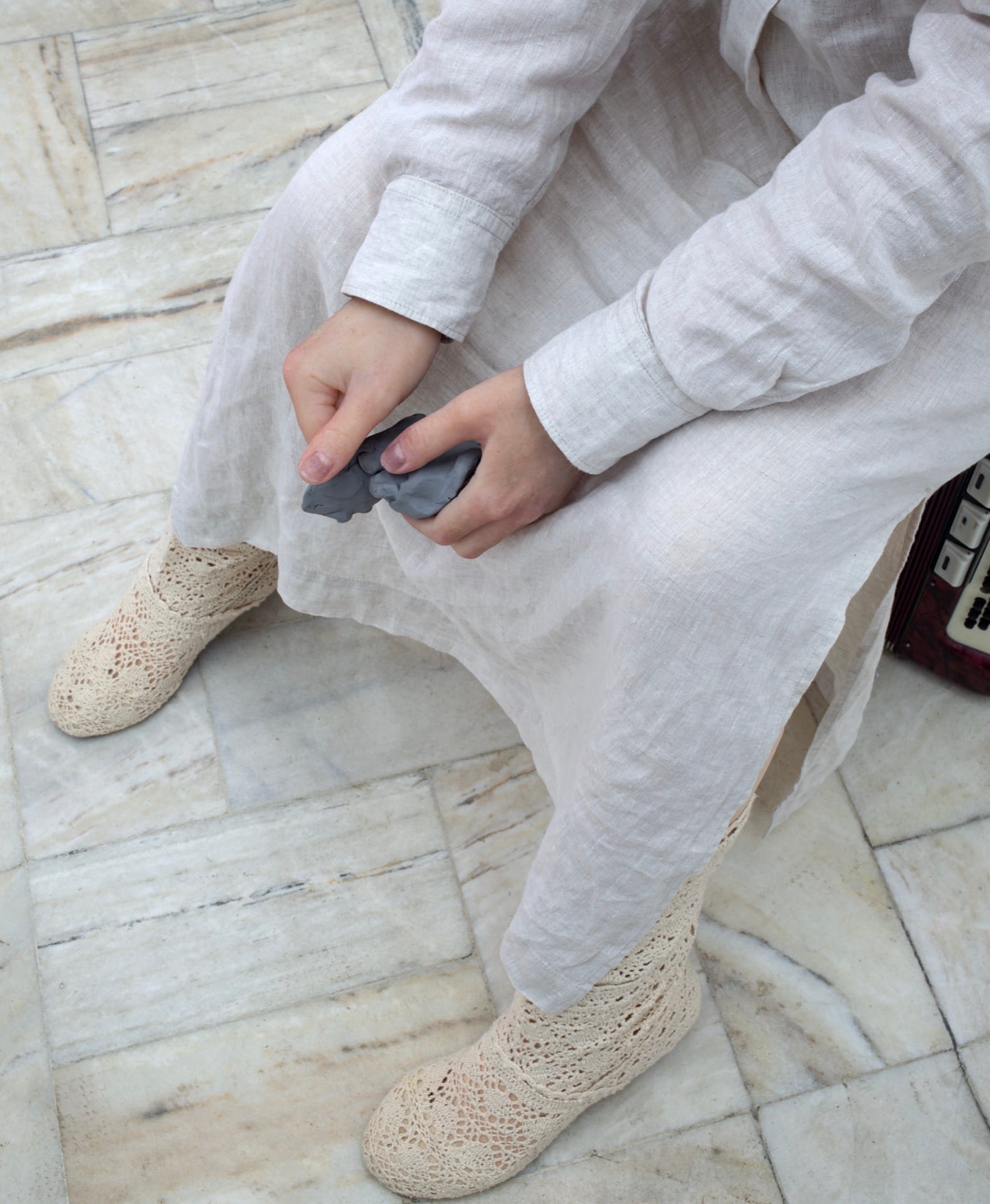
On the ground level, a figure seated on a vintage accordion holds the room. Dressed entirely in loose linen, coat, trousers, lace-crochet boots, wearing a crocheted balaclava that encases the head and neck, the figure carries an unresolved ambiguity: the whitened eyes beneath the crochet helmet don't confirm whether this is the artist in performance or a hyperrealistic sculpture. In the hands rests a small grey silicone fragment, handled like a worry stone. The accordion beneath them suggests folk music as another form of somatic transmission, sound as echo, instrument as inheritance.
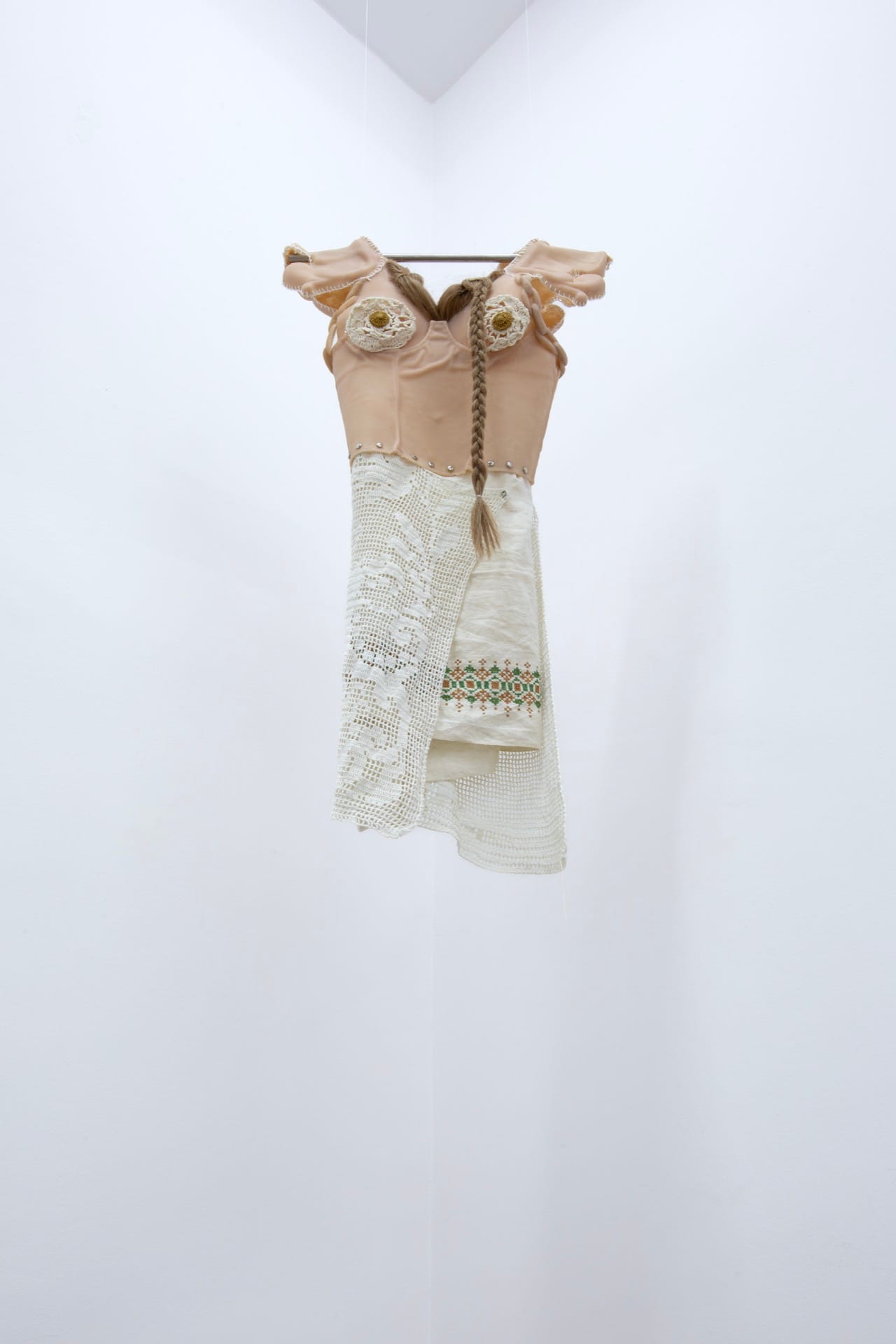
Suspended nearby is a garment assemblage that concentrates the exhibition's material logic. A skin-toned torso form hangs from a metal rod, silicone surface fitted with crocheted circular ornaments, a long plait of hair descending through its center, the lower body dissolving into layered lace and cross-stitched folk embroidery in red and green. The piece holds several temporalities at once: industrial manufacture, domestic craft, a body neither fully present nor fully absent. It seems to ask whether a garment can outlive the labor that made it, and whether what gets passed down is the form or the making.
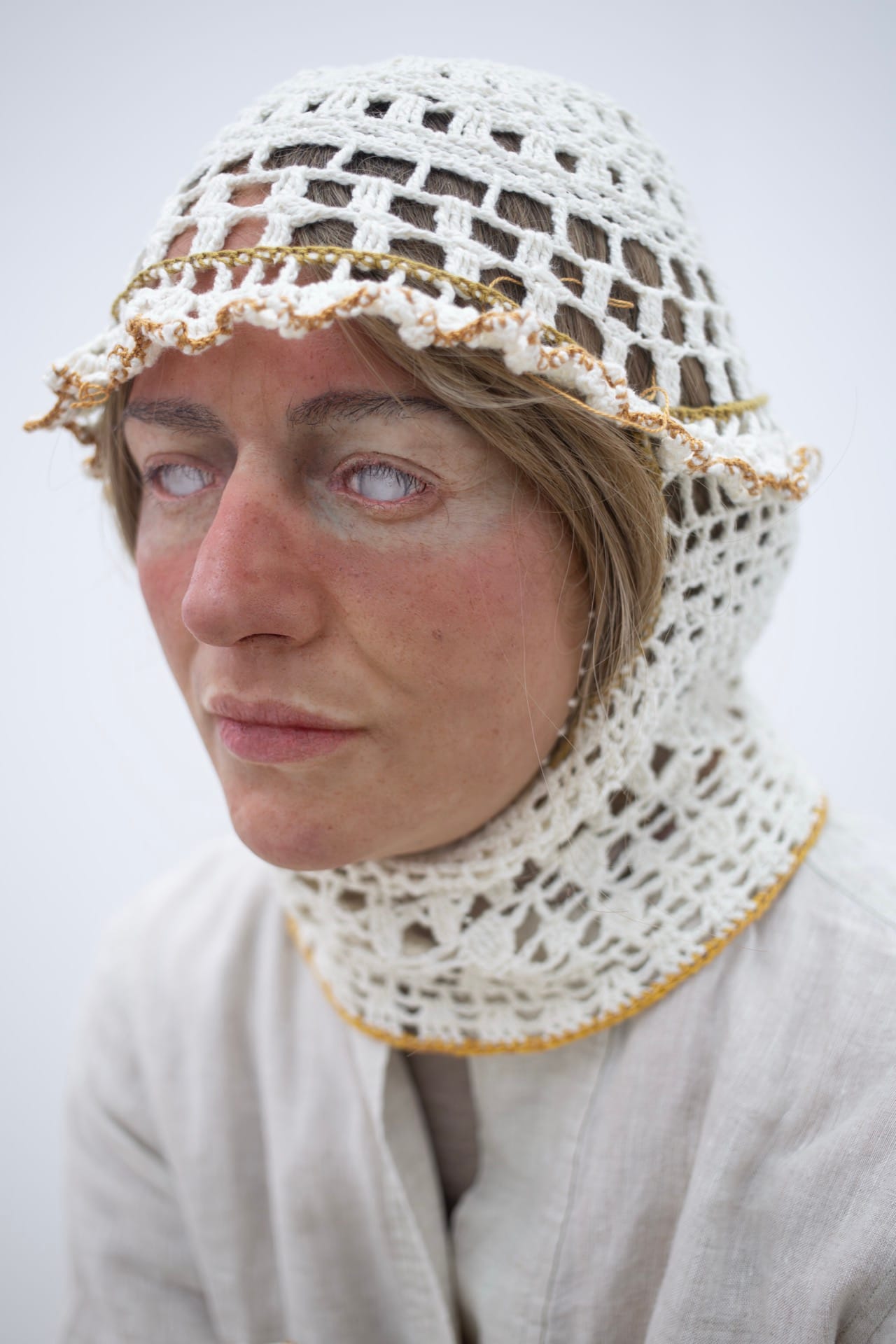
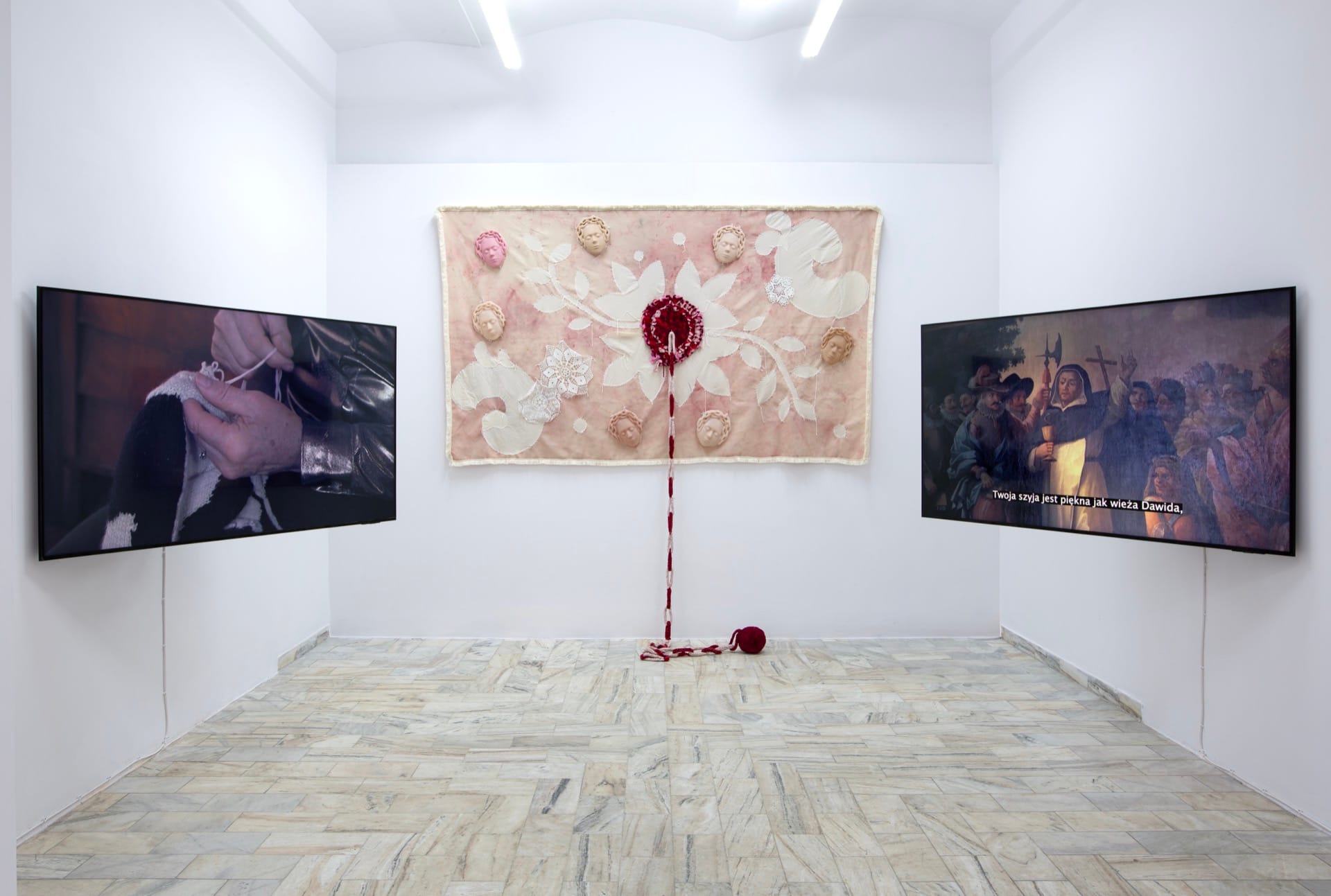
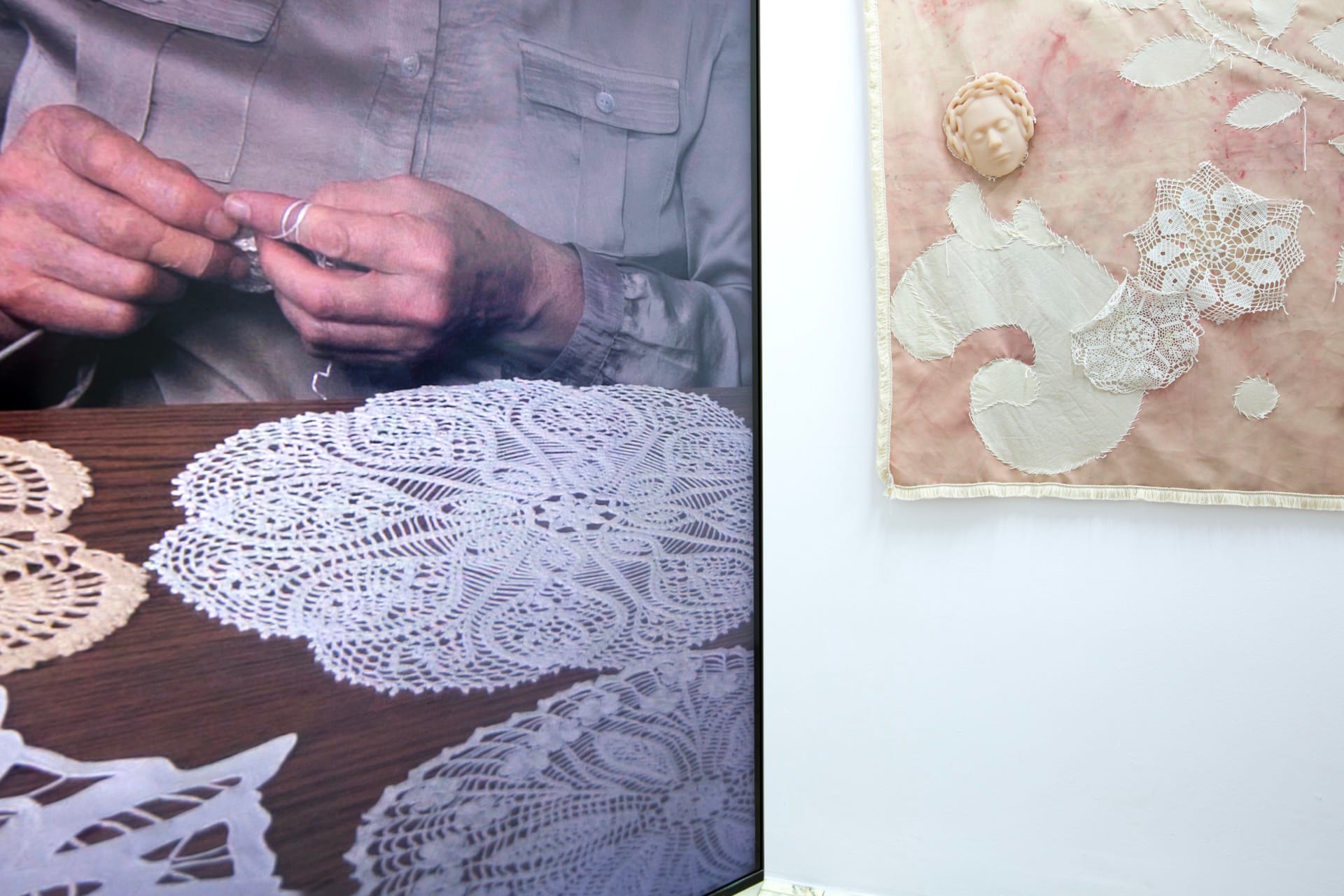
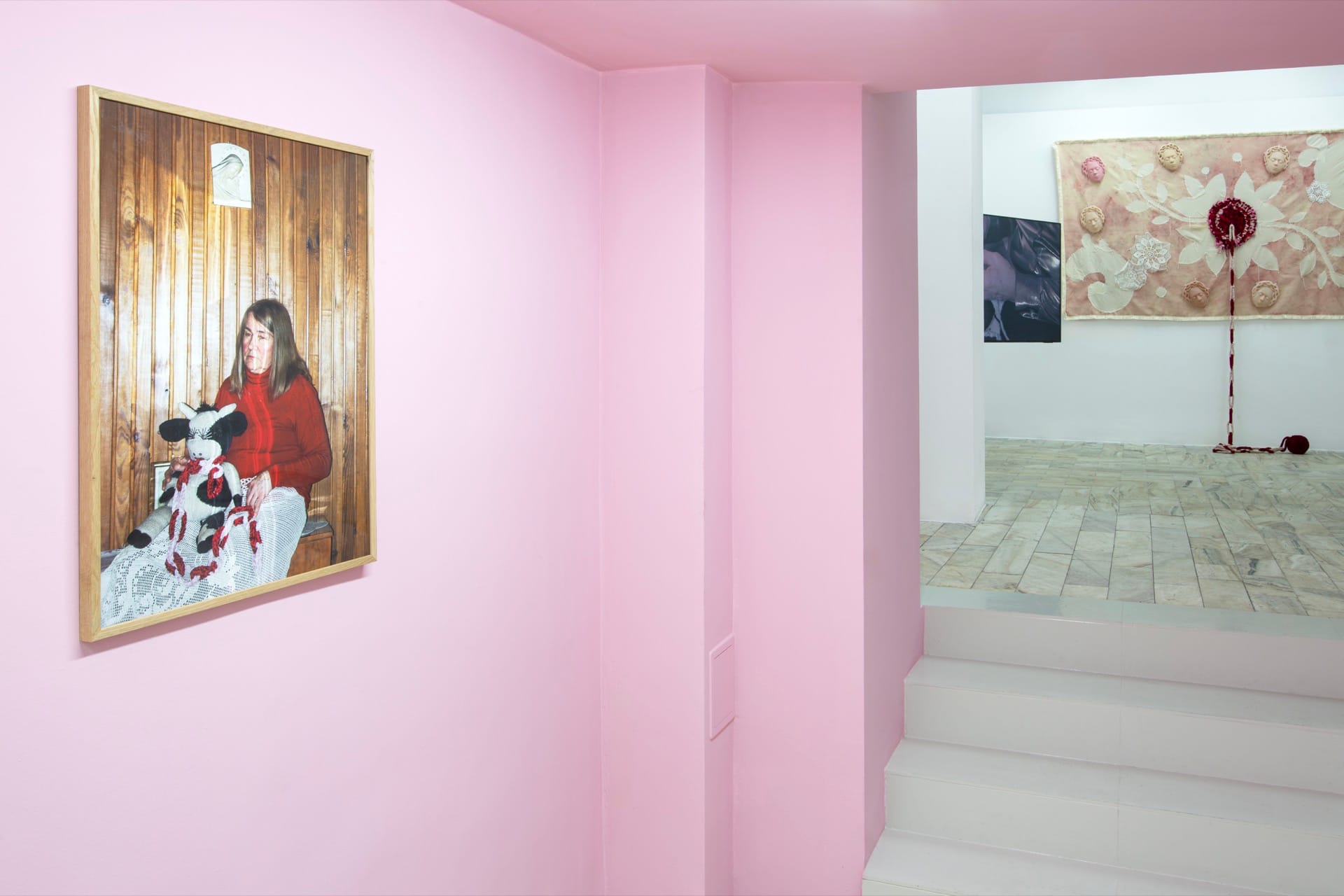
The upper gallery, reached through the pink corridor where a photograph of a woman in a red sweater holding a crocheted toy serves as threshold, opens into a triptych arrangement. Two large video screens flank a central textile: a horizontal banner in pale pink and beige, with appliquéd white flower forms and silicone face-casts embedded at intervals, a red crocheted rose at its center from which a braided cord descends to the floor, ending in a ball of yarn still unspooling.
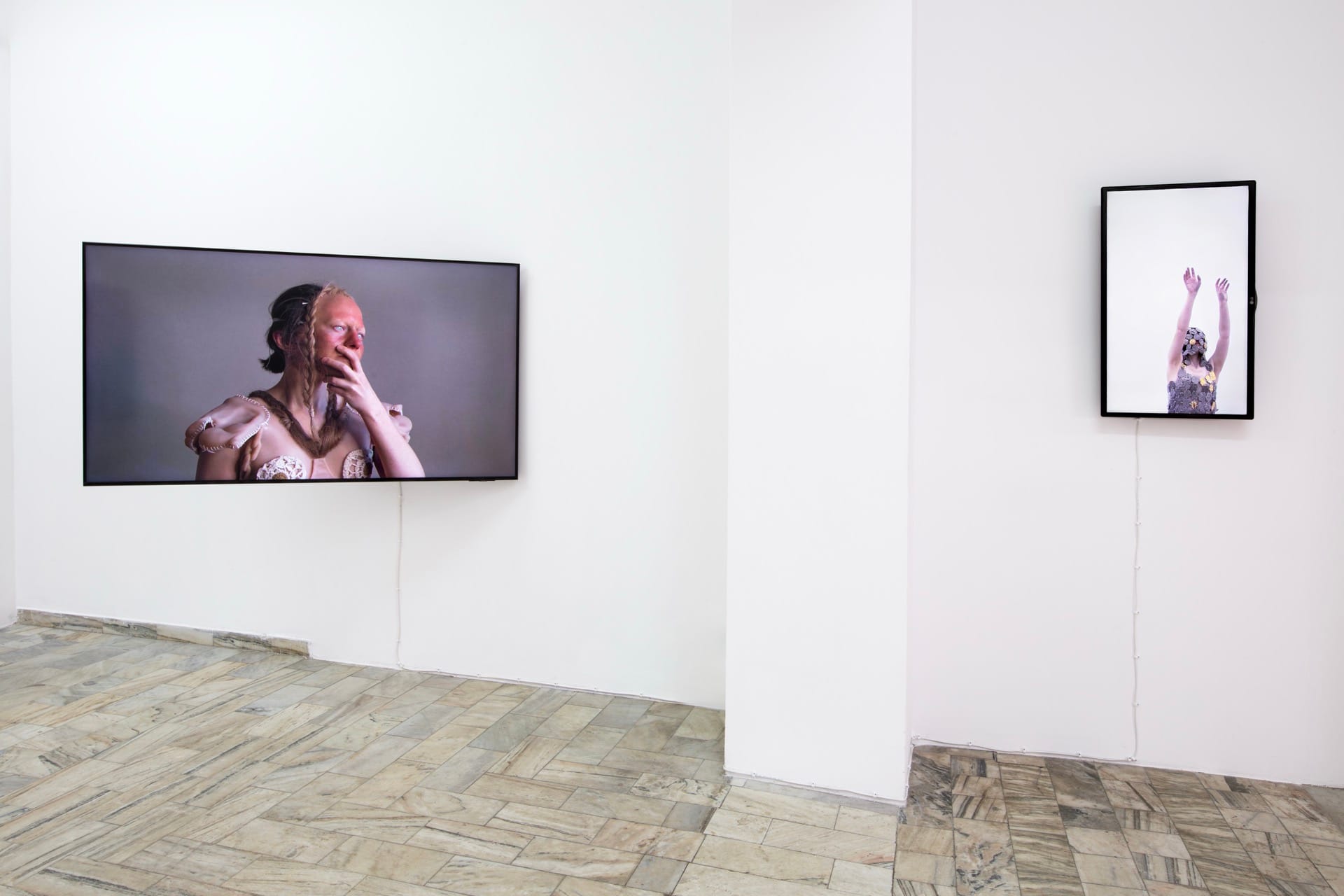
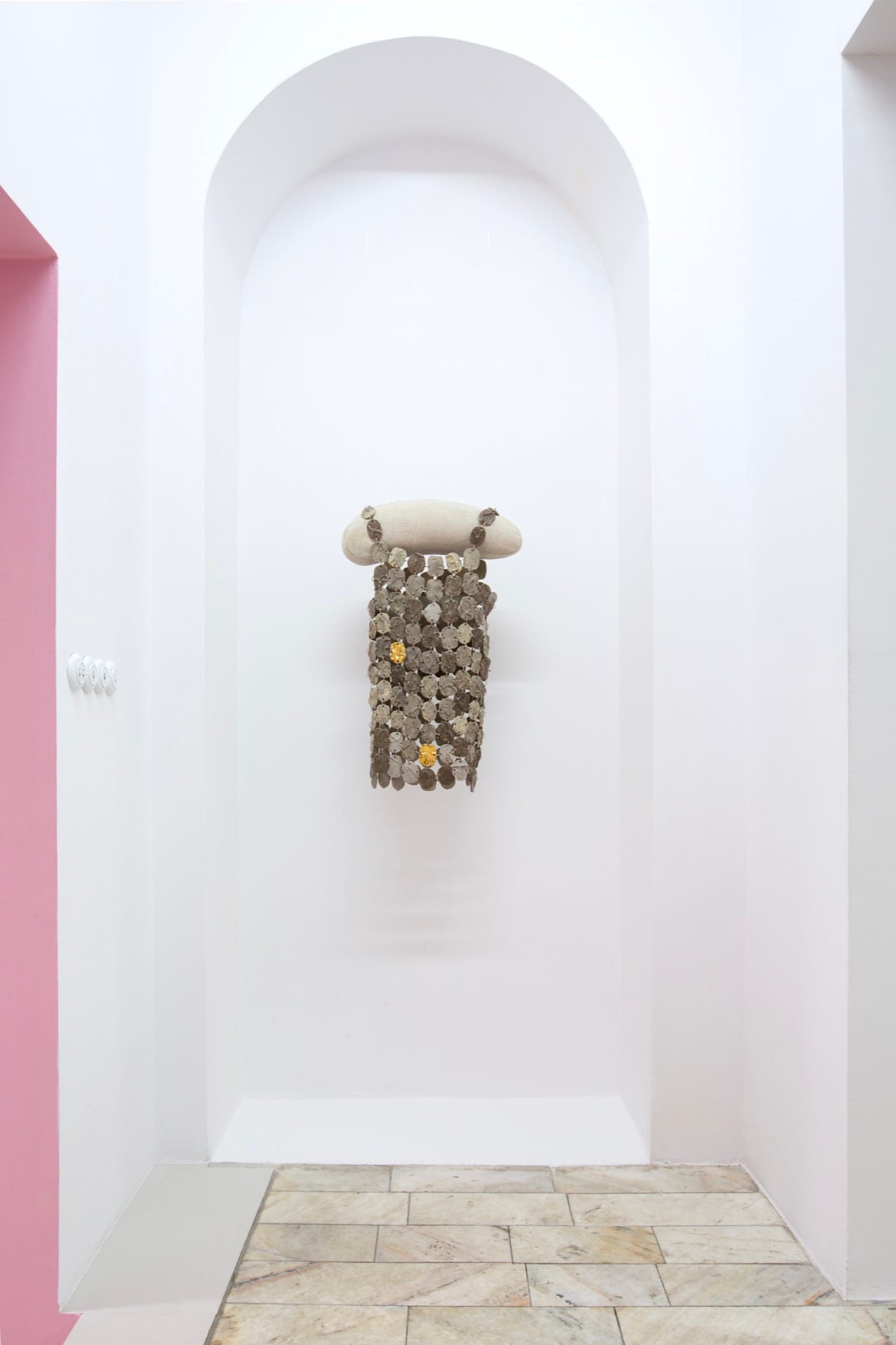
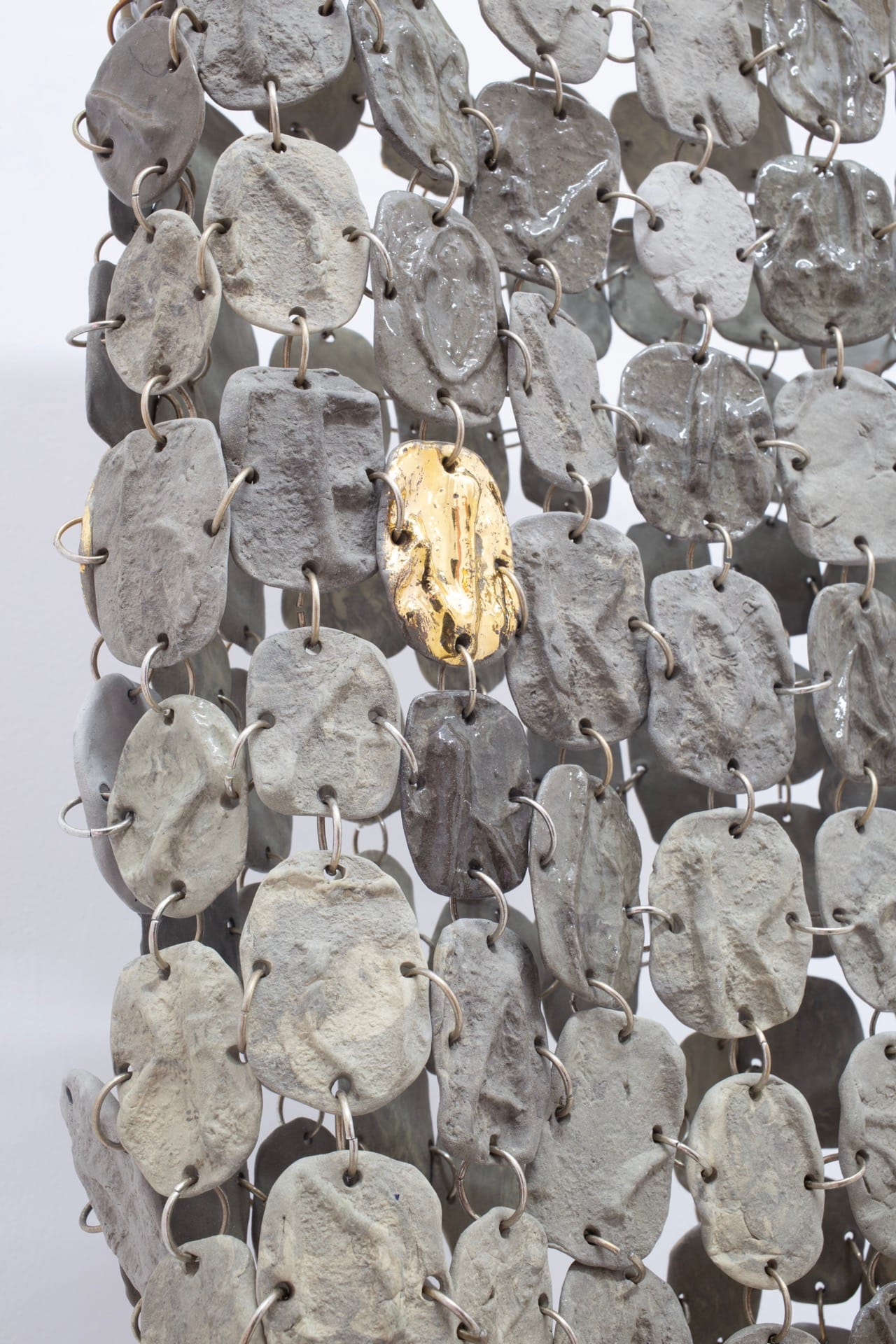
On the left screen, hands work with dark materials in close-up, the labor visible, the face absent. On the right, a historical Polish religious painting carries a subtitle: Twoja szyja jest piękna jak wieża Dawida - "Your neck is beautiful like the Tower of David", the Song of Songs folded into a nationalist image. Elsewhere, a hanging mesh of identical grey silicone pieces contains one exception: a single gold form, linked into the chain like all the others. Cultural assimilation rendered as object, the cost of passing, made tangible.
Jarosławiec's work arrives at a moment when the visibility of domestic and affective labor has become a site of real political dispute, not as a new conversation, but as an old one returning, slightly distorted, carrying everything it has already been.
Folk craft in Eastern Europe holds a specific history of instrumentalization: by nationalism, by nostalgia, by economic conditions that made such labor invisible in the first place.
Jarosławiec doesn't rehabilitate that history. She works through it the way an echo works through a cave, not arriving as the original sound, but arriving differently, carrying the shape of the space it passed through.
What returns in this show is not memory. It is the shape memory makes in matter when it has nowhere else to go.
Instagram Agata Jarosławiec
Galerien Piana Instagram
About Catapult
This is an artist interview published by Catapult — an independent editorial platform for contemporary art, based in Vienna. We publish exhibition reviews, artist features, interviews, and critical context, with a focus on emerging and mid-career practices from Europe and beyond.
catapult.art
Want to be featured? Submit your work →